
Bessent calls it "the single greatest financial offensive ever." Iran's answer is a threat to seize ships in a strait that carried a fifth of the world's oil
The Treasury secretary announced the sanctions on Monday morning after posting at dawn that an "economic D-Day" had begun. More than 30 brokers, tanker operators and shipping companies were named. The rial passed two million to the dollar on Sunday, Tehran's parliament moved to start charging ships for passage through Hormuz, and crude fell anyway.
Scott Bessent gave the world about twelve hours' notice. In a post on X on Sunday evening in Washington, the Treasury secretary wrote that "at dawn begins an economic D-Day," and described what was coming as the "endgame" of the American campaign against Iran. On Monday he stood at a press conference and called it the greatest campaign of "coordinated economic isolation in the history of the world" — the single greatest financial offensive, he said, ever marshalled against an adversary.
The measures themselves, when they landed, looked less like a thunderclap than like the next turn of a screw that has been turning for a year. More than thirty brokers, tanker operators and shipping companies were designated over their role in selling and transporting Iranian petroleum. They join a sanctions architecture that already covers Iranian banking, energy, aviation and cryptocurrency. What is new is not the category of target. It is the explicit threat to everyone standing behind them.
The threat is aimed at third countries, not at Tehran
The line in Bessent's post that matters most was not about Iran at all. "Any nation that serves as a financial artery of a withering regime," he wrote, "should expect to share in its isolation." Writing in the Financial Times on Sunday, he was more specific about who he meant. "Iran's enablers purchase and transport its petroleum. They facilitate the flow of its finances through exchange houses and free trade zones."
"They welcome Iran's flights and maintain registries on its behalf," he continued. "They turn a blind eye to seaborne fuel transfers and the illicit use of their banks, all while concealing the extent of their complicity." Read as a list of grievances, that is a description of the Gulf's free zones, of flag-of-convenience ship registries, of the exchange houses that move dollars around the region, and — above all — of China, which has for years been the buyer of last resort for discounted Iranian crude.
Any nation that serves as a financial artery of a withering regime should expect to share in its isolation.
This is the mechanism of secondary sanctions, and its logic is simple enough to state and difficult to execute. Washington cannot stop a Chinese refiner from buying Iranian barrels. It can, however, tell that refiner's bank that it must choose between clearing dollars in New York and clearing payments for Tehran. The instrument is not force. It is the plumbing of the dollar system, and the willingness to threaten institutions that have done nothing illegal under their own laws.
The record of that instrument is mixed. It worked in 2012, when it helped push Iran toward the negotiations that produced the nuclear deal. It has worked less well since 2018, because a shadow fleet of ageing tankers, ship-to-ship transfers in the dark, and a barter and rial-based trade with a handful of partners have absorbed a great deal of pressure. Sanctioning thirty shipping companies removes thirty names. The vessels are usually re-registered, re-flagged and re-sold.
There is also a question of what is left to sanction. Iranian banking has been designated since 2018 and in many cases since 2012. The central bank is cut off. The aviation sector has been under restrictions long enough that Iran's fleet is maintained on parts bought through intermediaries. Crypto exchanges handling Iranian volume have been named repeatedly. The frontier of this policy is no longer Iranian entities; it is the foreign banks, insurers, port operators and flag registries that touch them, and those institutions are not adversaries. They are, in most cases, allies or trading partners.
That is why the language about "financial arteries" is doing so much work, and why it carries risk. Threatening a Chinese state-owned bank with loss of dollar access is an escalation against Beijing, not against Tehran, at a moment when Washington is simultaneously running a tariff confrontation with Canada and a fragile trade arrangement with China. The measures announced Monday name shipping intermediaries. The measures that would actually stop the barrels have not been announced, and the reason is not oversight.
Iran's counter-leverage is a strait, and it is using it
Tehran's response over the weekend was to reach for the one lever that reliably moves prices in New York and London. On Sunday, Iran's state-controlled Persian Gulf Strait Authority warned in a series of posts on X that vessels violating its transit rules in the Strait of Hormuz could face "fines, seizure, or confiscation" on future passages. Iran's parliament approved a provision the same day stipulating that ships passing the choke point will pay Tehran for services rendered. It still requires full parliamentary approval.
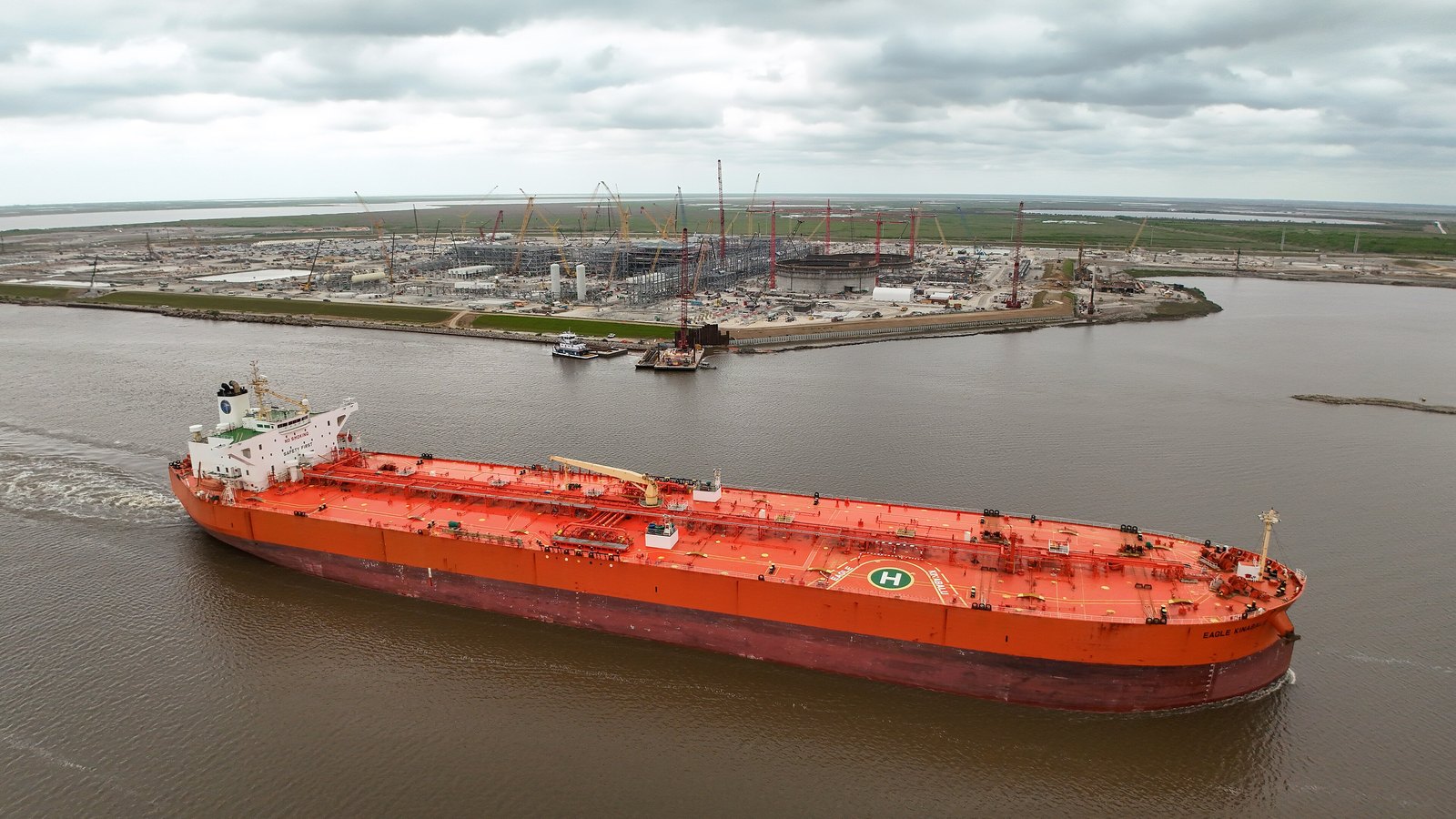
Before the war, roughly a fifth of the world's seaborne oil passed through Hormuz. The strait is not a piece of Iranian property, and the claim to charge for passage through it is contested by every maritime power that uses it. But a state that cannot easily sell its own oil has an obvious interest in raising the cost of everyone else's, and the threat need not be executed to be effective. Insurance rates move on statements.
Mohsen Rezaei, the longtime military commander who became secretary of Iran's Supreme National Security Council earlier this month, put the warning to Iran's neighbours in plainer language on state television on Saturday. "Any country that becomes a partner in creating economic restrictions against us will be regarded by us as an enemy," he said. The audience for that sentence sits in Abu Dhabi, Riyadh, Doha and Manama — the same governments Washington needs if a coordinated squeeze is to mean anything.
Iran's foreign minister, Abbas Araghchi, has dismissed the new round as a "desperate" ploy and argued that American measures, including the naval blockade, are set to fail. That is the required public position. The market's position is harder to dismiss: the rial hit a new open-market low on Sunday, with the dollar passing two million rials, according to Gulf News. An economy in that condition is not a negotiating partner. It is a patient.
The oil price says something the rhetoric does not
If Monday really were an economic D-Day, crude would ordinarily be the first thing to register it. Instead, prices fell in Asian trading. West Texas Intermediate, the US benchmark, dropped about 1.3 percent to $85.93 a barrel; Brent fell 1.3 percent to $93.22. Those are high prices by the standards of the past three years and unremarkable ones by the standards of the past six months of this war.
There are two readings, and they are not mutually exclusive. The first is that traders have already priced the loss of Iranian exports, so removing more of them changes little. The second, less comfortable for Washington, is that the market does not believe enforcement will bite hard enough to take significant barrels off the water. Sanctions announcements move prices when they are believed. This one moved them down.
The UK Maritime Trade Operations agency reported no confirmed attacks in the strait in the 48 hours to Sunday, while warning of a "continued risk of drifting or uncharted mines," with mine danger areas still active. That is the operative risk in shipping right now: not a formal closure of Hormuz, which would be an act of war against every customer Iran has left, but a slow accumulation of hazard, delay and insurance cost that does the same work more deniably.
For Iranians, the exchange rate is not an abstraction or a signal. A currency past two million to the dollar is an import bill — for medicine, for industrial inputs, for the wheat and animal feed a drought-prone country buys abroad — that rises every week regardless of what any ministry does. Humanitarian trade is formally exempt from American sanctions. In practice, banks that fear designation decline the transactions anyway, because the cost of getting one wrong exceeds the profit on all of them. The Trump administration has said Iran's economy is in freefall, with runaway inflation and a collapsing currency. It is describing the intended result.
What comes after the endgame
The escalation follows the expiry of a 60-day window in which both sides were meant to reach a deal, and did not. That window was the formal mechanism for ending a war now in its sixth month, and its closure is the reason Bessent can describe an accounting measure as an endgame. There is no longer a truce process running in parallel to be disrupted.
What is left is diplomacy conducted by intermediaries. Oman's foreign minister, Sayyid Badr Albusaidi, is scheduled to arrive in Tehran on Tuesday for talks with Araghchi; the Iranian foreign ministry spokesman, Esmail Baghaei, said the Strait of Hormuz would be on the agenda. Oman has carried messages between Washington and Tehran for two decades. That it is the channel still open says something about how narrow the aperture has become.
The strategy Bessent described has an unstated theory of victory: that a currency past two million to the dollar, a banking system cut off from correspondent relationships, and a shipping industry too frightened to lift Iranian cargoes will force a decision in Tehran that six months of bombing has not. It is a theory with a long history and an uneven record. What it does reliably produce, in the interval before any decision, is a poorer country and a more dangerous strait.
Reporting compiled from CNBC, CNN, Al Jazeera and Fox News coverage of Sunday and Monday's developments, Scott Bessent's Financial Times column of August 23, and statements carried by Iranian state media. Prices are as of Monday's Asian session.