
Google secured the right to buy $12.2 billion of Marvell stock. It vests only if Google buys $120 billion of chips first
The quiet Santa Clara chipmaker disclosed a warrant deal this week that could make Google its fifth-largest shareholder — and sent Broadcom down 5% in a session. The structure says as much about the AI chip war as the number does: hyperscalers no longer just buy silicon, they take equity in the companies that design it.
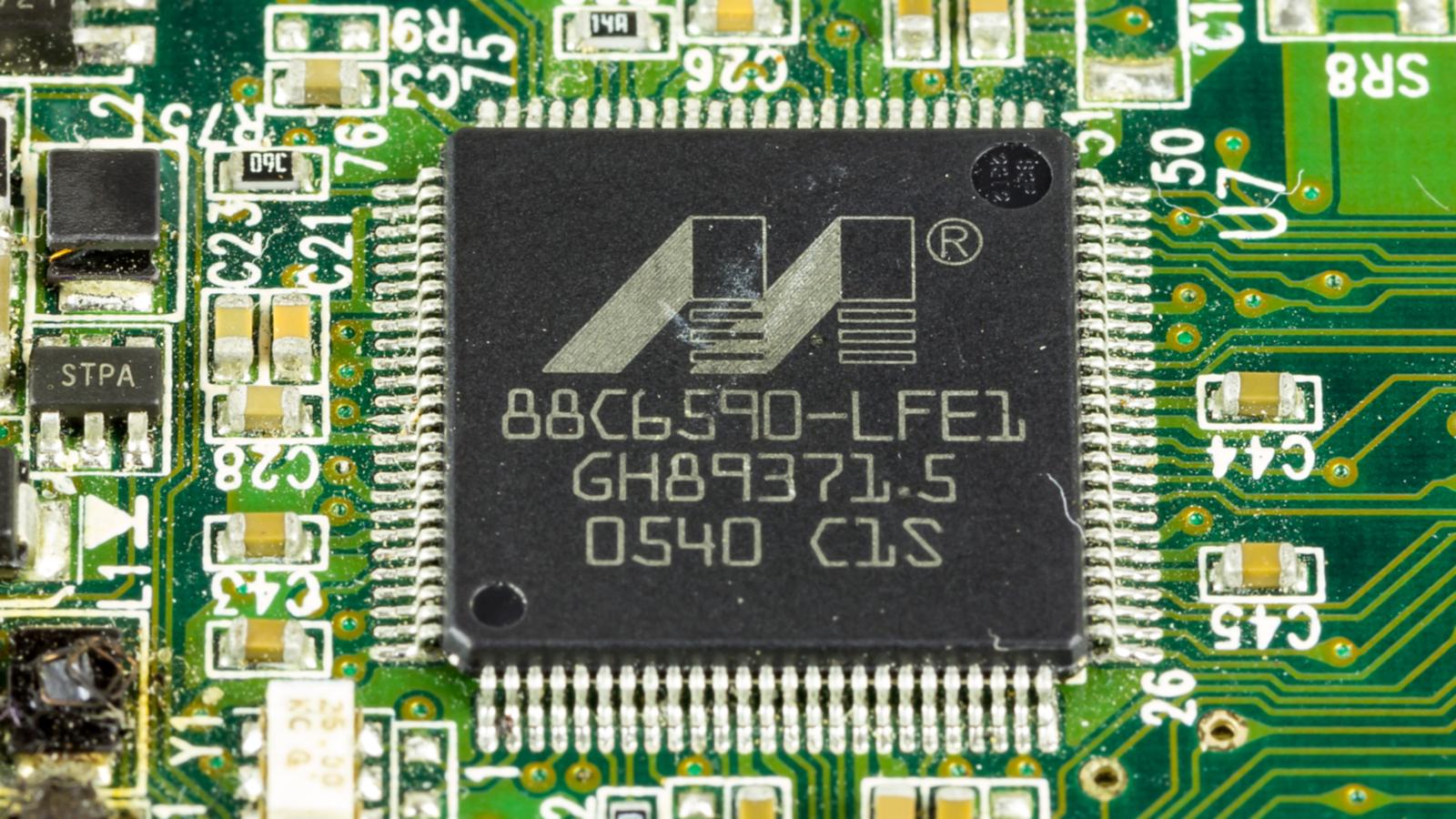
The most consequential chip deal of the week was not announced at a keynote. It surfaced in a securities filing. On Wednesday, Marvell Technology disclosed in an 8-K that it has expanded its custom-silicon collaboration with Google — and granted Google a warrant to buy up to 58,970,907 Marvell shares at $206.58 each, a position worth roughly $12.2 billion if fully exercised. Marvell's stock jumped as much as 10% on the news, adding about $18 billion in market value, according to Reuters and CNBC. Broadcom, the dominant player in custom AI chips, fell more than 5%.
The shorthand headline — Google takes a $12.2 billion stake in Marvell — is not quite what happened, and the difference is the story. Google has bought nothing yet. What it holds is an option that vests almost entirely on one condition: that Google actually spends money on Marvell silicon. A lot of money.
Two hundred and forty tranches
The mechanics, laid out in the filing, read like a loyalty program designed by an investment bank. A small slice — about 1.36 million shares — vests quarterly over the first year. The remaining 57.6 million shares vest in 240 tranches of roughly 240,000 shares apiece, one tranche for every $500 million of cumulative qualifying revenue Google sends Marvell's way. Full vesting requires about $120 billion of purchases through fiscal 2033, with the warrant exercisable until August 2033. And the filing is explicit that Google's purchases are discretionary — there is no binding commitment behind the ceiling.
That design is deliberate on both sides. For Google, a warrant priced at $206.58 — near where the stock traded before the announcement — costs nothing if the relationship fizzles and pays enormously if it works: the equity only becomes valuable in the world where Marvell has become a critical supplier, which is also the world where Marvell's stock has likely re-rated. For Marvell, granting up to 7% dilution is the price of admission to a program that could, at the ceiling, roughly triple the size of its entire data-center business.
Fully exercised, the warrant would hand Google roughly 7% of Marvell's share count and make it the company's fifth-largest holder, per Reuters. The commercial agreement underneath it was signed July 29; the warrant was issued August 18; the market found out on the 19th — five trading days before Marvell reports earnings on August 27, where the Street expects revenue of about $2.71 billion, up 35% from a year earlier.
The timing was not lost on anyone. An April report that Marvell would help Google with custom AI chips had already lifted the stock once and knocked Broadcom on the same seesaw. Wednesday's filing converted that rumor into a signed commercial agreement with a dollar figure attached — and the market repeated the trade at larger scale, in both directions.
What Marvell is actually building
It is not the TPU. Google's tensor processing units — the custom accelerators at the heart of its answer to Nvidia — remain, by every analyst account, a Broadcom co-design. What Marvell gets is everything that attaches to them: AI inference accelerators, storage controllers, network interface controllers, memory interface controllers and near-memory compute, per the filing. Reuters described it as the processors that run AI models, manage data storage and move information across networks. Bank of America's read was that Broadcom keeps the core compute die while Marvell takes the attach silicon, and UBS's Timothy Arcuri doubts Google would hand anyone a TPU redesign.
"This is a big win for Marvell," Morningstar analyst William Kerwin told Reuters, calling it "a growing pie at Google for new sources, rather than a competitive displacement of Broadcom." Bernstein made the same point more bluntly: there is plenty to go around — the pie just keeps getting bigger. Morningstar raised its fair-value estimate on the stock to $270 from $235.
Still, the win lands on a company that has spent two years as the perennial number two. Broadcom holds an estimated 70% of the custom AI co-design market and counts Google, Meta, OpenAI and Anthropic among its disclosed or reported customers. Marvell's custom accelerator business generated about $1.5 billion in its last fiscal year — meaningful, and guided by chief executive Matt Murphy to more than double by fiscal 2028 across roughly 18 active programs — but a fraction of its rival's franchise. Industry reporting has long identified Marvell as the lead design partner on Amazon's Trainium line and a contributor to Microsoft's Maia chips, though neither customer is named in Marvell's disclosures. With Google, Marvell now touches all three major US clouds.
Equity is the new purchase order
The structure has precedents, all recent, all pointing the same direction. OpenAI received warrants for up to roughly 10% of AMD, vesting in tranches tied to chip deployments. Nvidia took a $5 billion stake in Intel last September, and this week finalized a guarantee of up to $105 billion in credit support for OpenAI's Ohio data-center campus. Now a hyperscaler has taken the other side of the trade: equity in the supplier, vesting dollar-for-dollar with purchases. In the AI buildout of 2026, a purchase order is no longer just a purchase order — it is a cap-table event.
For Google, the logic is straightforward. If it is going to spend tens of billions turning its TPU ecosystem into a genuine alternative to Nvidia's GPUs — a push aimed squarely at cheaper inference — it would rather own a slice of the appreciation it creates in its suppliers than hand it to other shareholders. The warrant costs Google nothing unless Marvell delivers; it dilutes Marvell's holders only in the scenario where Marvell's revenue has grown by up to $120 billion. Skeptics, including Seeking Alpha's, note that the deal and the dilution are both real; Motley Fool analysts flagged that every dollar of the headline number is optional.
For Marvell, the calculus is heavier. The company was reportedly a SoftBank acquisition target as recently as last November — Bloomberg reported Masayoshi Son had studied it for years before talks collapsed over terms. Its stock has roughly tripled in twelve months, putting its market value near $200 billion. Binding its future this tightly to hyperscaler programs concentrates risk: the same earnings calls that celebrate custom-silicon wins now carry the question of what happens when a cloud customer redesigns, resources, or simply pauses.
That question has a fresh answer five days away. Marvell reports on August 27 with a stock that has already priced in a great deal of future, an option package that rewards only delivered revenue, and a new shareholder-in-waiting whose interest is precisely aligned with squeezing its supplier's prices. Wednesday's filing made Marvell one of the AI trade's anointed names. The next decade of tranches — all 240 of them — will decide whether the anointing pays.
The wider lesson of the week sits above any one ticker. Broadcom is reportedly assembling as much as $100 billion in debt to finance chips for Anthropic. Nvidia has guaranteed $105 billion of OpenAI's lease obligations. And Google now holds a twelve-billion-dollar option on its own component supplier. The AI supply chain is no longer a chain of invoices — it is a lattice of loans, warrants and guarantees, each one betting that the demand at the end of it is real. Marvell just became one of its load-bearing nodes.
There is also a quieter risk in the vesting math itself. Two hundred and forty tranches at $500 million apiece is a decade-long metronome: every quarter, analysts will be able to estimate how much Google actually spent by watching the warrant's vested share count in Marvell's filings. A program that hums along vests steadily. A program that stalls will be visible in public documents within months — a level of customer transparency no chip supplier has ever volunteered before.
TNN Analysis is Torbrook News Network's original-reporting desk. Figures are drawn from Marvell's SEC Form 8-K and reporting by Reuters, CNBC, Bloomberg and Morningstar analyst notes as cited. Customer identities for Amazon and Microsoft programs are industry-reported and not confirmed by Marvell.