
Bangladesh's measles death toll passes 1,000 children with nearly 190,000 infections, after an emergency vaccination drive missed roughly four million kids
Health officials reported 1,002 deaths and 187,484 infections since March in what the US CDC calls the largest measles outbreak in the world. The immunisation gap behind it opened during a nationwide vaccine stockout in 2024 and 2025. Hospitals are handling it alongside a record dengue season.
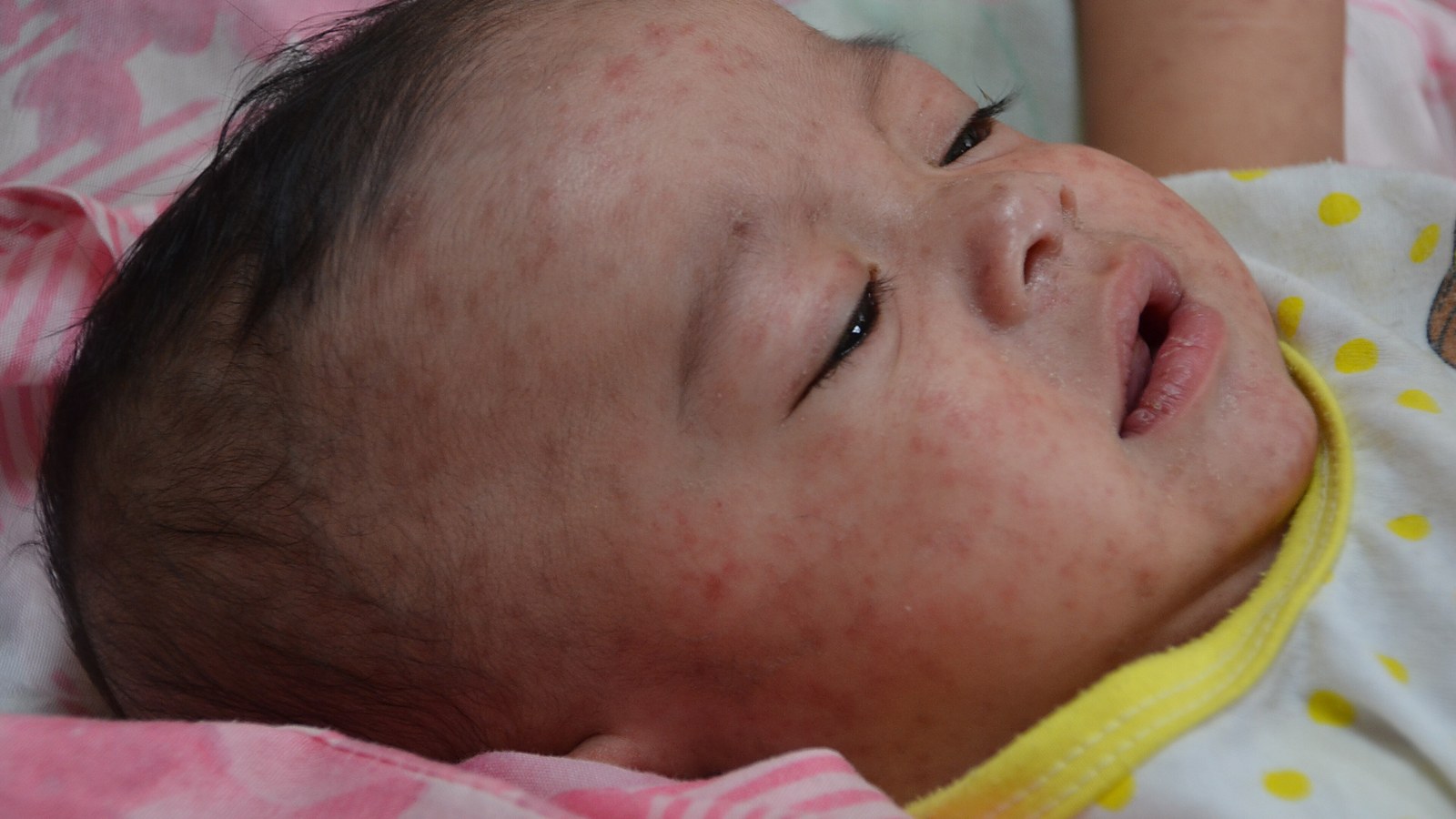
Bangladesh's Directorate General of Health Services reported on Wednesday that at least 1,002 children have died of measles since March, out of 187,484 recorded infections. The United States Centers for Disease Control and Prevention has described the outbreak in the country of 178 million as the largest in the world.
The number that explains those figures is not in the casualty report. It is four million — the approximate number of children that Bangladesh's own emergency vaccination campaign, launched in April, failed to reach. Officials say the drive vaccinated 18 million. The gap is the outbreak.
We couldn't achieve herd immunity. — Zahid Raihan, spokesman for the Directorate General of Health Services, speaking to AFP
Why the missed four million matters more than the 18 million reached
Measles is the most contagious disease in routine human circulation. A single case in a fully susceptible population generates something on the order of twelve to eighteen further cases, which is why the threshold for herd immunity sits at roughly 95 per cent coverage with two doses — far higher than for most other vaccine-preventable diseases.
That threshold is what makes an 82 per cent campaign a different category of event from a 95 per cent one, rather than a slightly worse version of it. Below the threshold, transmission does not slow proportionally to the vaccination rate; it continues, more slowly, until it has found the remaining susceptible children. A campaign that reaches most children reduces how fast an outbreak burns through a population. It does not stop it.
Raihan's framing was correspondingly modest. "Measles cannot be eradicated and the aim was to reduce casualties," he told AFP, saying teams were still searching for children who had been missed. That is an accurate description of what a sub-threshold campaign can achieve, and it is not the description of a campaign that ends an epidemic.
How the immunity gap opened
The World Health Organization and UNICEF have linked the crisis to gaps in the national immunisation programme that emerged during 2024 and 2025, in the political turmoil that followed the ousting of then prime minister Sheikh Hasina. On Monday, Health Minister Sardar Husain told parliament that changes to procurement policy in that period created a vaccine shortage.
The mechanism is specific and worth stating plainly, because it is the part that transfers to other countries. Bangladesh experienced a nationwide stockout of measles-rubella vaccine across 2024 and 2025. Coverage figures had already been drifting: the country's 2023 Coverage Evaluation Survey found first-dose measles-rubella coverage had fallen to 86 per cent from 88.6 per cent in 2019, with second-dose coverage down to 80.7 per cent from 89 per cent. There had also been no regular nationwide supplementary measles-rubella campaign since 2020.
Each of those is survivable on its own. Together they describe two consecutive birth cohorts that were never immunised at all, layered on top of a population where second-dose coverage had already slipped roughly eight points below where it had been. Bangladesh entered 2026 with several million children who had no protection and no scheduled opportunity to acquire any.
What the epidemiology says about who is dying
WHO's assessment of the outbreak's first month found that 79 per cent of reported cases were in children under five, 66 per cent in children under two, and 33 per cent in infants under nine months. That last figure is the one that should be read twice.
Nine months is when the first measles dose is normally given in Bangladesh's schedule. Infants younger than that are too young to be vaccinated and depend on two things: maternal antibodies, which wane over the first months of life, and the absence of circulating virus in the community around them. A third of cases falling in that group is a direct measurement of how much virus is circulating, because those infants cannot have been protected by any campaign and cannot have failed to be.
It also explains the case fatality rate. WHO recorded 166 suspected deaths against 19,161 suspected cases in the outbreak's first month, a rate of 0.9 per cent, and 1.1 per cent among laboratory-confirmed cases. Measles kills through complications — pneumonia, encephalitis, the immune amnesia that leaves survivors vulnerable to other infections for months or years afterwards — and it kills infants and malnourished children at rates far above the population average. An outbreak concentrated in the under-twos is an outbreak concentrated in the people it kills most efficiently.
A health system carrying two epidemics
The outbreak has spread across all eight of Bangladesh's divisions and 58 of its 64 districts. Hospitals have run out of beds. They are absorbing this while simultaneously handling a severe dengue season: more than 45,000 people have been admitted with dengue, and Tuesday was a record day for both admissions and deaths from that disease.
Concurrent epidemics do not simply add. They compete for the same finite resources — beds, oxygen, paediatric staff, laboratory capacity — and the constraint binds hardest on exactly the interventions that keep measles cases from becoming measles deaths. Most measles mortality is preventable with supportive care, vitamin A and treatment of secondary bacterial infection. Those are cheap and require a functioning ward and a nurse. They are the first things a hospital cannot supply when it is full.
The staffing position was fragile before either epidemic. Reporting on the sector has documented that in 2025, more than half of Bangladesh's districts had 45 per cent of health worker positions vacant. A vaccination campaign that misses four million children and a hospital system that cannot find beds are not two separate failures; they are the same shortage of people, observed at two points in the same system.
The professional judgement
Professor Mahmudur Rahman, former director of the Institute of Epidemiology, Disease Control and Research in Dhaka, told Reuters that the situation was without precedent in the country. "To my knowledge, Bangladesh has never witnessed so many children dying from measles," he said. "Nor have we ever seen such a high number of patients in a single year. This is a truly terrible situation, and the saddest part is that the victims are children."
The trajectory supports that reading. WHO logged 166 suspected deaths in the period to mid-April. By late May, published assessments put suspected child deaths above 470 with more than 67,000 suspected cases. The confirmed toll now stands above 1,000 against nearly 190,000 infections. The curve has not turned over.
The counter-argument
There is a real case that the response has worked as well as the circumstances allowed. Bangladesh identified the outbreak, reported it transparently, ran an emergency campaign with UNICEF, WHO and Gavi that began within weeks, and reached 18 million children — a genuinely large logistical achievement in a densely populated country with a depleted health workforce. Without it the toll would be higher, and Raihan's stated objective of reducing casualties rather than eradicating the disease is the correct objective once an outbreak of this size is under way.
The objection is that this defends the response and not the position it was responding to. Nothing about the 2024–25 stockout was epidemiologically surprising. Coverage data showing the decline was published. Measles is the disease that always arrives first when routine immunisation lapses, because its transmissibility means it finds a gap before anything else does. The outbreak was the predictable consequence of a procurement failure, and the campaign was an attempt to undo two years of missed immunisation in a few weeks.
The durable point
WHO has assessed the risk as high at the national and regional level and moderate globally. That last word is the one that carries beyond Bangladesh. Measles does not respect the boundary between a health system that failed and one that did not, and 187,000 infections is a reservoir large enough to seed cases anywhere its population travels.
The general lesson has been demonstrated repeatedly and is being demonstrated again at unusual cost. Measles immunity is not a stock that can be drawn down and topped up later. It is maintained by delivering two doses to substantially every child in every birth cohort, continuously, and a two-year interruption produces a susceptible population that no emergency campaign can fully close once the virus is already moving through it. Bangladesh lost roughly two years of routine coverage. The bill arrived in March, and it is being paid by children under two.
This report is based on figures released by Bangladesh's Directorate General of Health Services on September 9, 2026 as reported by Al Jazeera, AFP and Reuters; on the World Health Organization's Disease Outbreak News assessment covering 15 March to 14 April 2026; on Bangladesh's 2023 Coverage Evaluation Survey; and on published UNICEF, WHO and academic assessments of the outbreak. Case and death counts during an ongoing outbreak are provisional, distinguish between suspected and laboratory-confirmed cases, and have been revised upward repeatedly. The four-million figure for children missed by the April campaign is the government's own estimate.