
Brazil election: Flávio Bolsonaro beats the polls with 47% to Lula's 45.2% and forces an October 25 runoff — after final surveys had the president three points ahead
Polls had Lula three points ahead. He finished almost two behind, the right won big in Congress, and markets prepared for a rally. History says the first-round leader wins in Brazil. One analyst's warning is that Bolsonaro may already have spent the votes he needs for round two.
The number that matters most from Brazil's first round is not 47 or 45. It is three: the margin by which the final polls had President Luiz Inácio Lula da Silva leading. Datafolha's last survey, published on Saturday, had Lula on 45 per cent of valid votes and Senator Flávio Bolsonaro on 42. When the electoral court finished counting on Sunday night, the order had flipped. A polling miss of roughly five points on the gap is not a rounding error. It is a signal about who turned out, who hid their vote, and how much the next three weeks of polling can be trusted.
With more than 99.99 per cent of polling stations counted, the Superior Electoral Court (TSE) showed Bolsonaro, 45, of the right-wing Liberal Party (PL) on 47.03 per cent of valid votes — 56.1 million — and Lula, 80, of the Workers' Party (PT) on 45.16 per cent, or 53.9 million, according to the Rio Times' tally of official figures. The gap was about 2.2 million votes. Because Brazil requires more than half of valid votes to win outright, the two meet again in a runoff on Sunday, October 25.
The son on the ballot, the father in prison
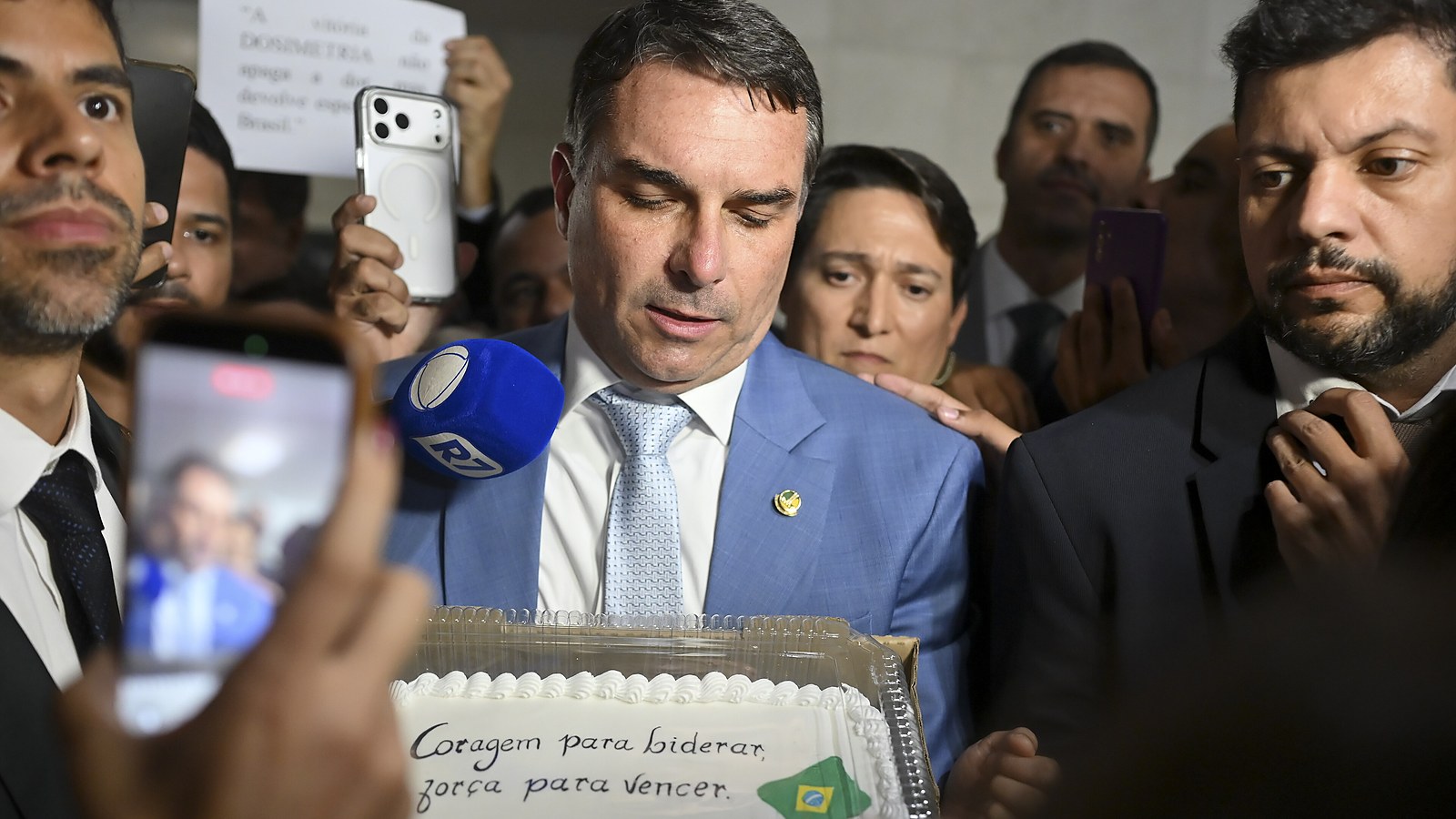
The rematch is a family affair in a literal sense. Four years ago Lula beat Jair Bolsonaro by 1.8 percentage points. The former president is now serving a 27-year sentence for plotting a coup to overturn that result and is barred from running. His eldest son has run as the standard-bearer of the movement, pitching himself to investors as a "more centered" version of his father, with a programme of tighter public spending, privatisation and lower taxes. He has also pledged to seek a congressional amnesty for his father if elected.
The wider family had a strong night. Michelle Bolsonaro, the former first lady and Flávio's stepmother, won a Senate seat in the Federal District in her first run for office; his brother Carlos won a Senate seat in Santa Catarina; and his youngest brother, Jair Renan, was elected to the lower house, Al Jazeera reported. The PL won 121 of the 513 seats in the Chamber of Deputies against 70 for Lula's PT, on track to be the largest bloc in a Congress that was already conservative.
"I admit, I was convinced I would win in the first round. The game is about to start. We are in extra time." — President Luiz Inácio Lula da Silva, speaking in São Paulo on Sunday night
The map: a country split north and south
The state results drew Brazil's familiar line. Lula dominated the North-East, taking 66.1 per cent in Bahia, 63.5 per cent in Pernambuco and 63.3 per cent in Ceará. Bolsonaro carried the big southern and south-eastern electorates — 51.9 per cent in São Paulo, 53.0 per cent in Rio de Janeiro, 59.9 per cent in Paraná — and led 48.2 to 43.3 in Minas Gerais, Brazil's second-largest electorate.
The count itself told a story. Early returns from the south showed Bolsonaro more than seven points clear; the North-East, which reports later, pulled the gap down through the evening to under two. Lula's team will read that as proof the race is close. Bolsonaro's will point out that the late votes are already counted and he is still ahead.
Why history favours Bolsonaro
Oliver Stuenkel, a professor of international relations at the Getulio Vargas Foundation in São Paulo, told Al Jazeera that no candidate who came second in a Brazilian presidential first round has gone on to win since the return of direct elections in 1989. "Unless something very unusual happens in the next three weeks, Flavio Bolsonaro is set to win," he said. Lula's own record fits the pattern: he led the first round in 2002, 2006 and 2022 and won all three runoffs.
The arithmetic of the remaining votes also looks difficult for the president. About 7.6 per cent of valid votes went to the other candidates — the psychiatrist and author Augusto Cury on 2.89 per cent, Renan Santos on 2.24, former Goiás governor Ronaldo Caiado on 2.18 and Romeu Zema on 0.27. Stuenkel noted that most of that support is centre-right and unlikely to shift to Lula. Caiado and Santos, who together drew about 5.3 million votes, have said they will endorse neither finalist.
That leaves Lula's best hope in the people who did not vote at all. About 30 million Brazilians — 21 per cent of the electorate — stayed home, Al Jazeera reported, despite compulsory voting. Stuenkel said Lula must change tactics and mobilise a significant share of them; his own supporters complained that the right had used social media far more effectively. Both leading candidates skipped the major television debates.
The campaign itself was fought less on policy than on mood. Reuters and CNBC reported that voters ranked the cost of living, crime and corruption as their main concerns, and that Lula had struggled to convert falling unemployment and inequality into goodwill among households squeezed by debt. As the race tightened, the government expanded welfare, proposed fresh debt relief for families and moved to ban online gambling. Public debt above 82 per cent of GDP and a growth forecast cut to 2.0 per cent for this year mean whoever wins inherits the same fiscal problem.
The case that the race is still open
There is a serious argument that Sunday flattered Bolsonaro. Political analyst Rafael Favetti told Reuters the senator benefited from a "protest vote" — people who preferred another candidate but saw beating Lula as the priority and moved early. "While this should benefit Flavio Bolsonaro now, his growth potential in the second round drops precisely because that support has already been front-loaded," he said. Bolsonaro himself had said on Sunday morning that he was counting on exactly that vote.
Pre-election polling of a hypothetical runoff showed the two roughly tied. Robert Muggah of the Igarapé Institute argued the other way — that pollsters "missed badly" and runoff surveys showing a dead heat will understate Bolsonaro too. Both readings can be true at once: the polls may be biased against the right and the right may have less room to grow. Bolsonaro also carries a live liability. A federal police investigation into the collapsed Banco Master is examining suspected money laundering that police have tied to him; he denies wrongdoing.
Markets, Washington and Beijing
Investors made their preference clear before Brazilian exchanges even opened. A Frankfurt-listed MSCI Brazil exchange-traded fund jumped more than 14 per cent on Monday morning, Reuters reported, and overseas-listed shares of Itaú Unibanco and Petrobras rose. Ivo Chermont, chief economist at Quantitas, predicted the dollar falling 2 to 4 per cent against the real and equities rising 4 to 6 per cent. The precedent is 2022, when the real strengthened more than 4 per cent and the Bovespa jumped 5.5 per cent after Jair Bolsonaro's stronger-than-expected first round. He lost the runoff anyway.
The result also places Brazil inside a larger contest. Donald Trump has not formally endorsed a candidate but has hosted Flávio Bolsonaro at the White House and praised him, and Lula has accused Washington of using tariffs to interfere in Brazilian affairs. Lula's allies warned before the vote that the US might refuse to recognise a Lula win; Reuters reported last week that Brazilian intelligence briefed French and German officials on alleged US and Russian interference, which Washington rejects. China remains Brazil's largest trading partner, which means whoever wins will have to manage both.
Regionally, a Bolsonaro victory would extend a run of wins by US-aligned right-wing governments across Latin America, including in Ecuador, El Salvador, Panama and Paraguay. A Lula win would leave a left-wing president facing an even more conservative Congress than the one he already struggles to move, Al Jazeera's analysts noted — and Vinicius de Carvalho of King's College London said that even re-elected, Lula would have to respond to some demands of the right.
The durable point from Sunday is that Brazil's right did not need Jair Bolsonaro on the ballot to beat expectations — it needed only his name. The polls missed that once. Whether they have corrected for it by October 25 is the question both campaigns, and every investor watching the real, will spend the next three weeks trying to answer.
This analysis is based on official results published by Brazil's Superior Electoral Court as compiled by the Rio Times, and on reporting by Al Jazeera, Reuters, CNBC and NPR, as of Monday, October 5. Vote shares are from the near-complete count and may move by hundredths of a point when the TSE certifies the result. Market figures reflect pre-open and early trading reported by Reuters and analysts' forecasts, not closing prices. Seat totals for Congress were as reported on Monday and may be revised.