
At least 24 children were killed at two primary schools in Bukavu, and survivors describe a stampede in the corridor rather than the flames as what killed them
A fire that started in the surrounding settlement reached the Ujamaa and Furaha schools at around eight in the morning. Nineteen of the dead were girls. The death toll is being compiled by a rebel administration that has held the city since February 2025 and does not run a fire service.
The most precise account of what happened at the Ujamaa and Furaha primary schools in Bukavu on Thursday morning did not come from a fire officer or an investigator. It came from a nurse. Christophe Zigashane, working at a local clinic, told the AFP news agency that his clinic received around fifty students and several teachers in what he called a critical state of asphyxia. Ten of them were already dead. Four more died at the clinic.
"That makes a total of fourteen deaths, all under ten years old," Zigashane said. That was one clinic. The wider toll, as of Thursday evening local time, stood at between 20 and 24 dead, with the higher figure coming from the rebel administration that governs the city.
Asphyxia is the detail that reframes this story. It is not the injury profile of people caught in flames. It is the injury profile of people who could not get out of an enclosed space while the air in it was replaced by smoke — and, in the accounts that have emerged, of people crushed while trying.
What the survivors describe
Patrice Buduge, a local leader in the affected district, told AFP that the fire was "followed by a violent stampede that forced students to trample over one another or look for a dangerous way out." Many fainted, he said; others lost consciousness. The BBC, citing a senior official in the city, reported at least 24 schoolchildren feared dead specifically in a stampede as they tried to flee.
The fire was followed by a violent stampede that forced students to trample over one another or look for a dangerous way out.
That sequence matters because it changes what kind of failure this was. A fire that kills by burning is a fire-suppression failure: nobody put it out in time. A fire that kills by crushing and smoke inhalation in a corridor is an egress failure — the building could not empty at the speed the situation demanded. Those have different causes and different fixes, and only one of them requires anybody to own a fire engine.
The demographic breakdown reported by the rebel administration points the same way. Dunia Masumbuko Bwenge, vice governor of South Kivu in the government appointed by the Rwanda-backed AFC/M23 movement, told the Reuters news agency that 24 people had died — 19 girls and five boys — with 29 others injured. A toll skewed that heavily by sex within a single school population is not what an indiscriminate fire produces. It is what a specific room, or a specific exit, produces.
The fire did not start at the schools
According to UN Radio Okapi, quoting local authorities, the blaze broke out at around eight in the morning in the Chimpunda area, in the densely populated Kadutu commune, and involved the two primary schools and a neighbouring settlement. Footage verified by Al Jazeera showed flames consuming a number of houses before reaching the schools. Local media put the damage at between 300 and 500 homes destroyed, along with a clinic.
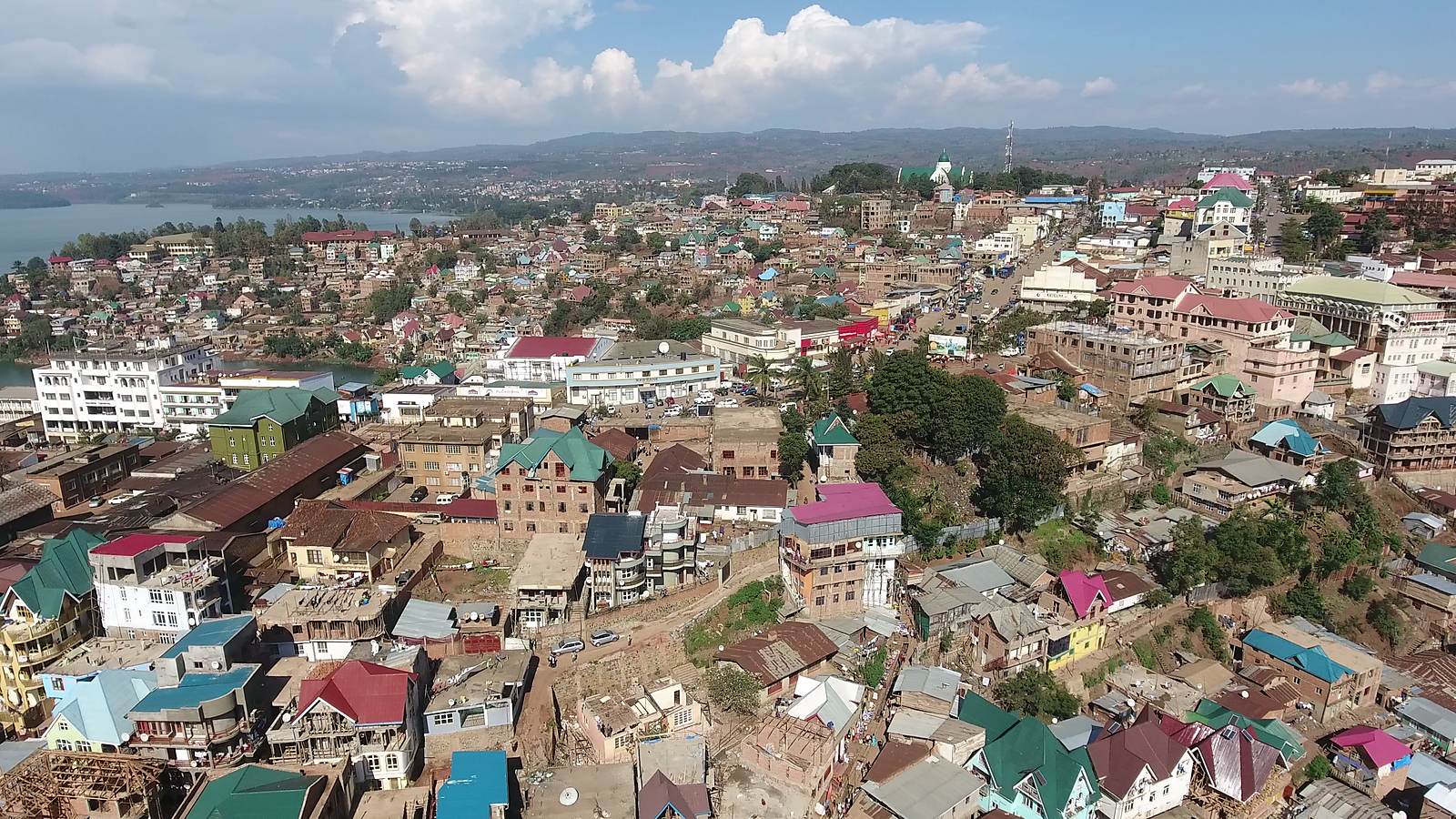
The schools, in other words, were downstream. The fire began in housing and travelled into a compound full of children at the exact hour of the day when that compound was fullest. Anyone who has seen an aerial view of Bukavu understands why it travelled: the city climbs the hills above Lake Kivu in continuous sheets of corrugated roofing, with structures built against one another and almost no gaps between them. There are few firebreaks because there is almost no unbuilt ground left to make one from.
Bukavu is the capital of South Kivu and, with a population above one million, the largest city in eastern Democratic Republic of the Congo after Goma. It absorbed a very large number of displaced people during the conflict of the past two years. Roughly 1.65 million people in the province — more than a fifth of its population — have been displaced, and cities that receive that kind of inflow do not get denser in a planned way.
Two governments, and neither of them owns this
The response to Thursday's fire has been split between two authorities that do not recognise each other. Bukavu has been under the control of AFC/M23 since the group's lightning offensive in February 2025, three weeks after it took Goma. The rebel-appointed administration said it was assessing the situation and would issue a provisional toll. It is that administration's vice governor who supplied the figure of 24.
Meanwhile the government in Kinshasa, which has not administered the city for a year and a half, released a statement on X through its Ministry of National Education and New Citizenship. The ministry expressed deep sorrow, said the toll remained provisional, offered condolences, and — the operative clause — "ordered assessments of affected schools to ensure learning continuity."
It is difficult to see how a ministry in Kinshasa inspects a school in Bukavu. That gap is not a rhetorical point about legitimacy. Fire safety is an unglamorous, continuous administrative function: someone has to inspect buildings, enforce a minimum exit width, require doors that open outward, run drills, and maintain water pressure and access roads. It works only when one authority does all of it, repeatedly, over years. A city with two claimants and one disputed border has, functionally, nobody performing that job.
A pattern, not an isolated accident
This was not the first crowd-crush death in the country in a week. The BBC noted that a fire at a wedding banquet hall in Kinshasa the previous weekend killed residents in a stampede, prompting the national government to order strict safety measures at public gathering places and to deploy inspection teams nationwide. Bukavu itself had a separate blaze the preceding Sunday that destroyed more than 45 houses.
Two fatal stampedes in a week, in two cities, a thousand kilometres apart, in buildings that filled and could not empty. That is the signature of a building stock — schools, halls, markets — that was constructed to hold people rather than to release them, and of an enforcement regime that reaches the buildings it can reach.
What the numbers cannot yet settle
The cause of the fire remains unestablished. Nothing in the reporting to date identifies an ignition source, and there is a real difference between an electrical fault in the settlement, a cooking fire, and anything deliberate — a difference that matters enormously in a city under armed occupation, where accidental and non-accidental events are read through the same political lens by every party.
The tolls also do not reconcile. Radio Okapi's local-authority figure of 20 and the rebel administration's 24 are not the same count, and the nurse's 14 is a subset from one clinic. In the first day of a mass-casualty event, that spread is normal rather than suspicious: different institutions count different populations at different hours, and children taken home by relatives appear in no register at all. Officials on both sides have said the figure is provisional and warned it could rise.
The counter-argument
It is worth stating the case against reading too much into the governance angle. Fatal school fires and crowd crushes happen in states with functioning inspectorates, stable budgets and no armed groups anywhere near them. Density and poverty explain a great deal on their own, and a settlement fire that jumps into a school compound at eight in the morning would be dangerous under any administration. Attributing every element of Thursday to the occupation would be both wrong and convenient — for Kinshasa, which would rather this were a story about rebel misrule than about Congolese building stock, and for AFC/M23, which can point to a fire service it inherited rather than dismantled.
But the argument does not need the occupation to have caused the fire. It needs only the more modest claim: that the years-long, boring work which converts a burning building into an evacuated one requires a single accountable authority, and that Bukavu has not had one since February 2025. In August, the Congolese government and M23 agreed a roadmap for peace talks. Whatever else such a process is meant to deliver, it determines who is responsible for the exit doors.
The durable point
Nineteen girls and five boys, most of them under ten, died a few metres from a door. The fire that reached them started somewhere else and was, by afternoon, out — a witness told Reuters that only smoke was still rising from rubble and corrugated metal. What killed them was the distance between where they were sitting and open air, measured in seconds. That distance is set by architecture and enforcement long before any fire starts, and it is the same in every crowded city on earth. Bukavu's problem is not that it is uniquely dangerous. It is that nobody there has been in a position to measure it.
This report is based on figures from UN Radio Okapi, the Reuters and AFP news agencies, the BBC and Al Jazeera, and on statements from the AFC/M23-appointed South Kivu provincial administration and the Democratic Republic of the Congo's Ministry of National Education and New Citizenship, as of Thursday evening local time. Casualty counts in the first hours of a mass-casualty event are provisional and have been revised in comparable incidents; the reported figures of 20 and 24 dead come from different authorities counting different populations. The cause of the fire has not been established. Displacement figures for South Kivu are drawn from United Nations humanitarian reporting from the period following the February 2025 capture of the city.