
CIA director John Ratcliffe flew to Moscow to warn Russia against attacking NATO — the first such trip since the warning that preceded the invasion of Ukraine
A US Air Force jet on a Moscow runway and a motorcade on social media were the only public evidence until the Wall Street Journal reported what the visit was for: an intelligence assessment that Russia may be preparing to test the alliance with a limited assault, probably in the Baltics. Hours later, Moscow threatened to strike British targets.
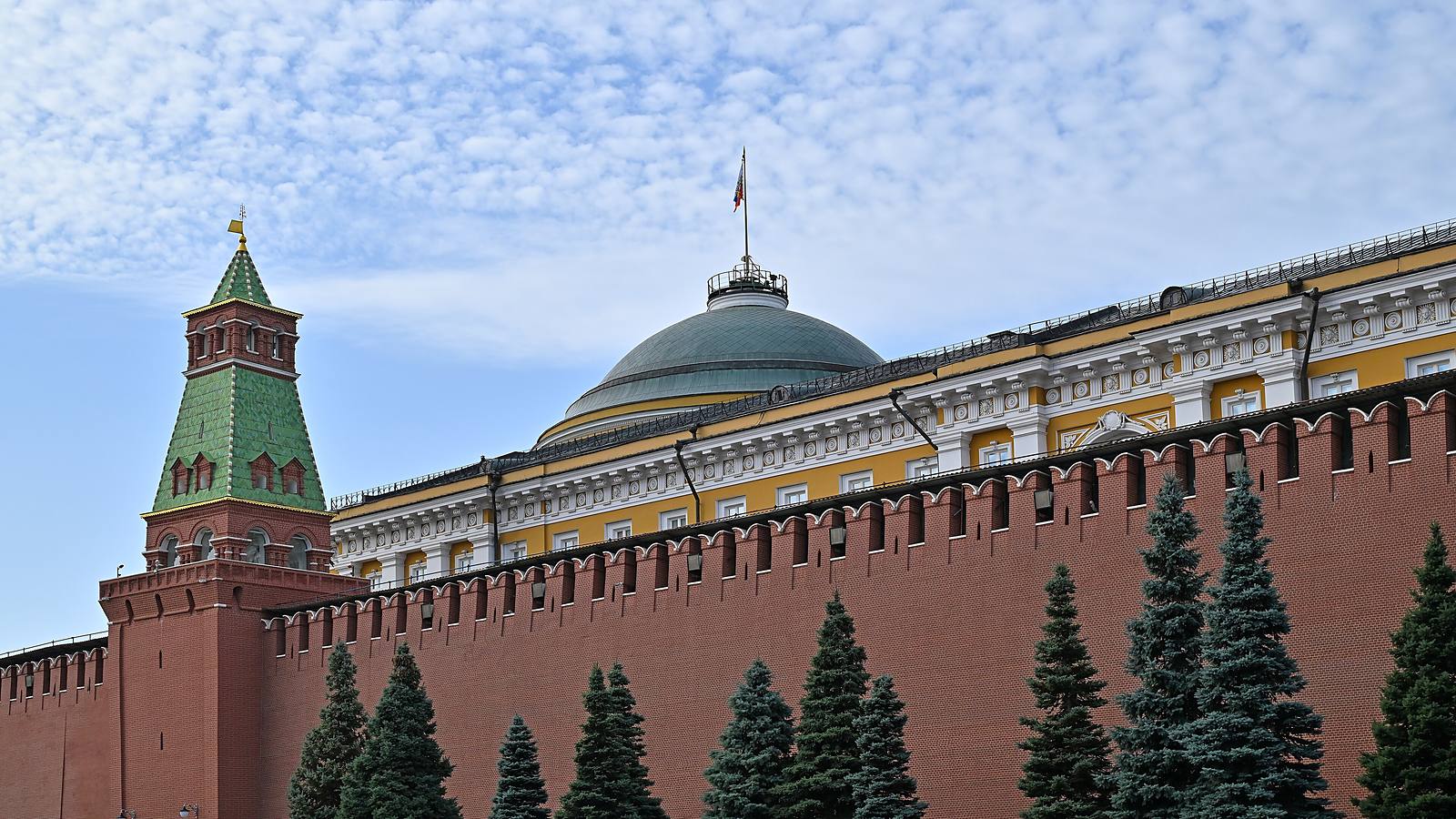
The last time a director of the Central Intelligence Agency travelled to Moscow to deliver a warning, it was November 2021. William Burns told his Russian counterparts that the United States knew what was being assembled on Ukraine's borders and that invading would carry a cost. Moscow denied it was contemplating anything of the kind. The full-scale invasion began ten weeks later.
John Ratcliffe made the same journey on Tuesday. According to the Wall Street Journal, which first reported the purpose of the trip, and Politico and CBS News, which separately confirmed it, he carried a comparable message: do not attack NATO.
How a secret trip stopped being secret
Nothing about the visit was announced. It surfaced the way these things now surface — a US Air Force jet was spotted arriving at a Moscow airport on Tuesday, and footage of a diplomatic motorcade moving through the city appeared on social media the same day. By Wednesday the reporting had caught up with the aircraft tracking, and by Thursday the Kremlin was answering questions about it.
Dmitry Peskov, the Kremlin spokesman, confirmed the essentials while conceding nothing. Ratcliffe did not meet President Vladimir Putin, he said. He declined to specify whether the discussions concerned Ukraine or Iran. "I can only tell you that contacts took place through the intelligence services," he told the state news agency Tass — a formulation that acknowledges the channel while denying the substance.
President Donald Trump, speaking to the conservative broadcaster Glenn Beck on Wednesday, called the meeting "semi-routine" and added that "something may come out of" the Moscow visit, repeating that Washington would like to see the war end. The characterisation is doing a great deal of work. Contacts between the CIA and Russia's services genuinely are routine and have continued throughout the war; a director flying to Moscow in person is not.
The assessment behind the trip
The Journal reported that the visit followed a US intelligence assessment that Russia could be preparing to test NATO with a limited assault on an allied country. The described range runs from a cyber-attack at one end to a small-scale ground incursion at the other, with a Baltic state named as the most likely location.
That is a specific and unusual thing for an assessment to say, and it is worth being precise about what it is not. It is not a warning of general war. It is a warning about a probe — an action calibrated to sit below the threshold at which Article 5 obviously applies, designed to find out whether the alliance would treat it as an attack on all. The strategic value of such an operation, from Moscow's perspective, lies entirely in the ambiguity. The strategic danger, from Washington's, is that ambiguity is exactly where miscalculation lives.
Katia Glod, deputy head of foreign policy at the New Eurasian Strategies Centre, called the trip "quite an unusual visit" but not unprecedented, and linked it to the pattern of hybrid operations across Europe rather than to the front line in Ukraine. Incidents attributed to Russia — cyber-attacks, drone sightings over airfields and infrastructure, arson at facilities connected to Ukrainian supply — have accumulated in Germany and Britain in particular. "The level of communication needs to be stepped up," she said, "because the situation has been escalating."
Iran came up too
CBS News reported that Ratcliffe raised a second file in Moscow: Iran, and specifically the Strait of Hormuz. The message was that additional sanctions would follow if the strait does not reopen to shipping traffic. Six months into the war between the United States, Israel and Iran, Washington has been threatening secondary sanctions on Tehran's trading partners — a category that includes China, the United Arab Emirates and Turkey, and which Russia has spent three years working to enlarge.
Raising Hormuz in Moscow is not a courtesy. It is an acknowledgement that Russia is now a load-bearing part of Iran's ability to move oil and absorb sanctions pressure, and that any American squeeze on Tehran runs through Russian tolerance. It also gives the visit a transactional shape: two files, one channel, and an implicit suggestion that movement on either might be traded.
Within hours, Moscow threatened Britain
Whatever was said behind closed doors, the public temperature rose immediately. On Thursday morning, Russia said it could retaliate against the United Kingdom for its support of Kyiv by striking military targets both inside and outside Ukraine. Maria Zakharova, the Russian foreign ministry spokeswoman, said Britain and France were "playing with fire."
The trigger was Monday's announcement by Britain's prime minister, Andy Burnham, that the UK would give Kyiv access to classified technology so that Ukraine could begin producing its own Storm Shadow long-range cruise missiles. Transferring finished missiles is an act of supply that ends when the stockpile does. Transferring the technology to build them is an act of industrial policy that does not end at all, and Moscow has clearly read it that way.
A lot of this kind of scare-story material is being published right now. Of course, it has nothing to do with reality and nothing to do with the intentions of the Russian Federation.
That was Peskov, asked about the reports of the Ratcliffe warning — on the same morning his foreign ministry threatened British targets. The two statements are not in tension so much as they are addressed to different audiences.
The bellicosity is not only about Ukraine
The rhetorical escalation has been broad. Within days Russia invoked the threat of its nuclear arsenal against Japan over the disputed Kuril Islands and described relations with the United States as being in "crisis" and at a historic low point. Much of this is aimed inward: Ukrainian long-range strikes on Russian oil refining infrastructure have imposed a real and rising economic cost, and a government absorbing that at home has reasons to sound dangerous abroad.
President Volodymyr Zelenskyy has been arguing for weeks that Putin is preparing to escalate rather than settle, and pressing partners for both tougher sanctions and faster delivery of air defence. His most specific request is for ballistic missile interceptors, which Ukraine is running short of precisely as Russia increases the tempo of missile strikes on cities — a shortage he has said directly cost lives in Kyiv on August 5.
The interceptor shortage is the quiet strategic fact under all of this. Ukraine's ability to keep its cities standing depends on a category of munition that only a handful of Western production lines make, at rates set years ago for a peacetime demand curve. Every week that Russia fires more ballistic missiles than the alliance can replace interceptors is a week in which the cost of continuing rises for Kyiv and falls for Moscow. That arithmetic, more than any speech, is what determines whether the war escalates — and it is the same arithmetic that makes a NATO probe look cheaper to Moscow than it should.
The alliance is already moving
NATO members on Russia's border are not waiting for the diplomacy to resolve. Poland took delivery this week of its first shipment of South Korean Black Panther main battle tanks, to be deployed near the Kaliningrad exclave. Cezary Tomczyk, the deputy defence minister, described the posture without diplomatic softening earlier this month: Warsaw is preparing for the possibility of full-scale conflict. "We are preparing for war, hoping it never happens."
That is the context in which a probe would land. A limited incursion or a major cyber-attack against a Baltic state would arrive in an alliance that has spent three years rebuilding its eastern posture and whose frontline members have already publicly concluded that war is possible. The assumption that a sub-threshold action would produce a sub-threshold response is exactly the kind of assumption that has historically been wrong.
What the 2021 precedent actually teaches
It is tempting to read the Burns comparison as a prophecy: the CIA director flew to Moscow, was disbelieved, and the invasion came anyway. But the more useful lesson from 2021 is narrower. The warning did not prevent the invasion. What it did was establish, in advance and on the record, that the United States had seen the preparations — which is what made the subsequent intelligence-sharing with allies, and the speed of the sanctions response, possible at all.
A warning delivered in person by the director of the CIA is not principally an attempt at persuasion. It is a removal of deniability. After Tuesday, Moscow cannot claim it did not know how Washington would read a Baltic probe, and Washington has positioned itself to say that it said so first. Both governments spent Wednesday and Thursday describing the meeting as routine and the reporting as invented. The aircraft was real, the motorcade was real, and the Kremlin has confirmed the contact took place. That is usually the part that matters.
This report is based on reporting by the Wall Street Journal, Politico, CBS News, CNBC and the Guardian, and on statements from the Kremlin, the Russian foreign ministry and the White House as of Thursday, August 27, 2026. The purpose of the visit has not been officially confirmed by the CIA, which did not respond to requests for comment.