
Warren Buffett has gone quiet. Greg Abel is spending Berkshire's cash — $36 billion in one quarter
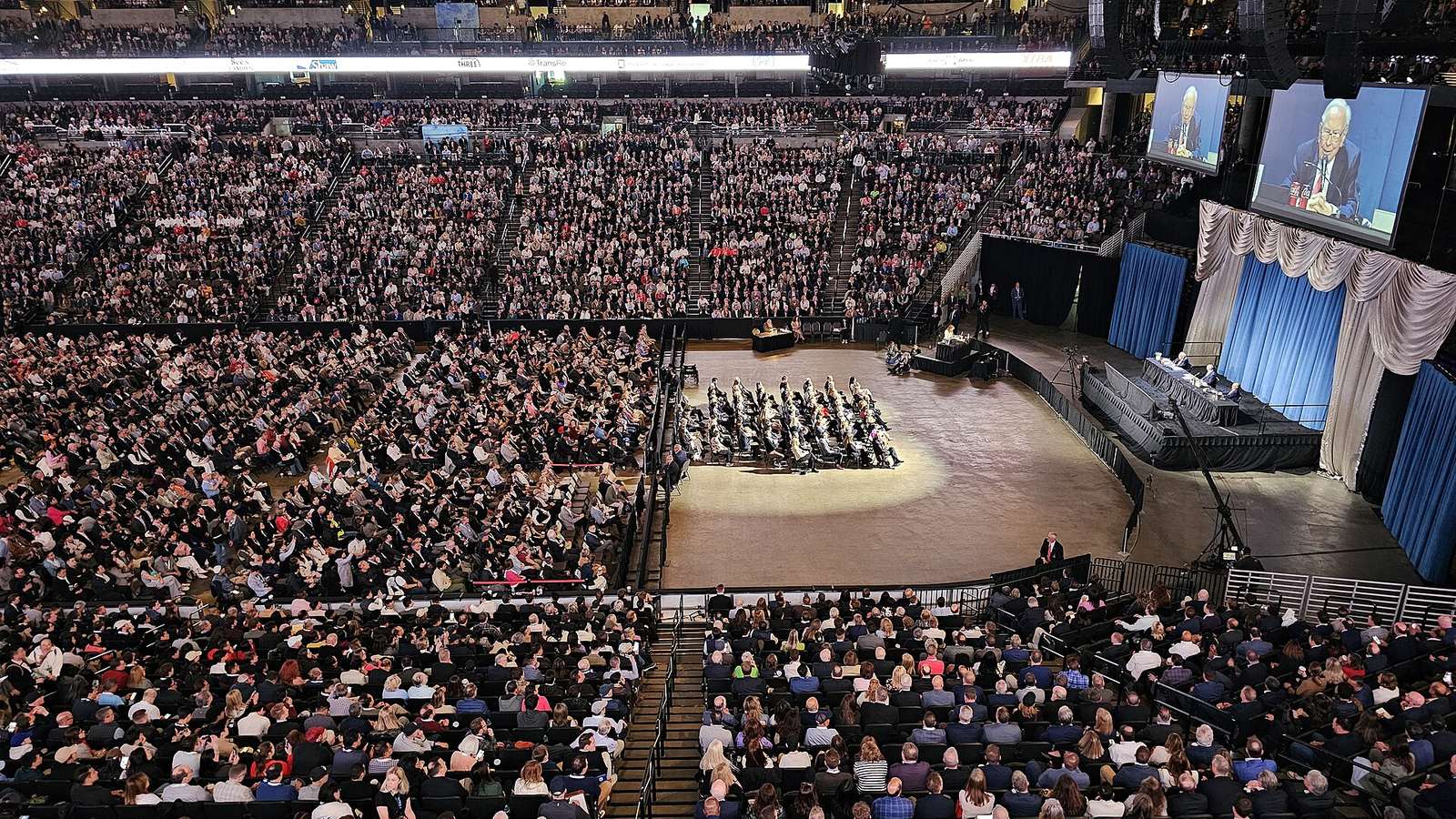
Warren Buffett ended sixty years of letters with a Thanksgiving note, handed Berkshire Hathaway to Greg Abel on New Year's Day, and sat in the arena crowd at his own annual meeting. Since then: the cash pile shrank for the first time in four years, the buying resumed, and the stock has trailed the market by ten points — the price of finding out whether the premium was the man or the machine. An analysis of Berkshire's first year after.
Every figure in this article is drawn from Berkshire Hathaway's press releases, SEC filings and 13F disclosures, or from reporting by CNBC, Bloomberg, Fortune and Forbes as attributed. Sections marked as analysis are identified as such.
The most consequential succession in the history of American capitalism was announced in the tone of a man declining a second helping. "I will no longer be writing Berkshire's annual report or talking endlessly at the annual meeting," Warren Buffett wrote in his final letter last November. "As the British would say, I'm 'going quiet.' Sort of. Greg Abel will become the boss at yearend. He is a great manager, a tireless worker and an honest communicator."
On January 1, after six decades, it was done: Abel became chief executive; Buffett, 95, stayed on as chairman and converted another tranche of his shares for his family's foundations on the way out. The question that has hung over markets for thirty years — what is Berkshire without Buffett? — stopped being hypothetical. Seven months in, the early returns are specific enough to read.
The machine, running
Operationally, nothing wobbled. Second-quarter operating earnings — the measure Buffett always insisted on — rose 16 per cent to $13.0 billion, with the railroad, the utilities and manufacturing all up, insurance underwriting softer, and the insurance float steady near $177 billion. (Headline net earnings doubled to $25.7 billion, a figure inflated by paper investment gains that Berkshire's own releases call "usually meaningless" quarter to quarter.) Fiscal 2025 closed with $44.5 billion of operating earnings, down 6 per cent in a soft insurance year.
The balance-sheet news was the real headline: Berkshire's cash hoard — which had marched relentlessly to a record $397.4 billion at the end of March — fell to $365.5 billion by June 30, the first quarterly decline in roughly four years. The reason it fell is the story of the Abel era so far: he spent it.
What Abel did with the keys
The deployment came in waves. OxyChem — the $9.7 billion all-cash purchase of Occidental's chemicals business, Buffett's final big deal — closed on January 2. In June came the first acquisition that was Abel's own: Taylor Morrison, the American homebuilder, for roughly $6.8 billion in equity, closed by mid-August — with Abel signalling he will integrate it into a combined homebuilding platform with Berkshire's existing operations. That one sentence marks a genuine departure: Buffett bought companies and left them alone; Abel, the career operator, intends to operate.
The stock portfolio turned over just as decisively. Berkshire was a net buyer of $19.8 billion of equities in the second quarter — ending a fourteen-quarter net-selling streak — including a $10 billion negotiated private placement in Alphabet, whose stake grew 83 per cent to become Berkshire's third-largest holding. Apple, trimmed relentlessly through 2025, was left untouched at the top of the book. Buybacks, suspended entirely in 2025, resumed: $4.5 billion in the quarter. All told, Abel moved something like $36 billion in three months — more capital than Berkshire had deployed in some entire years of the late Buffett era.
Buffett's public verdict on the Taylor Morrison deal, via CNBC: "Greg did that faster than I could have done it, smoother than I could have done it, and I never talked to the CEO."
The first meeting without him on stage
May's annual meeting in Omaha measured the transition in atmosphere. Buffett did not appear on stage; he sat on the arena floor with the directors and spoke briefly from his seat. Attendance, by press accounts, was roughly half of the old capacity crowds. Abel, asked directly whether Berkshire's conglomerate structure should be broken up, closed the door: "Absolutely not... We do not see ourselves divesting subsidiaries for that reason or ever breaking off a group." He played Buffett's 1991 Salomon Brothers testimony to the hall and told shareholders he had reissued Buffett's "newspaper test" to every subsidiary chief executive. Continuity, performed deliberately.
The discount
The market has rendered a more ambivalent verdict. Berkshire's shares are up roughly 3 per cent this year against about 13 per cent for the S&P 500 — a ten-point gap that analysts attribute to three things: the drag of $365 billion earning Treasury-bill rates in a rallying market, the absence of any meaningful artificial-intelligence exposure, and the slow evaporation of what Wall Street called the Buffett premium. The Kraft Heinz saga added a sour note: the planned split was shelved by its new management in February, and Berkshire — after publicly weighing an exit from its 27.5 per cent stake — decided to hold.
Analysis: was the premium the man, or the machine?
The following section is analysis, drawn from the reported facts above.
Mechanically, the succession has been close to flawless — arguably the best-executed founder transition a giant company has ever staged. The capital is moving faster under Abel, not slower; the discipline (no breakup, no strategy lurch, buybacks only at prices Berkshire likes) is intact; and the one visible change, a willingness to integrate and operate acquisitions, plays directly to the new chief executive's strengths rather than imitating the old one's.
The ten-point underperformance deserves a fairer reading than "the magic left." Holding a third of a trillion dollars in cash while an AI-led market melts up is not a failure of nerve; it is the same posture that looked foolish in 1999 and 2007 and paid for itself spectacularly after. If the exuberance JPMorgan's chief executive keeps warning about ever meets its cockroaches, the largest war chest in financial history is the strategy, and Abel inherited it fully loaded — and has shown, at $36 billion a quarter, that he is not afraid to fire it.
What cannot be inherited is the voice. For sixty years Berkshire's ultimate asset was a man who could steady markets with a letter and make patience sound like adventure. That asset retired to the arena floor in May. The company now has to speak for itself — and so far it speaks in acquisitions, in resumed buybacks, and in a refusal to be broken up. Quieter. Not yet worse. The next bear market, not this bull one, will grade the handover properly.
Sources
- Berkshire Hathaway Q2 2026 earnings release and Form 10-Q, August 8, 2026 — operating earnings $12.98B (+16%), net earnings $25.7B with the company's own caveat, float ~$177.5B, buybacks ~$4.5B, share count; CNBC — cash of $365.5B, down from the record $397.4B at March 31, first decline in ~4 years.
- Berkshire FY2025 release, February 28, 2026 — operating earnings $44.5B (−6%), zero 2025 buybacks; Abel's first shareholder letter per CNBC.
- Buffett's Thanksgiving letter (berkshirehathaway.com), November 10, 2025 — the "going quiet" passage and Abel endorsement; the share conversion for family foundations.
- Berkshire release, January 2, 2026, and CNBC, October 2, 2025 — the $9.7B OxyChem acquisition and closing; CNBC, June 1, 2026, and subsequent closing coverage — Taylor Morrison (~$6.8B equity), Abel's integration plans, and Buffett's quoted praise.
- Berkshire Q2 2026 13F (filed August 14, 2026) and CNBC, August 15, 2026 — net purchases of $19.8B ending a 14-quarter selling streak, the ~$10B Alphabet placement and 83% stake increase, Apple unchanged, Delta added.
- CNBC and Forbes, May 2–3, 2026 — the first Abel annual meeting: Buffett off-stage, attendance, the "Absolutely not" breakup answer, the Salomon tape and newspaper test.
- CNBC, July 11, 2026 — Berkshire trailing the S&P 500 by roughly ten points year-to-date and the attributed causes.
- CNBC, February 11, 2026, and Bloomberg, March 5, 2026 — the Kraft Heinz split pause and Berkshire's decision to hold its stake.
Figures are in U.S. dollars as reported. Quarterly net earnings include unrealized investment gains that Berkshire itself describes as not meaningful for short-period analysis. Year-to-date share-performance figures are as of mid-August 2026 and move daily. The equity-portfolio total and July buyback estimates from newsletter sources are excluded.