
Hurricane Isaias kills at least four after a Category 2 landfall near Destin, Florida — gusts of 116 mph, a near-record surge and more than 700,000 customers without power
The season's first Atlantic hurricane went from a 20% chance of forming to a brief Category 3 in under a week, came ashore on the Panhandle exactly two years after Milton, and spun up tornadoes from Georgia to North Carolina. Falling trees and an indoor generator, not the surge, did the killing.
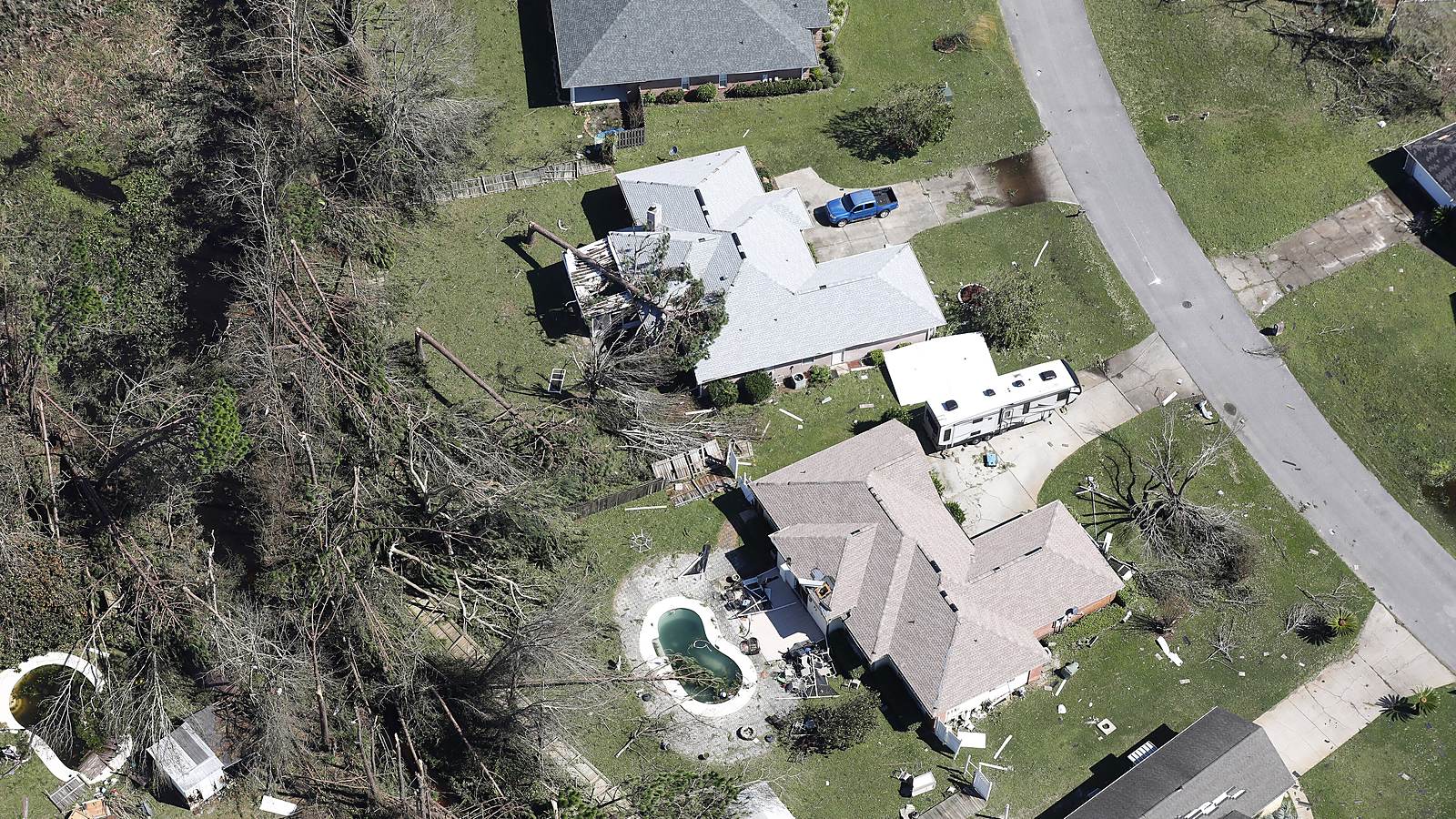
Hurricane Isaias did most of its killing after the hard part was supposedly over. The storm came ashore near Destin, Florida, at about 9:30 p.m. Eastern time on Friday as a Category 2 hurricane with 105 mph winds. Its storm surge was the second-highest ever measured at Panama City Beach. Yet none of the four deaths confirmed by Monday was caused by water. Two people died when trees fell onto their homes, one in a garage where a generator was running, and one in a rural Alabama county as the storm pushed inland.
That pattern — wind and trees and carbon monoxide rather than drowning — is the story of Isaias, and it is a reminder that a hurricane's danger does not end at the coastline or when the National Hurricane Center downgrades it. By Monday morning, Isaias had long since weakened into a post-tropical cyclone. More than 150,000 customers in Florida and more than 20,000 in Alabama were still without power, according to poweroutage.us figures cited by CBS News.
From a 20% chance to a major hurricane in a week
Isaias is the first hurricane of the 2026 Atlantic season and the first to make landfall on the US mainland in exactly two years, since Hurricane Milton struck western Florida on October 9, 2024. It was the fourth named storm to reach the US coast this year, following three short-lived tropical storms, and by a wide margin the strongest.
Its development was fast. According to the FOX Forecast Center's reconstruction, the National Hurricane Center flagged an area to watch with a 20% chance of development on the Saturday before landfall. By Monday it had become Invest 92L with 80% odds. Tropical Depression Nine formed on Tuesday evening and became Tropical Storm Isaias early Wednesday. Hurricane Hunter aircraft found 75 mph winds late Wednesday, making it a hurricane; by Thursday evening it was a Category 2. On Friday morning it briefly reached Category 3 strength with 120 mph winds before easing back to 105 mph at landfall, with a minimum central pressure of 971 millibars.
A storm that goes from a disorganised cluster of thunderstorms to a major hurricane inside a working week leaves coastal communities very little time. Thousands of residents along the Florida and Alabama coasts were ordered to evacuate, and Alabama Gov. Kay Ivey has since rescinded the evacuation order for non-residents in parts of Mobile and Baldwin counties.
Where the wind was worst
As the eyewall approached, the National Weather Service issued a rarely used extreme wind warning for the western Florida Panhandle, including Pensacola and Destin, for gusts likely to exceed 115 mph. The forecast held. The Weather Channel recorded a gust of 116 mph in Santa Rosa Sound, where sustained winds reached 91 mph, and a report of 117 mph near Oriole Beach. Pensacola City Hall logged 102 mph. Less than 12 hours before landfall, an uncrewed NOAA Saildrone measured a 104 mph gust near the eyewall at sea.
Some of the most violent gusts struck well inland. In Milton, Florida, about 15 miles from the coast, wind shredded roofs from apartment buildings, peeled the roof and rear wall off a convenience store and brought down large trees across a residential neighbourhood. Phyllis Hennebery told CBS News she was lying down in her room when a tree came through the house.
"I never expected to be 77 years old and go through this." — Phyllis Hennebery, Milton, Florida, to CBS News
In Pensacola, part of a hotel roof was torn away and gas-station canopies collapsed on Blue Angel Parkway and Mobile Highway. Recreational vehicles were blown over, including one onto US 98 between Gulf Breeze and Navarre. In Alabama, every road in Conecuh County was impassable because of debris and fallen trees.
A near-record surge, and how to read it
Water levels rose 5.6 feet above the average high tide at Panama City Beach, the second-highest reading on record there, behind only Hurricane Opal in October 1995, according to the FOX Forecast Center. For comparison, Hurricane Michael — a far stronger storm that made landfall farther east in 2018 — produced a 3.86-foot reading at the same gauge, which ranks fifth. Destin saw water more than four feet above normally dry ground.
There is a caveat that matters for anyone comparing storms. The Weather Channel noted that these figures are measured relative to mean higher high water and include the tide, so they are not pure storm-surge heights. A storm that arrives at high tide will post a bigger number than an identical storm at low tide. The ranking says Panama City Beach saw unusually high water; it does not by itself say Isaias pushed more ocean ashore than Michael.
Rain, tornadoes and the long tail inland
Once it moved inland, Isaias became a rain and tornado event. Bellwood, Alabama, recorded more than a foot of rain in 13 hours. A monitoring station at Caney Creek, Florida, measured 12.06 inches in 24 hours, nearly ten of them in three hours. A flash-flood warning was issued for part of Atlanta on Saturday morning.
The remnants spun off at least eight confirmed tornadoes in Georgia and the Carolinas, according to CBS News. Near Appleton, South Carolina, four homes were severely damaged. Another tornado tore the roof off a home about 90 miles west of Charleston. In western North Carolina, more than half a foot of rain flooded roads and triggered landslides, and flood watches stretched on Sunday into Virginia, West Virginia, Maryland and Pennsylvania.
Who died, and why
Florida Gov. Ron DeSantis confirmed two deaths in the Panhandle. "One individual in Escambia County had a tree fall on his home and tragically was killed, and another one, unfortunately, died inside of his garage when they went to find him, the generator was running," he said. "And so just don't run the generator inside. It's something that could be fatal." The Escambia County Sheriff's Office said four other people in the home were treated for carbon monoxide poisoning after the group ran a generator without proper ventilation.
In Alabama, one person was killed in Birmingham when a tree crushed a house, and the state's Emergency Management Agency confirmed a second death in Barbour County. Trees also fell onto homes in Mountain Brook, Ensley, Opelika and Ladonia. Early reports cited three deaths before the toll was revised to four, and officials have cautioned that it may change.
The generator death is the kind that recurs after almost every major storm. When power fails for days, families run portable generators to keep refrigerators and fans going, and an engine running in a garage or enclosed space can fill a home with odourless carbon monoxide. The danger peaks after the storm has passed, precisely when people feel safe. With hundreds of thousands still waiting for power, that risk has not gone away.
The case that it could have been worse
It is fair to say Isaias was not a catastrophe on the scale of recent Gulf Coast storms. It weakened before landfall, it moved quickly inland rather than stalling, and its surge, though high at Panama City Beach, did not produce mass drownings. The evacuations ordered when it was briefly a major hurricane almost certainly kept people out of the most exposed places. A Category 2 that kills four is, by the grim arithmetic of hurricanes, a storm the region absorbed.
But the power figures argue against complacency. At the peak, the FOX Forecast Center estimated more than a million Americans were without electricity; the Weather Channel put affected customers above 700,000. Alabama Power said more than 5,000 additional crews were arriving from nearly 25 states. Restoring a grid across a region where trees are down on lines in every county takes days, and every one of those days is another day of generators running in garages.
On the other side of the country, the remnants of Tropical Storm Rachel sent eight-foot waves into beachfront homes south of Los Angeles, floodwater spread onto the Las Vegas Strip and about 70 runners in Utah's Moab 240 ultramarathon had to be rescued by bus. The name Isaias, which replaced "Ike" after the destructive 2008 hurricane, was last used in 2020 for a storm that came ashore in North Carolina. The durable lesson of its second landfall is that Category numbers measure wind at the coast; the deaths happened under trees and behind garage doors.
This report is based on information from the National Hurricane Center and National Weather Service as relayed by the Weather Channel and the FOX Forecast Center, statements by Gov. Ron DeSantis, the Escambia County Sheriff's Office and the Alabama Emergency Management Agency as reported by WALA FOX10, and reporting by CBS News, as of Monday, October 12, 2026. Death tolls, outage counts and storm-surge figures are provisional; surge readings include tide and are not pure surge heights. Outage figures vary by source and by the hour they were taken.