
Janeese Lewis George, a democratic socialist, is set to become Washington D.C.'s mayor — in the one American city where Congress can veto her budget and the president has already taken its police once
Lewis George won June's Democratic primary with about 53 per cent of first-choice votes and faces only independent and Green opponents on November 3. Her signature tax plan is already the target of a House bill, National Guard troops remain on the streets, and the office she is about to hold answers to Congress in a way no state-chartered city hall does.
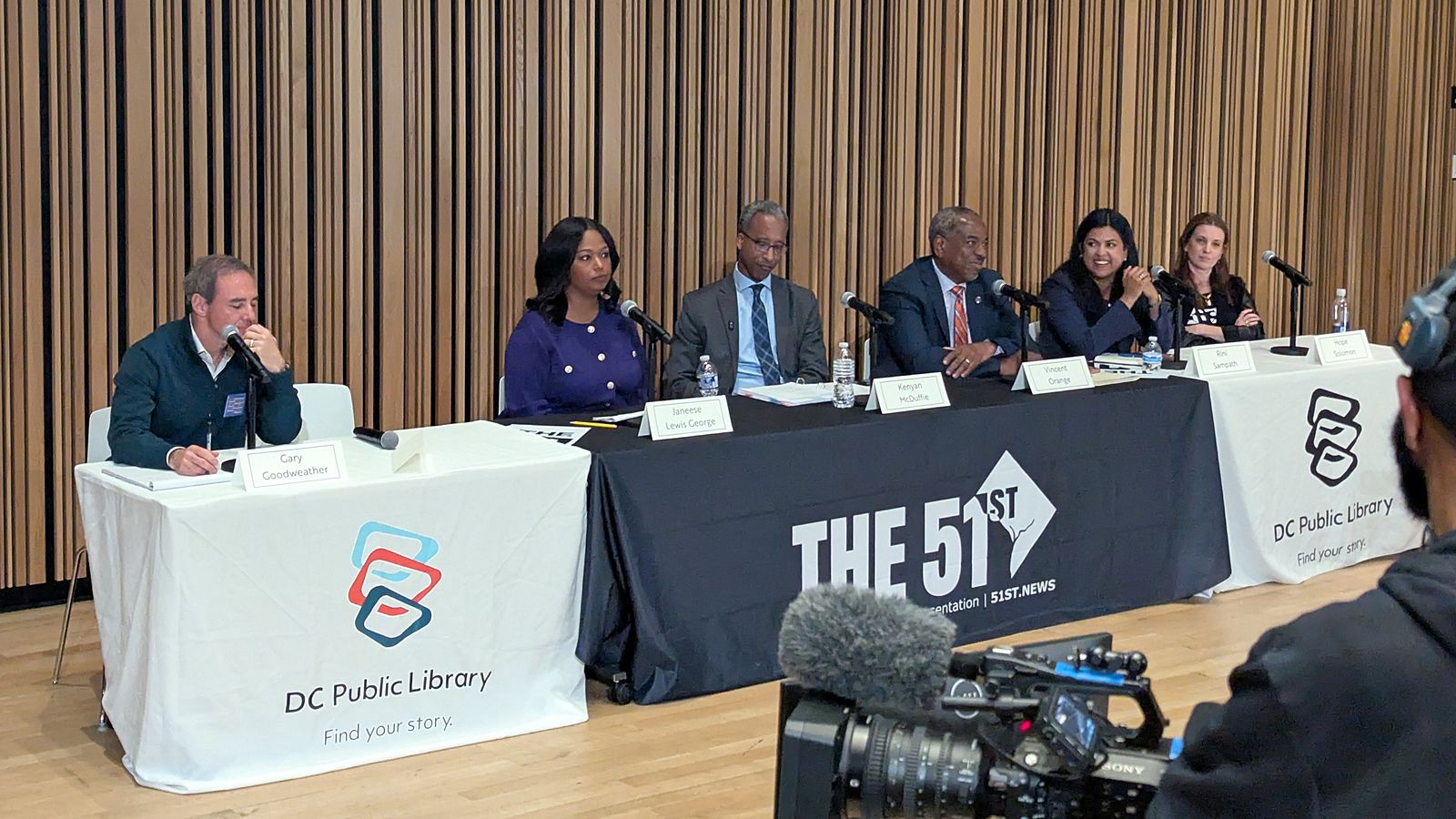
The most important fact about Washington D.C.'s next mayor is not her politics. It is the office. Janeese Lewis George, a city council member and a member of the Democratic Socialists of America, is all but certain to win the November 3 general election in a city that votes overwhelmingly Democratic. What she inherits is a mayoralty that sits beneath Congress, beside a president who has already seized the city's police department once and inside a federal district whose laws the national legislature can review and overturn.
Lewis George won the June Democratic primary, the city's first contest run under ranked-choice voting, with about 53 per cent of first-choice votes against roughly 36 per cent for Kenyan McDuffie, a moderate Democrat, according to early and near-final counts reported by local outlets. McDuffie conceded, saying that "it is clear that the voters have chosen a different path." In November she faces independent and Green Party candidates. She will succeed Muriel Bowser, a Democrat who has led the city for more than a decade.
Her campaign declined CNBC's request for an interview this week, but her platform is on the record: universal childcare, affordable housing, lower utility costs and a new business activity tax. Each of those runs, sooner or later, into the peculiar constitutional position of the city she will run.
A city that governs itself on licence
Washington's self-government rests on the District of Columbia Home Rule Act of 1973, a federal statute rather than a state constitution. Congress delegated the city its elected mayor and council and can revisit that delegation. Section 740 of the same act allows a president to take control of the Metropolitan Police Department in an emergency for 30 days unless Congress extends it.
That clause stopped being theoretical in August 2025, when President Donald Trump used it to take control of the city's police and deployed National Guard troops, citing crime, even though violent crime had fallen from earlier peaks. According to CNBC, thousands of Guard troops have now been deployed across the city for 14 months, with plans to keep them in place until Trump's term ends in 2029. Trump has repeatedly threatened to federalise the police again and, in June, called Lewis George a "communist".
Bowser's critics argued she complied with the 2025 takeover too easily. Lewis George's supporters expect the opposite posture, and that expectation is a large part of why she won. "Myself and basically every other D.C. resident I know, we don't take kindly to threats from the federal government on our ability to self-govern," Kurtis Hagans, chair of the Metro DC chapter of the Democratic Socialists of America, told CNBC.
The tax that drew a congressional response before she took office
The clearest early test is money. Lewis George supports a business activity tax aimed at a specific gap in the city's base. Under federal law, unincorporated partnerships based in Washington, such as law offices and lobbying firms whose owners live in Maryland or Virginia, can avoid the district's business franchise tax. Her proposal would tax that economic activity while exempting the first $200,000. She has said she does not support tax increases on working- or middle-class families, and has described the plan as closing a "loophole".
The DC Fiscal Policy Institute has estimated that a 2 per cent business activity tax could raise about $500 million a year. Lewis George said during the primary debate that the revenue could help fund her agenda. The council ordered a feasibility report in July and this month held a nine-hour hearing on tax proposals, including the business activity tax, as it tries to close budget shortfalls for fiscal year 2028.
Opponents argue the tax would land on the wrong people. "It's a self-defeatist approach that is punishing the small businesses we need to bring our economy back," said Malcom Fox, executive director of Opportunity DC, an independent expenditure group that backed McDuffie.
Congress moved before the voters did. This summer Representative James Comer, the Kentucky Republican who chairs the House Oversight and Government Reform Committee, introduced the D.C. Taxing Authority Review Act, which would effectively let Congress block tax increases the city approves. It cleared his committee on July 22. "Radical DC Democrats want to solve their spending problem by reaching deeper into taxpayers' pockets and driving further on the path to socialism," Comer said in a statement. Lewis George replied on X: "Let the people of D.C. govern D.C."
The bill has not had a floor vote, and Ankit Jain, one of the district's shadow senators, told CNBC he thinks its odds of passing both chambers are slim. But the mechanism it targets matters more than this one bill. Under the Home Rule Act, legislation the council passes already sits before Congress for a review period before it takes effect; the question is only how aggressively Congress chooses to use that position.
"What is the mayor going to do? They can't actually pass any kind of legislation that's going to massively increase some minimum wage or massively increase tax rates on residents and redistribute it." — David Barker, political science professor, American University, to CNBC
Not New York, and not trying to be
Lewis George is part of a wider rise of the left inside the Democratic Party at city level. Zohran Mamdani brought democratic socialism to New York's mayoralty. In Seattle, Katie Wilson won last year in a close race against incumbent Bruce Harrell. In Los Angeles, council member Nithya Raman is leading a tight runoff against Mayor Karen Bass. Several democratic socialists are also running for Congress, and in Michigan Abdul El-Sayed, who rejects the DSA label but shares many of its positions, is challenging former Representative Mike Rogers.
The comparison with New York is the one her supporters reach for and the one that flatters her least. Mamdani has been able to move quickly on initiatives such as a pied-à-terre tax and free childcare for low-income children, because New York's mayor answers to a state legislature rather than to Congress. Nick Cosgrove, co-chair of the Young Democratic Socialists of America chapter at the University of Maryland, put it bluntly: "Even in a best case, I don't think she's going to be the Mamdani in D.C." He added that he still expected her to be "a vast improvement over Mayor Bowser" because she is willing to say no to the president.
That distinction, between what a mayor can enact and what a mayor can refuse, is the real shape of the job. Barker's point is that mayors in general control services rather than redistribution: potholes, lighting, agencies, appointments. In Washington, even the redistribution that the council could theoretically legislate passes through a federal review that no other American city faces.
The case for a working relationship
There is a credible argument that the city's business community and the incoming mayor are less far apart than the campaign suggested. Chinyere Hubbard, president and chief executive of the D.C. Chamber of Commerce, said the chamber looks forward to working with Lewis George. "Janeese Lewis George has said that as mayor, she really wants to create a thriving economy that works for everyone to ensure good-paying jobs, and we share that goal at the chamber," Hubbard said. "It doesn't matter how someone's labeled or anything, but whether they implement policies."
The counter-argument to the confrontation her base wants is the one Bowser lived by. Nadia Brown, a professor of government at Georgetown University, said Bowser had to learn when to work with Trump and when to fight him, and that Lewis George "is going to have to thread that needle as well." A mayor who fights every federal intervention risks provoking the next one; a mayor who accommodates them risks the charge that ended Bowser's political line.
Her own leverage is limited but not zero. She can decline to cooperate with federal requests that the law does not compel, shape how city agencies work alongside federal forces, and use the office's visibility in a city where the national press corps lives. She can also choose which fights to put on the record. The business activity tax is the obvious first one, because it is popular with her base, already has a council hearing behind it, and already has a congressional bill aimed at it.
What the November vote actually decides
The general election itself carries little suspense; in a city this Democratic, the June primary was the decisive contest. What November will set is the frame for the next four years: a progressive mayor, a Republican-led House Oversight Committee with a bill ready, a president with a statute he has already used once, and Guard troops whose deployment is planned to outlast her first two years in office.
Supporters and sceptics agree on one point. The mayor of Washington is not primarily a policy-maker. The office is a negotiating position between residents who vote and a federal government that does not answer to them. Lewis George won on a promise to hold that position more firmly than her predecessor. Whether she can do so without inviting the intervention she campaigned against is the test that begins in January, not in November.
This analysis is based on reporting by CNBC published October 23, 2026, including interviews with Kurtis Hagans, Malcom Fox, Ankit Jain, Chinyere Hubbard, David Barker, Nick Cosgrove and Nadia Brown, and on primary results reported in June by local outlets including Fox 5 DC and Notus. First-choice vote shares cited are from near-final counts reported at the time, not certified round-by-round ranked-choice totals. Lewis George's campaign declined to comment to CNBC. The general election is on November 3, 2026; the D.C. Taxing Authority Review Act has passed committee but has not received a House floor vote.