
Norway's King Harald V dies at 89 after 35 years on the throne — his son automatically becomes King Haakon VIII
Europe's oldest reigning monarch died at 6:35 a.m. Friday at the National Hospital in Oslo, where he was being treated for a rare blood condition — one day before his 58th wedding anniversary. The king who swore his oath 'lasts for life' kept the promise, and Norway woke to its first change of reign since 1991.
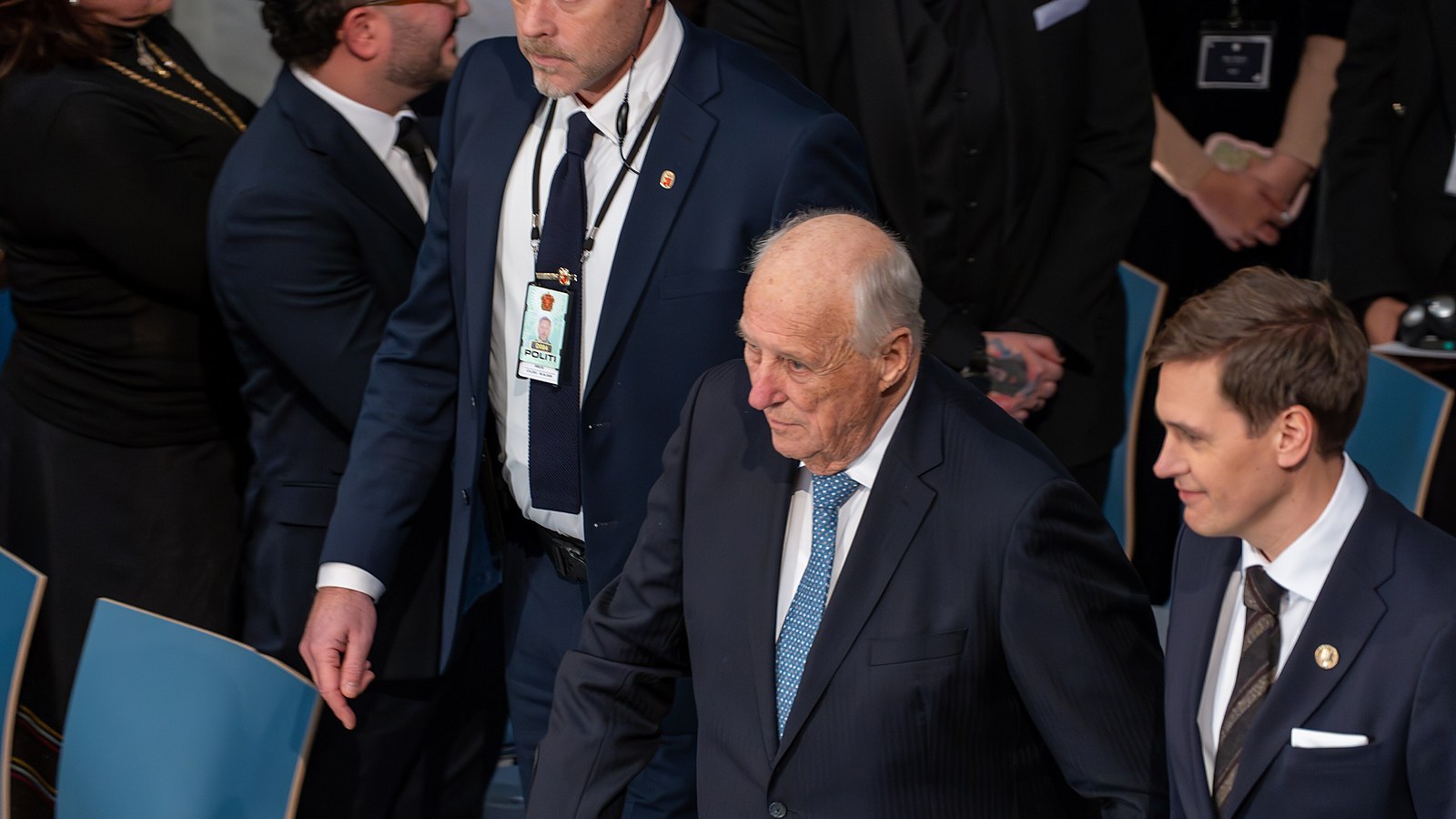
In January 2024, days after Denmark's Queen Margrethe — his second cousin — stunned Europe by abdicating, King Harald V of Norway was asked whether he would ever do the same. His answer was the oath he had sworn on taking the throne: "It lasts for life." On Friday morning it did. The palace announced that Harald died at 6:35 a.m. at the National Hospital in Oslo, where he was being treated for a rare blood condition. He was 89, Europe's oldest reigning monarch — and he died one day before his 58th wedding anniversary.
The succession was instant and silent, as Norwegian law provides. His son Crown Prince Haakon, 53, automatically became King Haakon VIII at the moment of his father's death — no coronation, no proclamation gap, no interregnum. He is only the fourth monarch of Norway's restored modern line, after Haakon VII, Olav V and his father. Norway, a democracy of 5.5 million where real power sits with an elected parliament and the crown's role is symbolic, woke to its first new reign in 35 years.
The grief was immediate and personal in a way that surprised no one who had watched the country with its king. Crowds gathered through the day to lay flowers and flags at the Palace Square in Oslo. Prime Minister Jonas Gahr Støre, in a televised memorial address, said the country was "united in grief and gratitude" for Harald's service and that his "legacy lives on." Oslo's mayor, Anne Lindboe, postponed her own wedding — it had been scheduled for Friday — and wrote in tribute: "It's hard to imagine an Oslo and a Norway without you. You didn't need a crowd to be King." Lindboe had announced her engagement in June after five years with her fiancé; no new date has been set, her office told the BBC. "Even the majority of Norwegians who never met you in person still felt like they knew you," she added — as concise a summary of Harald's standing as any offered on Friday.
A reign that began in exile
Harald's biography tracked the entire arc of modern Norway. Born in 1937 in Asker, outside Oslo, he was the first prince born on Norwegian soil since 1370 — a statistic that captures how young the modern Norwegian monarchy is. For more than five centuries Norway had no king of its own; his grandfather, Haakon VII, was elected to a newly restored throne in 1905, after the dissolution of the union with Sweden.
The institution nearly did not survive its fourth decade. Harald was three years old when Nazi Germany occupied Norway in 1940. To keep the line of succession out of German hands, his mother fled with him and his sisters, Ragnhild and Astrid, first to Sweden and then by boat to the United States, while his father and grandfather went into exile in Britain with Norway's government. Haakon VII's refusal to legitimise the occupation became the moral core of the monarchy's standing. The young prince spent the war as a guest of the White House, and carried out his first official duty at age six — christening new warplanes at a Norwegian air base in Canada. The family came home in June 1945.
The future king was then educated deliberately as an ordinary Norwegian: public schools, the Norwegian military college, then Oxford. Like his father — an Olympic sailing champion in 1928 — he lived for the water. He represented Norway at several Olympic Games, and in 1987, at age 50, he skippered his yacht to gold at the World Championships.
The commoner who became queen
The defining fight of his young adulthood was over whom he would marry. Urged for years to choose from the princesses of Europe, Harald refused — for nine years — until his father relented and permitted him to marry his school sweetheart, Sonja Haraldsen, a businessman's daughter and a commoner. King Olav V had feared the match would weaken a still-young monarchy. Instead, the wedding on August 29, 1968 was met with public jubilation, and Sonja became one of the most naturally accepted queens in Europe. Harald died the day before what would have been their 58th anniversary.
The marriage produced two children, Märtha Louise and Haakon — and, in time, a constitutional modernisation that outlived the tradition it broke. In 1990, Norway amended its constitution to give the first-born child precedence in the line of succession regardless of gender. The change was not applied retroactively, which is why Haakon, the younger sibling, succeeded on Friday rather than his older sister.
The speeches a country remembers
"I remain convinced that the belief in freedom is stronger than fear. I remain convinced in the belief of an open Norwegian democracy and society. I remain convinced in the belief in our ability to live freely and safely in our own country," King Harald told a memorial service after the July 2011 terror attacks.
Those sentences, delivered after a right-wing extremist murdered 77 people in Norway's worst peacetime atrocity, are the reason Norwegians of a certain generation speak of Harald less as a head of state than as the voice the country needed on its worst day. He did it again, unprompted, in 2016 — an impassioned garden-party speech in defence of refugees, religious minorities and LGBTQ+ Norwegians. "Norwegians are girls who love girls, boys who love boys, and girls and boys who love each other," he said, adding that his compatriots "believe in God, Allah, the universe and nothing." The speech was viewed millions of times and quoted around the world.
It was a distinctly Harald form of monarchy: no political power, deployed at precisely the moments politics could not reach. He took the throne on January 21, 1991, on the death of his father, and adopted the same motto his father and grandfather had used — "All for Norway." His reign coincided with the oil-and-gas boom that made Norway one of the wealthiest societies on earth, and through it he kept the institution deliberately modest, modern and close to the ground.
The last chapters
The final years tested the house more than the man. His daughter Märtha Louise stepped back from royal duties after claiming she could communicate with angels and becoming engaged to an American self-described shaman. In early 2026, his daughter-in-law Crown Princess Mette-Marit faced renewed scrutiny over her past contacts with the sex offender Jeffrey Epstein — she is accused of no wrongdoing, but publicly apologised to those she had "disappointed" — and her eldest son from a previous relationship, Marius Borg Høiby, who holds no royal title, was convicted of rape and sentenced to four years in prison.
Through all of it, the king's own standing barely moved. The scandals attached to the periphery of the house, never to the man at its centre — in part because he had spent five decades demonstrating that the centre asked nothing for itself. His health, though, was failing visibly: he was fitted with a pacemaker after falling ill on a 2024 holiday in Malaysia, and was hospitalised again with an infection in Tenerife this February. He worked until the end, declining every invitation to follow Margrethe's example. "It has been my experience that the monarchy stands strong," he once said. "This is not least because my father and grandfather did most things right. That puts me under pressure, but I take it as a challenge."
The tributes traced the web of Europe's interlinked crowns. Britain's King Charles III mourned his "dear cousin" — Harald was a second cousin of Queen Elizabeth II — and the new King Haakon VIII is a great-great-great grandson of Queen Victoria. But the more telling tributes were the domestic ones: a mayor's postponed wedding, a carpet of flowers on the Palace Square, a prime minister speaking of gratitude before grief.
Haakon VIII inherits an institution his father leaves in better condition than he found it — more popular than the century-old elected monarchy of 1905 had any right to expect, constitutionally modernised, and stress-tested by war, terror and tabloid alike. He also inherits its burden, which Harald defined better than anyone: a job whose only real power is moral, exercised in the moments a country needs one voice. The reign that ended Friday at 6:35 a.m. spent 35 years proving how much that can be worth.
This report is based on the announcement from the Norwegian Royal Palace and reporting by the BBC and NPR published August 28, including statements by Prime Minister Jonas Gahr Støre, Oslo Mayor Anne Lindboe and Buckingham Palace as quoted in that reporting. Funeral arrangements and the formal accession ceremonies for King Haakon VIII had not been announced at time of writing.