
NTSB data shows a pilot warned repeatedly that the Amazon 767 was going too fast, and got no consistent answer, before the aircraft overran the Miami runway by 1,300 feet
The investigation update describes an approach flown fast enough to trigger two automated warnings, with flaps extended late and one pilot's cautions continuing to the end of the recording. Everyone who died was on the ground. The aircraft stopped 300 feet beyond the safety area that regulation deemed sufficient.
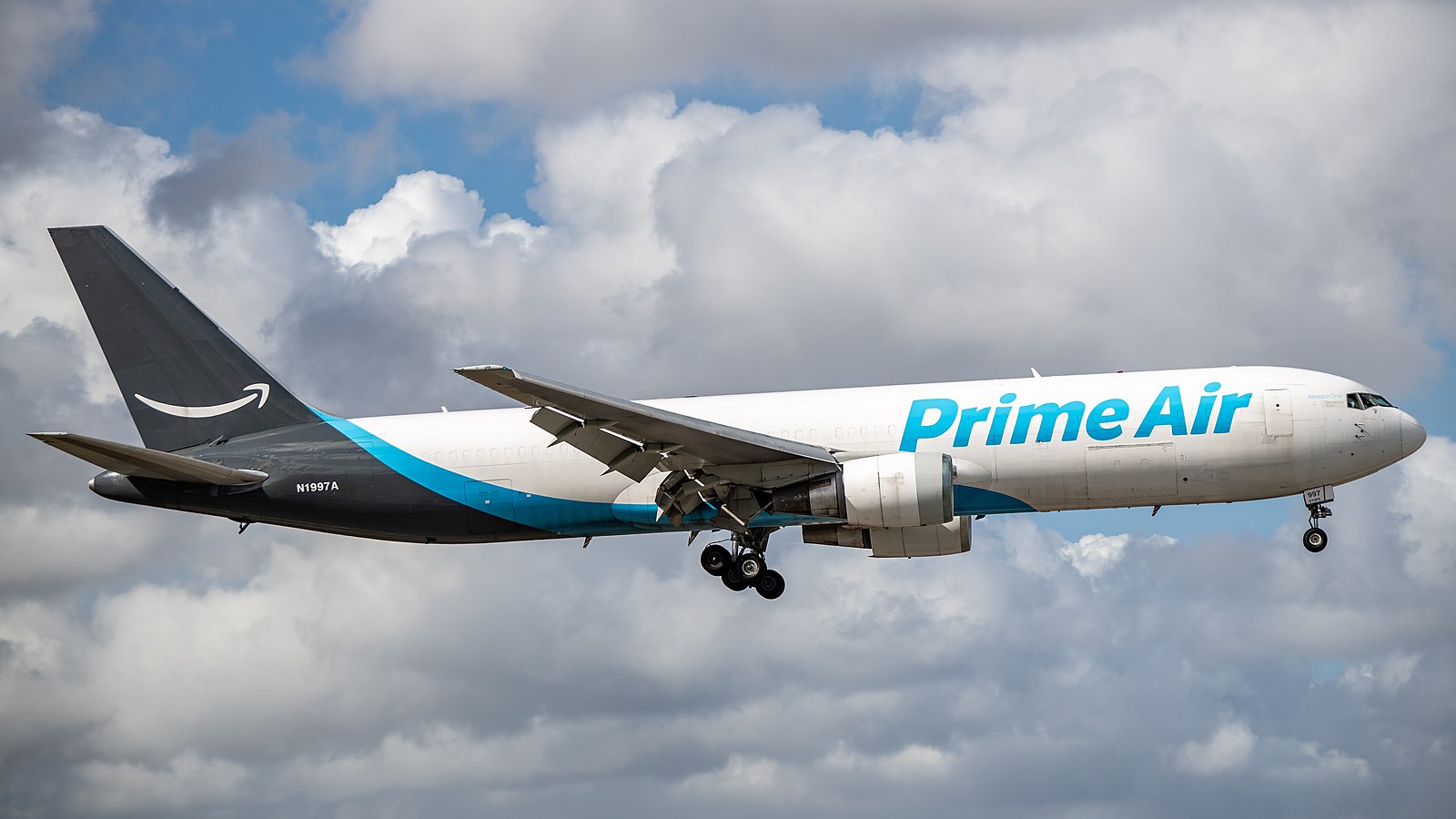
The most consequential sentence in the National Transportation Safety Board's investigation update on Amazon Prime Air Flight 7598 is not the one about speed. It is the one about the answer.
According to the update, released Thursday, one pilot warned the other in the cockpit multiple times about the aircraft's excessive speed. Those cautions continued, the NTSB said, throughout the remainder of the recording. And throughout that same period there was not a consistent verbal response.
A modern airline cockpit is designed around the assumption that a concern voiced by one pilot becomes a decision made by two. The entire discipline of crew resource management — built after a run of accidents in the 1970s and 1980s in which somebody on the flight deck knew and did not prevail — exists to convert the first half of that transaction into the second. The transaction requires a reply. What the NTSB has described is a cockpit in which the first half kept happening and the second half did not.
What the data records
The flight data released by the NTSB covers the Boeing 767-300's speed, altitude and flap deployment on approach, together with a summary of the conversation between the two pilots. The aircraft's landing speed was 158 knots, or about 292 kilometres per hour — a figure aviation specialists quoted by the BBC described as being at the high end.
Two automated callouts fired in the final minutes. The first was "sink rate, sink rate," the ground proximity warning system's alert that the aircraft is descending faster than the situation allows. The second was "too low terrain," which fires when the aircraft is close to the ground without being configured for landing. An altitude alarm also sounded during the period in which the speed cautions were being given.
Those are not subtle instruments. They are loud, unambiguous, and specifically designed to be impossible to work around. By the time both have sounded on the same approach, the aircraft is being told by its own systems that the approach is not recoverable in the configuration it is in.
Why late flaps are the tell
The detail that ties the sequence together is the flaps. Pablo Rojas, an aviation attorney, told CBS News — the BBC's US partner — that the flap data in the NTSB update is an area of concern. Flaps, located at the trailing edge of the wing, are, as he put it, "part of what helps the plane kind of slow down and gently approach a landing."
"The flap deployment here happened much later in the accident sequence," Rojas said. "That's maybe because the pilots were responding to the fact that they were going too fast."
This describes a trap that tightens on itself, and it is worth spelling out the mechanism because it explains why excess speed on approach is so much more dangerous than it sounds. Every stage of flap on a large aircraft carries a structural speed limit — extend it above that limit and you risk damaging the wing. So a crew that is fast cannot simply add drag to slow down: the drag device they need is locked out by the very speed they are trying to shed. They stay clean, they stay fast, and the aircraft arrives at the runway threshold carrying energy it has no remaining way to lose.
It really confirms that this was, in a way, a doomed approach.
That was Rojas's summary to CBS News, with the caveat that without the actual recording it is difficult to know precisely what the NTSB meant by an inconsistent verbal response. The caveat is the responsible part. The NTSB has released a summary of a conversation, not the conversation.
The physics of arriving fast
Kinetic energy rises with the square of speed, which is why a modest-sounding excess at touchdown becomes a large problem on the runway. An aircraft crossing the threshold roughly ten to fifteen per cent above its target speed does not need ten to fifteen per cent more runway to stop; it needs substantially more than that, before accounting for the extra distance covered while it floats above the surface refusing to settle. Landing distance calculations are built around a specific speed at a specific point, and they degrade quickly when that speed is wrong.
Flight 7598 overshot the runway. It struck ground equipment, hit a white Ford van, went through a perimeter fence, collided with a Toyota Corolla and came to rest about 1,300 feet — roughly 394 metres — beyond the end of the runway.
The 300 feet that regulation did not require
That distance is the fact that turns this from an aviation accident into a policy question. Miami International Airport is not equipped with an Engineered Materials Arresting System, the bed of lightweight cellular cement installed past a runway end that collapses under the concentrated weight of landing gear and drags an overrunning aircraft to a halt. A standard EMAS installation will stop most aircraft overrunning at up to 70 knots.
The airport is not in violation of anything. It appears to be in compliance precisely because it has a 1,000-foot runway safety area at the end of its runways — the buffer that the requirement was written to accept as an alternative to an arresting bed. Airports that cannot fit 1,000 feet of clear ground install EMAS. Airports that can fit it are permitted not to.
Flight 7598 came to rest at approximately 1,300 feet. It cleared the compliant safety area and travelled a further three hundred feet into the ground beyond it — through the fence, into a car, into the space where a van was parked. The regulation was satisfied and the aircraft went past the end of it anyway.
Who died
Five people were killed and five more injured. None of them were in the air. The five who died were members of a plane-cleaning crew sitting in the van the aircraft struck after leaving the paved surface. Miami authorities identified them on Tuesday: Rolando Aleman Leon, 55; Yoel Rodriguez Naranjo, 53; Julio C. Pineda, 75; Carlos Acosta Fajardo, 53; and Javierkys Reyes Quevedo, 47.
This is the part of runway-overrun risk that almost never features in the discussion of it. The people exposed to an aircraft that does not stop are, overwhelmingly, the ones working on the airfield: the cleaning crews, the fuellers, the baggage handlers, the drivers on the perimeter roads. They are not passengers who accepted a flight's risk. They are employees standing in a defined zone that somebody has calculated to be far enough away.
The counter-argument
There is a real case against reading the EMAS point too hard. Arresting beds are expensive, they are designed against a 70-knot overrun and would not necessarily have contained an aircraft that left the runway substantially faster, and they occupy ground that busy airports use for taxiways and approach lighting. The system has an excellent record — it has worked 26 times, six of them in Florida, and is credited with saving as many as 250 lives over the past decade, a requirement that traces back to the 1999 overrun at Little Rock that killed nine people — but a safety device that works at 70 knots is not a guarantee at any speed.
More importantly, EMAS is a last line. It exists to catch failures that have already happened. Nothing about an arresting bed addresses why an approach continued to touchdown after two ground proximity warnings, or why a repeated verbal caution from one crew member did not produce a go-around. The go-around is free, it is available until the moment of touchdown, and it is the specific remedy for exactly the condition the NTSB has now documented. The most valuable finding in this investigation will be about the seconds in which it was not called.
What comes next, and what is still unknown
The NTSB will publish a preliminary report in the coming weeks and a final report, with probable cause, considerably later — these investigations routinely run one to two years. Nothing released so far assigns cause, and the update is deliberately descriptive: it says what the recorders contain, not what it means. The identity of which pilot was flying, the crew's duty history, the aircraft's weight and configuration, weather at the threshold, and the full cockpit voice recording are all outstanding.
But the shape of the thing is already visible, and it is a shape the industry knows well. An unstabilised approach is not a rare or exotic event; airlines detect them routinely through flight data monitoring, and the standard operating procedure for one is unambiguous. Every element of this accident that involved the aircraft was survivable and reversible until the wheels touched. What was not reversible was the 1,300 feet — and the five people who were working inside them.
This report is based on the National Transportation Safety Board's investigation update released Thursday, September 10, 2026, on BBC News reporting of that update, on comments given to CBS News by aviation attorney Pablo Rojas, on identifications released by Miami authorities on Tuesday, and on reporting regarding Engineered Materials Arresting System coverage at Miami International Airport. The NTSB update is a factual release and does not state a cause; no probable cause has been determined and none should be inferred here. The summary of cockpit conversation is the NTSB's, not a transcript. Figures on EMAS activations and lives saved are as reported and are attributable to the Federal Aviation Administration's programme record.