
Nepal-Tibet flash flood kills at least 356 and leaves as many as 1,500 missing after a Himalayan glacier collapses
A wall of ice, rock and water came down the Lhende valley on Wednesday and did not stop for hundreds of miles. Most of the missing are foreign trekkers and pilgrims — 178 Indians, 65 Americans, 35 Australians, 33 Britons and 25 Canadians among them — and the roads and bridges rescuers would use to reach them are gone.
The first official explanation for what happened on the Nepal-Tibet border early Wednesday was an earthquake. It was wrong, and the correction tells you almost everything about the scale of what came down the mountain. The United States Geological Survey initially logged a magnitude-4.4 event beneath the Himalayan frontier north of Kathmandu. It later withdrew that reading and issued a rare clarification: what its instruments had recorded was not the earth moving but a mass of glacial ice and rock detaching from a mountainside and beginning to travel. No earthquake had occurred. The collapse itself was large enough to register as a seismic event.
By Thursday afternoon local time, Nepali police had recovered 353 bodies. Chinese state media reported three more dead on the Tibetan side. The count of the missing ran from roughly 1,400 to more than 1,500 depending on which register was being read, and almost half of them were foreign nationals — trekkers at the height of the post-monsoon season and Hindu and Buddhist pilgrims returning from Kailash Mansarovar, the high-altitude site across the border in Tibet that draws thousands of visitors through the Rasuwagadhi crossing every year.
What actually came down the valley
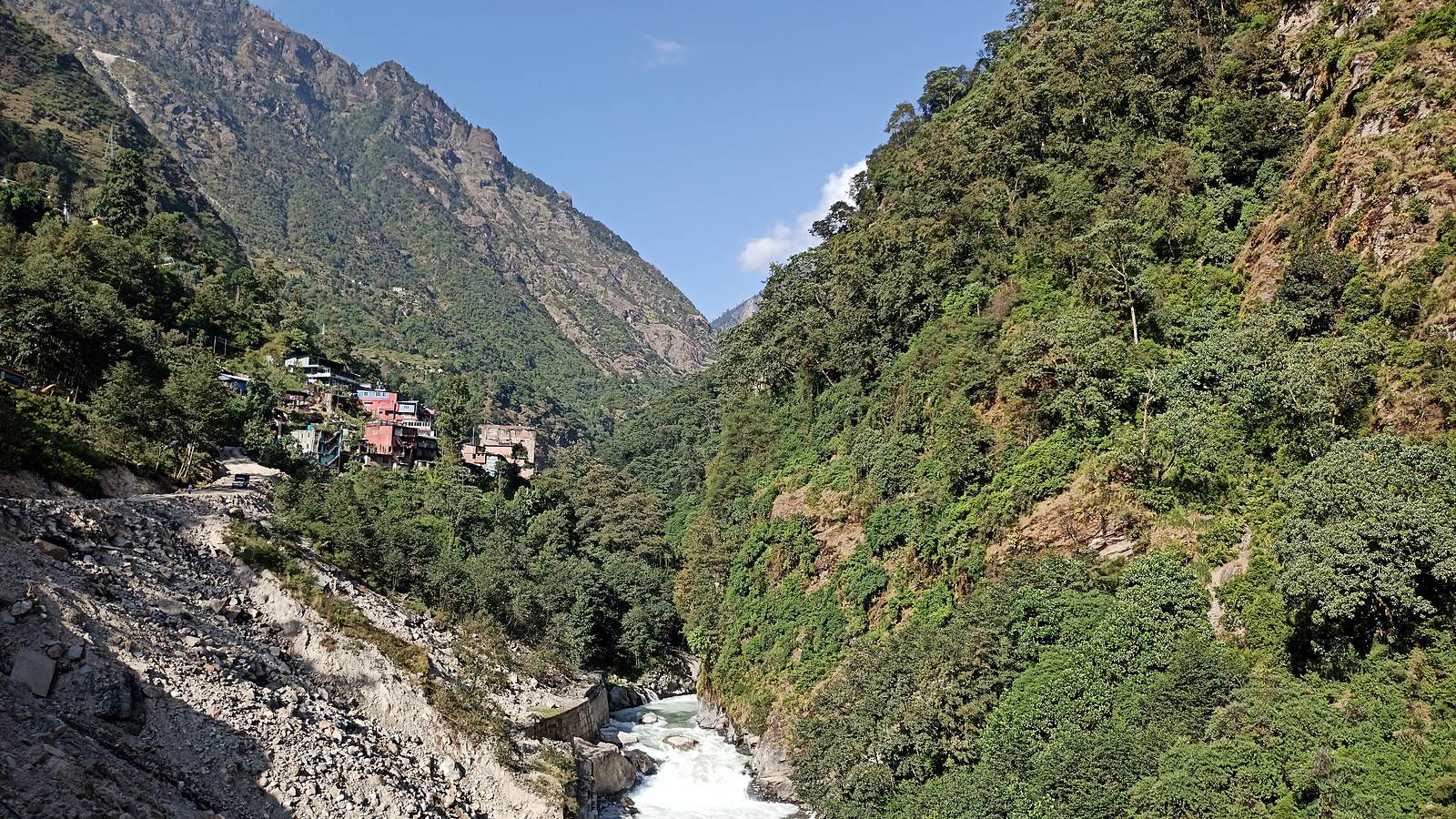
Nepal's national disaster authority, working from an initial reading of Planet Labs satellite imagery, placed the trigger about 12 miles north-east of the Rasuwagadhi border post, in the headwaters of the Lhende River. A landslide of ice and rock detached, entrained water and debris, and became what glaciologists call a debris flow — not a flood of water carrying sediment but a moving slurry of boulders, mud and ice with roughly the density of wet concrete and the speed of a train.
That distinction matters for why the death toll is what it is. A river flood rises; people climb. A debris flow arrives as a front, and the front in the surveillance video released from the Tibetan side of the border is a wall taller than the buildings it erases. Keshav Prasad Baral, a 68-year-old survivor being treated at a small hospital downstream, described it to reporters in exactly those terms: a gush of mud coming straight at him that kept rising as it got closer. He reached for his wife's hand to pull her onto a terrace roof. She was taken by the mud. A helicopter found him four or five hours later.
Bibek Kumal, a labourer working downstream in the worst-hit Rasuwa district, survived by grabbing a mango tree as the torrent carried him. "Had there been no mango tree, I would have been washed away to death," he said from his hospital bed.
Why the rescue is so slow
The flood destroyed dozens of bridges and roughly 25 miles of road through the mountains. In a region where a single highway follows each river and there is no second route, that is not an inconvenience but a severing. Rescuers cannot drive to most of the affected settlements, which is why the Nepali army's helicopter fleet — which had lifted more than 100 people out by Thursday morning — has become the entire ground game rather than a supplement to it.
The damage also took the power out. Hydroelectric plants along these rivers are built exactly where a debris flow does the most damage, on the valley floor beside the water. In Nuwakot and Dhading, two of the hardest-hit districts, families gathered outside an army training centre being used as a helicopter base, and police recorded the names of the missing at the gate by the light of mobile phone torches because there was no electricity.
David Fisher, who heads the International Federation of Red Cross and Red Crescent Societies delegation in Nepal, said entire villages and market areas had been wiped out. The village of Soley in Nuwakot, which had about 25 homes, was effectively erased. A Kathmandu-based journalist with family there, Nirajan Paudyal, travelled to the district on Thursday looking for news of his parents. There was none. "I fear there won't be any update," he said.
Everything is gone. My childhood, my family, my community.
That was Santa Tamang, a 25-year-old university student whose family carried her elderly grandmother to high ground and watched their house go. Bodies have since been recovered hundreds of miles downstream in Chitwan district, which gives the geographic reach of the event more clearly than any casualty figure: material picked up on the Tibetan border was deposited in Nepal's lowland plains.
There is a second cost queued behind the first. The Rasuwagadhi corridor is one of only two functioning road crossings between Nepal and China, and the hydropower cascade along the Trishuli and its tributaries supplies a meaningful share of Nepal's domestic generation. Both were built on the valley floor because there is nowhere else to build them. Nepal has spent a decade trying to end its dependence on imported Indian electricity by developing exactly these rivers, and a single afternoon has taken out an unknown fraction of that programme along with the road used to maintain it.
A disaster with an unusually international casualty list
Nepal's police and tourism officials put the number missing inside Nepal at 826, of whom almost 600 were foreigners. The Nepal Tourism Board's own running tally reached 644 overseas nationals unaccounted for: 178 from India, 65 from the United States, 35 from Australia, 33 from Britain and 25 from Canada, with dozens of other nationalities in smaller numbers. Chinese officials reported 558 missing on the Tibetan side, at least 260 of them foreign.
One tour operator, Himalayan Glacier, said 47 people from a single group were unaccounted for, including two children — 15 Australians, 10 Canadians, nine Nepalis, eight Americans, two Britons, two Singaporeans and a Russian-American dual citizen. That one company's manifest explains the diplomatic scramble now under way. Australian officials said they were working around the clock to check the welfare of citizens, with children as young as 11 on the missing list; Prime Minister Anthony Albanese acknowledged that getting reliable information remained difficult.
The pilgrimage traffic compounds it. Kailash Mansarovar is reached overland from Kathmandu through Rasuwagadhi, which means the corridor that was destroyed is the same corridor that carries most of the region's religious tourism. The people on it were, by definition, not local, not registered with any single authority, and in many cases travelling without mobile coverage.
The response, and the part nobody can promise
United Nations Secretary-General António Guterres said UN teams and partners were mobilising supplies and personnel. The United States announced $500,000 in emergency assistance. On the Chinese side, Xinhua reported nearly 800 emergency workers deployed with 150 vehicles, sniffer dogs and speedboats, and Premier Li Qiang travelled to the border area on Thursday to oversee the search — a level of political seniority that signals Beijing expects its own casualty figures to rise.
Nepal has moved dozens of the injured to Kathmandu for advanced care. But search-and-rescue in a debris flow is not the same problem as search-and-rescue in a flood, and the officials running it know it. Victims are not in the water; they are under several metres of consolidated mud and rock that sets as it dries. The window in which heavy equipment can recover survivors closes within days, and most of the affected sites still cannot be reached by anything with wheels.
The hazard is getting worse, and it is not well monitored
Events of this kind — glacial and rock-ice avalanches that convert into long-runout debris floods — are the Himalayan hazard that experts have warned about most consistently and prepared for least. The extreme relief of these valleys means a collapse at 5,000 metres has thousands of metres of vertical drop in which to accelerate and pick up mass. Warming has been destabilising the ice and the frozen ground that holds the rock together at exactly those altitudes.
There is no equivalent of a hurricane track here. The 2021 Chamoli disaster in the Indian Himalaya, which killed around 200 people and destroyed two hydropower projects, was also a rock-and-ice avalanche that nobody saw coming and that was also initially misattributed to a glacial lake burst. Five years later, the density of instrumentation on the Nepal-Tibet frontier has not meaningfully changed, and the settlements and hydropower plants in the runout zones have multiplied.
The USGS correction is the detail worth keeping. The most sophisticated global seismic network in existence detected this event and, for several hours, told the world it was an earthquake. The warning that would have mattered — minutes, not hours, delivered to the valley floor below — does not exist anywhere along this border. Building it is a solvable engineering problem. It has simply never been funded, in a region where the people who would benefit are among the poorest on the continent and the people who die alongside them, as this week made plain, arrive from everywhere else.
This report is based on figures released by Nepal Police, the Nepal Tourism Board, Nepal's National Disaster Risk Reduction and Management Authority, the US Geological Survey, Chinese state media and international news agencies as of Thursday afternoon local time. Casualty and missing-person counts in the first 48 hours of a disaster of this kind are provisional and have been revised repeatedly.