
Trump approves death by Army firing squad for Fort Hood shooter Nidal Hasan — the first US military execution since 1961, if the civilian courts let it go ahead
Seventeen years after he killed 13 people at a Texas Army base, Hasan's sentence has the presidential approval federal law requires. The Pentagon says the Secretary of the Army will set a time and place. The last soldier whose death sentence a president signed is still alive on the same death row, 18 years later.
The last time a president of the United States approved a soldier's death sentence was July 2008, when George W. Bush signed off on the execution of Ronald Gray, a former Army specialist convicted of murders and rapes at Fort Bragg in the 1980s. Gray is still alive. He has spent the 18 years since in the US Disciplinary Barracks at Fort Leavenworth, Kansas, while his case moved through the civilian federal courts. That history is the context for Monday night's announcement that Donald Trump has approved the execution of Nidal Hasan by an Army firing squad.
Chief Pentagon spokesman Sean Parnell announced the decision in a post on X late on Monday. 'Secretary of War Pete Hegseth has recommended — and President Donald J. Trump has approved — death by U.S. Army firing squad for convicted terrorist Nidal Malik Hasan, the jihadist who opened fire on unarmed American soldiers at Fort Hood in 2009,' Parnell wrote. 'The Secretary of the Army will set the time and place of the execution. Judgement day for Hasan has finally come.' Hegseth reposted it with a single word: 'Justice.'
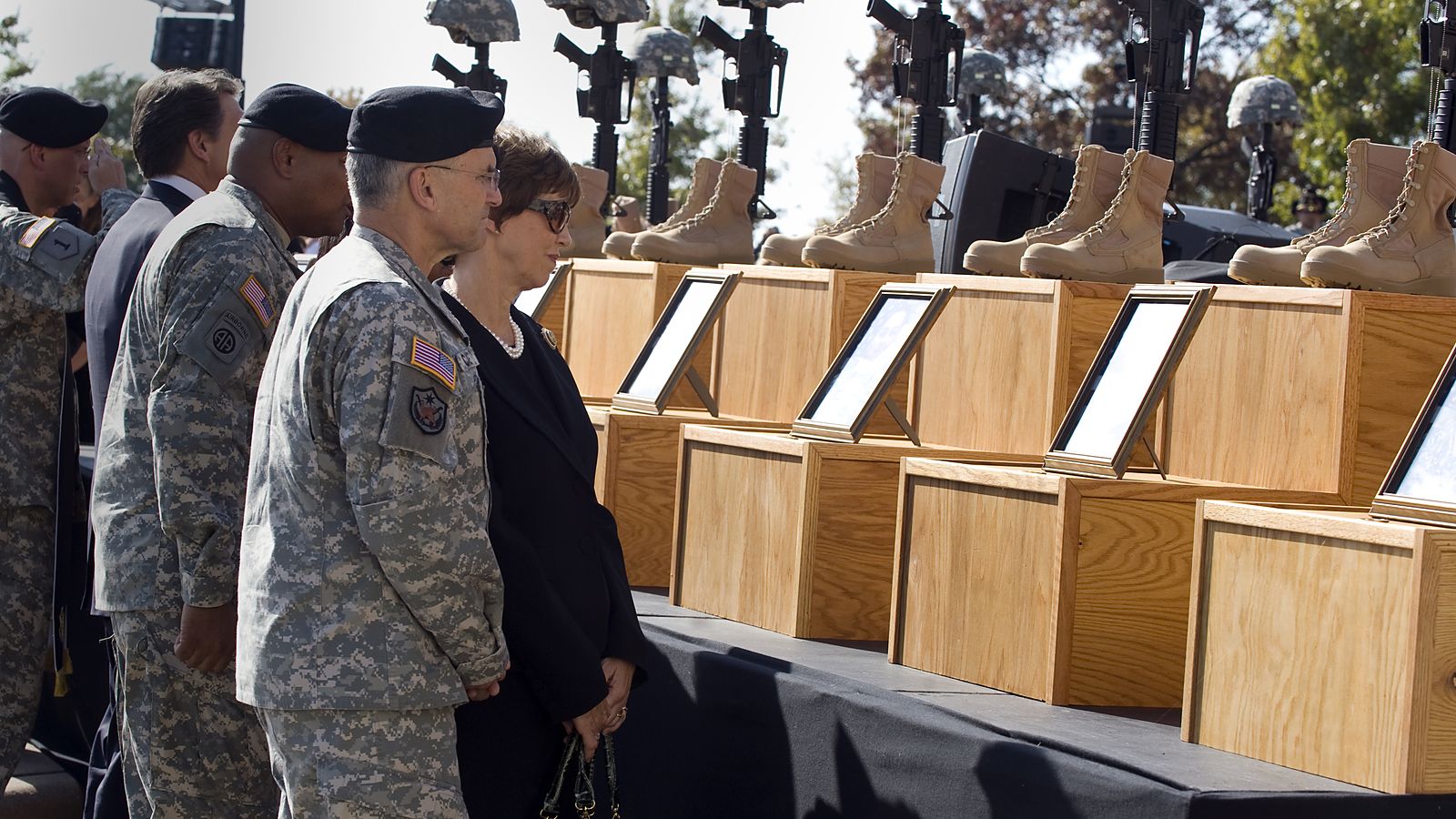
Hasan, now 56, was an Army major and psychiatrist on November 5, 2009, when he walked into the Soldier Readiness Processing Center at Fort Hood, near Killeen, Texas, and opened fire with a handgun on soldiers preparing to deploy. He killed 13 people, 12 of them active-duty soldiers and one a retired serviceman working as a civilian, and wounded 32 others, according to the Pentagon. One of the dead was pregnant. Police shot him at the scene, leaving him partially paralysed. The attack came weeks before he was himself due to deploy to Afghanistan.
A defendant who did not defend himself
At his court-martial in August 2013, Hasan represented himself and made almost no effort to contest the charges. He told the judge he had acted to protect the 'leadership of the Islamic Emirate of Afghanistan, the Taliban,' and that the shooting was an effort to stop soldiers going to Afghanistan to kill fellow Muslims. His court-appointed standby lawyers clashed with him openly, telling the court they believed he was deliberately seeking a death sentence. A military jury convicted him on 13 counts of premeditated murder and 32 of attempted premeditated murder and sentenced him to death.
The appeals ran for more than a decade. The Army Court of Criminal Appeals affirmed the sentence. The Court of Appeals for the Armed Forces, the military's highest court, upheld it unanimously in September 2023, Military Times reported. Hasan then asked the US Supreme Court to hear a claim that the judge had violated his right to a public trial by clearing the courtroom to discuss his disputes with his standby counsel. The court declined on March 31, 2025, according to CNBC, exhausting his direct appeals.
That is when Hegseth moved. In September 2025 he told The Hill he had asked Trump to approve the execution. 'I am 100 percent committed to ensuring the death penalty is carried out for Nidal Hasan,' he said then. 'This savage terrorist deserves the harshest lawful punishment for his 2009 mass shooting at Fort Hood. The victims and survivors deserve justice without delays.' Monday's announcement was the answer, thirteen months later.
Why a president has to sign
The requirement is statutory. Under the Uniform Code of Military Justice, a death sentence imposed by court-martial cannot be carried out until the president personally approves it. That provision is the reason military death sentences have become, in practice, sentences of indefinite confinement. Legal experts have observed for years that troops continue to receive death sentences while presidents have lacked the will to sign them. Bush's 2008 approval of Gray's sentence was the first since Dwight Eisenhower approved the execution of Private John A. Bennett in 1957.
Bennett was hanged at Fort Leavenworth on April 13, 1961, for the rape and attempted murder of an 11-year-old girl in Austria, after President John F. Kennedy declined a last-hour plea for clemency. He remains the last person executed by the US armed forces. According to the Death Penalty Information Center, Hasan is one of four men currently under military death sentence, all held at Fort Leavenworth and all convicted of premeditated or felony murder.
The method is the Army's choice. Army Regulation 190-55, the service's rule on military executions, leaves the manner of death to the Secretary of the Army, and the Death Penalty Information Center reported in June that internal Army plans reviewed by ABC News contemplated carrying out any execution at the federal death chamber in Terre Haute, Indiana, rather than at Leavenworth. The Pentagon has not said where or when Hasan would be shot.
Judgement day for Hasan has finally come. — Sean Parnell, chief Pentagon spokesman, in a post on X on October 5, 2026
The return of the firing squad
A firing squad would be rare but not unprecedented in modern America. South Carolina carried out three executions by firing squad last year, the first in the United States since Utah shot Ronnie Lee Gardner in 2010. The federal government has historically used lethal injection, but in April the Justice Department directed that other methods, including firing squad, electrocution and lethal gas, be considered, Al Jazeera reported. The military's own last use of the method, according to the Death Penalty Information Center, was an execution 'by musketry' in November 1945.
Supporters of the method argue it is faster and more reliable than lethal injection, which has been plagued by botched procedures and drug shortages. Opponents call it a deliberate return to spectacle. For the Trump administration, which has pressed the Justice Department to resume and expand federal executions, the symbolism of soldiers executing a soldier who murdered soldiers is plainly part of the point.
What could still stop it
Presidential approval ends the military appeals. It does not end the litigation. Hasan can now file a petition for habeas corpus in the civilian federal courts, challenging his conviction and sentence on constitutional grounds, and that route can take years. The Associated Press, reporting the approval, noted that such a petition could put the execution on hold 'potentially for years.' Gray's case is the proof: his habeas litigation has run since 2008, through district court and the Tenth Circuit, and he has not been executed.
Hasan's lawyers had not commented by Tuesday morning; CBS News said it had reached out to his attorney. Whether he will fight is itself uncertain. He sought to represent himself at trial, resisted efforts to spare his life and has described his sentence in terms that suggest he regards it as martyrdom. A condemned prisoner who declines to file habeas claims, as some have, would shorten the timeline dramatically. One who files them could extend it past the end of this presidency.
There is also the question of the four-man death row itself. A decision to execute Hasan but not Gray, whose sentence has carried presidential approval for 18 years, would invite the argument that the military is choosing whom to kill by the notoriety of the crime. The Army has not addressed it.
The durable fact
The victims' families know how long the system can take, because they have already waited once. The Army initially classified the Fort Hood attack as workplace violence rather than terrorism, a designation that denied the dead and wounded combat-related benefits and honours. It took an act of Congress changing the eligibility criteria before the Army announced in 2015, more than five years after the shooting, that the soldiers killed and injured would receive the Purple Heart and the civilian victims the Defense of Freedom Medal. Many of the same families lobbied Hegseth for Monday's decision.
For the families of the 13 dead and the 32 wounded, Monday's announcement is the first concrete movement toward the sentence a jury handed down thirteen years ago. For the military justice system, it is a test of a provision that has not been exercised to completion in 65 years. The gap between those two things, between a sentence approved and a sentence carried out, is where the Gray case has lived for nearly two decades, and it is where the Hasan case now goes.
What is certain is narrower than the Pentagon's language suggests. The president has approved. The Secretary of the Army has the authority to set a date and a method. No date has been set, no court has yet been asked to intervene, and the one precedent for a presidentially approved military execution in the modern era is a man who is still alive.
This report is based on the Pentagon's statement of October 5, 2026, as posted by spokesman Sean Parnell, and on reporting by CBS News, CNBC, the Associated Press and Al Jazeera; the Death Penalty Information Center's records on military capital punishment; and the published appellate history of United States v. Hasan. No execution date has been set. Whether Hasan will seek habeas corpus review in the federal courts was not known at the time of writing.