
Russia's nine-hour barrage on Kyiv kills at least 16 and hits a children's hospital — and Ukraine is running out of the only missiles that can answer it
The overnight assault combined 168 drones with cruise, ballistic and hypersonic missiles, drove 38,000 people into the metro and, the city's mayor says, purposefully targeted critical infrastructure for the first time in months. It landed as US deliveries of Patriot interceptors run at a third of last year's level, and hours before Romania destroyed an explosive-laden naval drone off its own coast. An analysis of a war being decided by arithmetic.
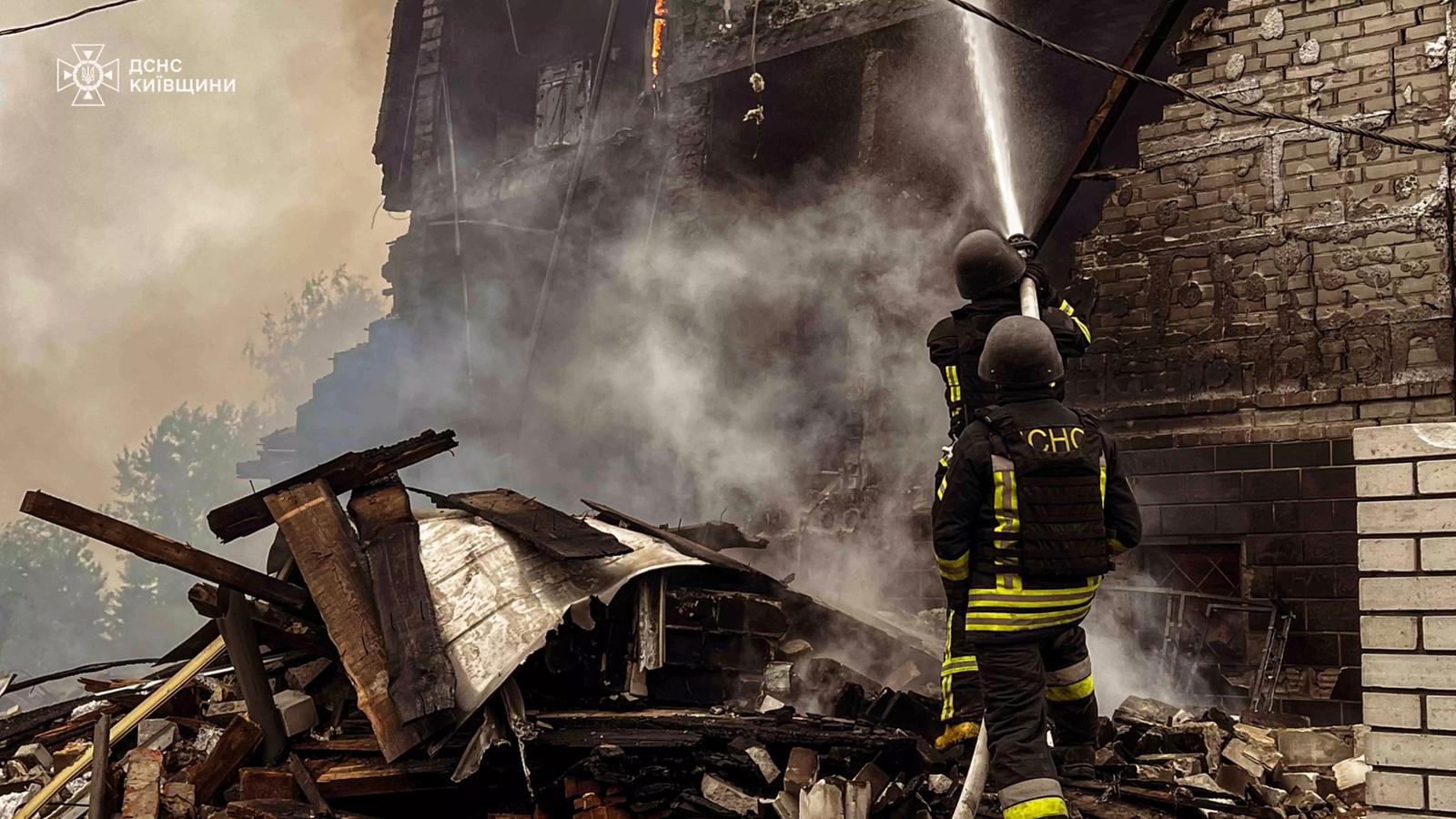
The explosions began in the early hours of Thursday and did not stop for nearly nine hours. By morning, at least 16 people were dead — 15 in the capital and one in the surrounding region, with tolls still being revised upward — and more than 38,000 Kyiv residents, among them over 2,000 children, had spent the night on the platforms of the metro. It was one of the heaviest attacks on the Ukrainian capital this year, and by the account of the man responsible for running the city, one of the most deliberate.
Ukraine's air force said Russia launched dozens of cruise missiles alongside ballistic and hypersonic weapons, together with 168 drones. The defence held better than the toll suggests: 41 cruise missiles and 145 drones were shot down or electronically suppressed — nearly 90 per cent of the drones and most of the cruise missiles. But munitions still struck 28 locations across the country, twelve of them in Kyiv's Darnytskyi, Sviatoshynskyi and Solomianskyi districts. President Volodymyr Zelensky said Russia "had been preparing it for a long time, combining different types of ballistic missiles, cruise missiles and drones, aiming to cause as much damage as possible to civilian infrastructure."
In Solomianskyi, a nine-storey residential building partially collapsed and burned; rescuers spent the day pulling bodies from the rubble while families watched. The district's children's hospital had its windows blown out, with vehicles burning in the street outside. Zelensky's accounting of the night ran to 30 residential buildings, a school, a kindergarten and the hospital. Two fuel and industrial facilities were struck, warehouses burned in Boryspil, and parts of two districts lost power.
A rocket hit the roof. It was incredibly loud. Immediately, debris and doors were blown out. There were columns of smoke, columns of fire, screams, crying and despair. — Larysa Bondaruk, Kyiv resident, to the Associated Press
Mayor Vitali Klitschko said people were trapped in the damaged buildings, and added the detail that gives the night its significance: the attack purposefully targeted the city's critical infrastructure — the first such strike in several months — and residents of Desnianskyi and parts of Dniprovskyi district should expect interruptions to their hot-water supply. Russia's defence ministry described the targets as military-industrial facilities, a transport and logistics centre, and warehouses. Beyond the capital, strikes hit gas infrastructure in Chernihiv region, a Ukrainian-Moldovan border crossing in Odesa region, and sites in Zhytomyr, Kherson, Kharkiv and Donetsk.
The interceptor math
What made Thursday survivable was air defence; what makes the pattern alarming is that Ukraine's air defence is being spent faster than it is being replaced. On August 5, a two-hour barrage on the Kyiv region killed 17 people — and that night, NPR and RFE/RL reported, Ukraine's depleted batteries intercepted none of the incoming missiles at all. Large-scale strikes have become, in NPR's phrase, almost routine this summer.
Russia has reorganised its air war around a specific gap. The New York Times, under the headline that a missile barrage shows Russia's doubt that Ukraine can defend itself, reported that Moscow fired 126 ballistic missiles at Ukraine in July — a monthly record for the full-scale war. Ballistic missiles matter because only one weapon in Ukraine's arsenal can reliably stop them: the American-made Patriot. Assessments cited by the Associated Press put Russian production at more than 200 cruise and ballistic missiles a month, with stockpiles above 1,100 cruise missiles and around 130 Iskander-M ballistic missiles.
The other side of the ledger is thinner. US deliveries of Patriot interceptors in 2026 have run at roughly one-third of last year's level, PBS NewsHour reported — a shortfall worsened by competing demand from America's own war with Iran, which draws on the same interceptor stocks. Zelensky's response on Thursday was less a statement than an invoice: "The interceptors for Patriot systems have not yet been replaced, and they are needed every day. Each additional missile saves the lives of our people." The world's response to such attacks, he added, is not always adequate.
A war on the things that keep a city alive
The return to infrastructure targeting lands with particular weight in late August, with the heating season weeks away. Klitschko told the Kyiv Post this month that roughly 4,000 of Kyiv's 12,000 buildings — every third structure in the city — have now been damaged in the war, and that each major strike costs the city around 500 million hryvnias to repair. If Thursday marks the resumption of the systematic campaign against power and heat, Kyiv enters this winter with fewer interceptors than in any previous year of the war.
The targets are not only physical. Reuters reported this month that Russian strikes have destroyed more than 10 million Ukrainian books since spring — around 8 million of them in a single drone strike on the children's publisher Ranok's Kharkiv warehouse on August 1, the biggest blow to Ukrainian publishing of the war, plus some 900,000 across two warehouses of the Kyiv publisher BookChef. "It's a terrible sight to see books burning," Ranok's director Viktor Kruhlov told Reuters, calling it a deliberately planned attack. Ukraine's education minister says the point is the destruction of Ukrainian language and history. Reuters frames it all as a war of endurance against an economy running a fifth below its pre-invasion size, with growth forecasts cut to 1.1 per cent and 60 per cent of state spending going to defence.
The war keeps crossing the border
The same night Kyiv burned, the war brushed against NATO territory twice. A Russian drone crossed into Romanian airspace at 3:21am near Galati and crashed in an uninhabited area of Tulcea County; two Spanish F-18s on NATO air-policing duty scrambled to track it. Poland activated its military aviation and air defences. Moldova reported a suspected Shahed drone in its airspace the same night. Ukraine's foreign minister, Andrii Sybiha, said Moscow is increasingly testing the resolve of NATO and its partners.
Hours later, Romania acted on a different threat entirely: its F-16s destroyed an explosive-laden naval drone drifting near the Neptun Deep gas platform in Romania's Black Sea economic zone — the field due to make Romania the EU's largest gas producer next year. The strike was ordered, defence minister Radu Miruta said, to protect the several hundred workers on the platform and secure critical infrastructure. Ukraine confirmed the drone was not its own; President Nicusor Dan blamed what he called the intensification of irresponsible incidents on the part of the Russian Federation, and Romanian divers had already destroyed two drifting drones in the same waters nine days earlier.
European Commission President Ursula von der Leyen tied the two stories together within hours. "An escalating campaign of threats is underway, unsettling our citizens and seeking to divide our Union. This is hybrid warfare," she wrote. More concretely, she said she would work with member states and partners to get anti-ballistic capabilities to Ukraine as an urgent priority — a direct answer to the arithmetic of the Patriot shortage.
What happens next
Ukraine is not only absorbing blows. Russia's defence ministry claimed to have downed 726 Ukrainian drones between Wednesday evening and Thursday morning — a figure that cannot be verified but would rank among Kyiv's largest drone operations of the war — and Ukrainian strikes were reported against an oil refinery in Tatarstan and a fuel terminal on the Krasnodar coast. Both sides, in other words, spent the same night going after the other's infrastructure.
The diplomatic track offers little relief. US-mediated talks stalled earlier this year over territory — Russia demands all of the Donbas; Ukraine refuses to withdraw from land it still holds — and Zelensky's argument to Western capitals has hardened into a single proposition: Moscow will not negotiate seriously while Ukraine's skies are open. Thursday's nine hours were Russia's case that they are. The 126 missiles of July, the empty launchers of August 5 and the interceptors that never arrived are the numbers behind it. Wars of endurance are decided by supply, and right now only one side's supply is growing.
This analysis draws on reporting by the Associated Press, Reuters, the New York Times, CNN, NPR, PBS NewsHour, RFE/RL, Al Jazeera and AFP, with additional figures attributed inline to the Kyiv Post and Ukrainian official statements. Casualty figures are as confirmed on the afternoon of August 20, 2026 and may rise.