
Micron's quarterly revenue went from $9.3 billion to $41.5 billion in a single year — and its chief executive says the memory cycle is finished
The most reliably cyclical business in semiconductors just posted an 84.6 percent gross margin, guided to $50 billion for the current quarter and started pouring $50 billion of concrete in Boise. Sanjay Mehrotra says AI has permanently changed the equation. His own stock fell 29 percent in July.
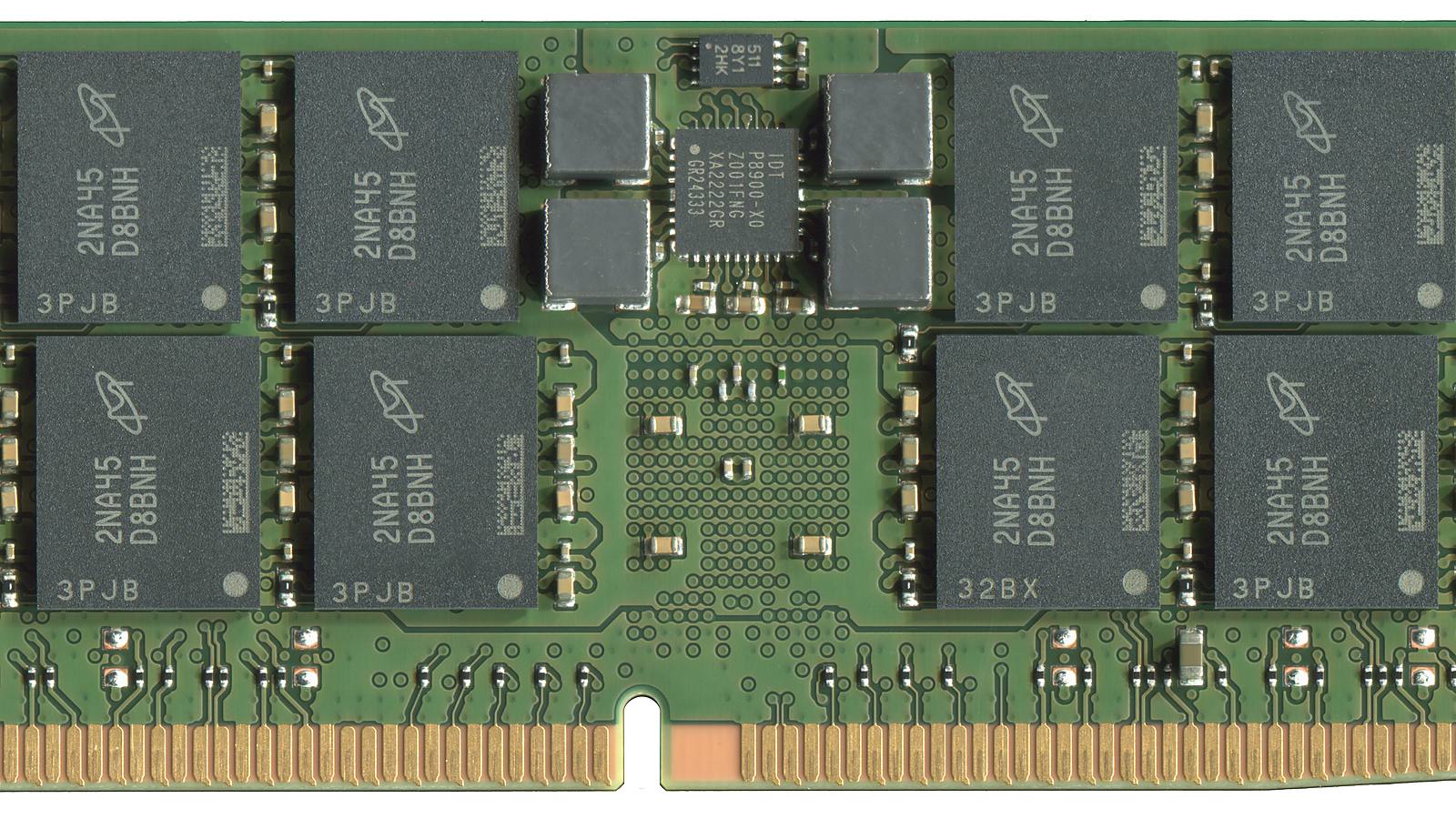
For most of its half-century, Micron Technology was the least glamorous company in the semiconductor industry: a maker of a commodity, headquartered a two-hour flight from Silicon Valley, whose share price was a barometer of a chip cycle nobody could predict and everybody had to survive. In its fiscal third quarter, which ended May 28, the company reported revenue of $41.46 billion. A year earlier, the same quarter produced $9.30 billion.
The rest of the results are the sort of numbers that usually indicate a typo. Gross margin came in at 84.6 percent on a GAAP basis. Net income was $28.24 billion, or $24.67 a diluted share. Operating cash flow was $25.39 billion against $4.61 billion in the year-ago quarter, while net capital expenditure was $7.1 billion — meaning Micron generated more than three dollars of operating cash for every dollar it spent building the plants everyone says it needs. Wall Street's consensus, per LSEG, had been $35.84 billion in revenue. Micron beat it by more than five and a half billion.
Then it guided higher. For the quarter now ending, the company told investors to expect roughly $50.0 billion in revenue, give or take a billion, at a gross margin near 86 percent, with non-GAAP earnings of about $31.00 a share. "Micron's record fiscal Q3 financial results and even stronger outlook for Q4 reflect the strategic value of memory in the AI era," chairman and chief executive Sanjay Mehrotra said. "Micron is investing at record levels in technology, products and supply to address our customers' rapidly growing demand."
The claim underneath the numbers
Any memory executive can report a good quarter. What Mehrotra has been arguing since is far more contentious: that the industry's defining feature — the boom-and-bust cycle in which strong demand invites new capacity, new capacity produces a glut, and the glut destroys pricing — no longer describes the business he runs.
"Today there is no AI without memory. AI systems need more memory. They need higher performance memory. They need lower power memory," Mehrotra told CNBC's Jim Cramer on Thursday, speaking from Boise. "So, the value of memory, that equation has totally changed." He has a phrase he repeats: "Memory is no longer the component in a system. Memory is the strategic infrastructure for AI."
That is a marketing line with an operating thesis behind it. Mehrotra — an engineer with more than 40 years in the industry who co-founded SanDisk before joining Micron nine years ago — says the way memory is bought has changed. Instead of customers taking bids and awarding the order to whoever quotes the lowest price per gigabyte, memory is now designed alongside the processors and systems it will serve. "We are working closely with them earlier and earlier in their development cycle," he said.
The commercial expression of that shift is contractual. On its late-June earnings call the company disclosed five-year strategic agreements with 16 customers, and Mehrotra says more have been signed since. "They have committed to taking the supply," he said. "So, this gives us assurance of demand." For a business whose historical exposure was to the spot market, multi-year committed volume is the single most important structural change available — and the one that would most plausibly justify calling the cycle dead.
For now, the constraint is in the other direction. Mehrotra says data-center customers currently want roughly 50 percent more supply than Micron is able to commit to, and that the shortage extends across the product line: "All our customers across our end markets will buy everything that we make."
Fifty billion dollars in Boise
The physical answer to that shortage is being poured into the ground beside Micron's headquarters. The company is spending roughly $50 billion on two new fabrication plants in Boise, part of a planned $250 billion investment in U.S. manufacturing and research through 2035, supported by up to $6.2 billion in CHIPS Act funding awarded under the Biden administration. Each fab is about the footprint of ten football fields; Mehrotra says a single one contains enough steel rebar to circle the Earth twice.
The first is scheduled to produce wafers in the middle of next year, which would make it the first front-end facility in the United States turning out leading-edge memory — a category currently manufactured almost entirely in Taiwan, Japan and Singapore. A larger campus is planned for Clay, New York. The long-term target is to make 40 percent of Micron's DRAM domestically. Last week the company added Micron Research Labs, headquartered in Boise and backed by $10 billion over the next decade, with construction due to start next year.
The buildout is expected to create more than 17,000 jobs in the area, including 3,500 at Micron, which already employs about 7,000 people in and around a city of roughly 250,000. Boise is discovering what that does to a place. Average rents there have risen 4.3 percent over the past year, according to Zillow, while the national average fell. Meta is building an $800 million data center 20 miles southwest in Kuna. Suppliers including Lam Research and the cleanroom builder Exyte have opened local offices. Wealth managers report clients holding Micron stock that has gone up more than tenfold since the end of 2024, and the awkward conversation that follows: "You've got a boatload of money now, and it's all tied up in one company."
The bill arrives downstream
The shortage Mehrotra describes does not stay inside his industry. High-bandwidth memory is built by stacking the same DRAM that goes into ordinary computers — DRAM was 76 percent of Micron's revenue last quarter — and as HBM consumes global DRAM supply, the price of memory everywhere has risen. That has already shown up in the cost of consumer electronics, including Apple's MacBooks and iPads.
It is now showing up at the top of the AI stack as well. Nvidia plans to raise prices on servers containing its Vera Rubin and Grace Blackwell chips by more than 15 percent in many cases, Bloomberg News reported on Saturday, with the increase depending on the chip generation and the memory configuration and taking effect on systems shipped next year. Nvidia has been absorbing soaring memory costs. Micron is one of three companies — with market leader SK Hynix and Samsung, both building mega-fabs at home in South Korea — able to supply the part that is causing them.
All three have been rewarded accordingly. Micron is up nearly 670 percent over the past year, SK Hynix about 470 percent and Samsung more than 250 percent; Samsung last week announced a shareholder-return package of up to $80 billion. Micron's market capitalization passed $1 trillion, a threshold no memory maker had approached, and the rally briefly made Mehrotra a billionaire.
The 29 percent reminder
Briefly, because in July the stock fell 29 percent — its worst month since 2002 — and pushed him back below the mark. It has recovered about 14 percent so far in August. Shareholders would like to read July as a correction in a rising market. The alternative reading is the one the industry's history supports: that a business selling every unit it can make at an 85 percent margin is precisely the business that attracts the capacity that ends the party, and that the three suppliers now racing each other to build mega-fabs are, collectively, constructing the glut.
Mehrotra's counterargument is that the demand is no longer a single product cycle. He expects autonomous vehicles, robots and AI-enabled consumer devices to require steadily more memory, and he points at the five-year agreements as evidence that customers believe it too. The honest assessment is that both propositions can be true at once: memory really has become strategic infrastructure, and strategic infrastructure has still, historically, been overbuilt.
Memory is no longer the component in a system. Memory is the strategic infrastructure for AI.
The test of the claim is not this quarter, which is already effectively booked, or the next one. It is 2028, when the first Boise fab has been running for a year, when SK Hynix and Samsung's Korean plants come up, and when whatever the AI buildout actually needs becomes visible against what three companies decided in 2026 to build. Until then, Micron's guidance of $50 billion for a single quarter — more than it earned in the whole of many previous years — stands as the most aggressive statement anyone in semiconductors has made about how long this lasts.
Financial figures are from Micron's fiscal third-quarter results for the period ended May 28, 2026, and its fourth-quarter guidance; executive quotations are from that release and from Mehrotra's August 20 interview with CNBC's Jim Cramer in Boise. Boise buildout details, share-price moves and local economic figures are from CNBC's reporting; the Nvidia server pricing report is Bloomberg News, via CNBC.