
No driver, no pilot: Amazon's Zoox is now charging for rides in a car with no steering wheel, and its drones are headed to nearly 500 cities
In three weeks, Amazon collected the first-ever federal exemption for a purpose-built robotaxi, started taking fares on the Las Vegas Strip, and announced a six-fold expansion of Prime Air drone delivery by the end of the year. The everything company's driverless, pilotless logistics ambitions stopped being a demo this month.
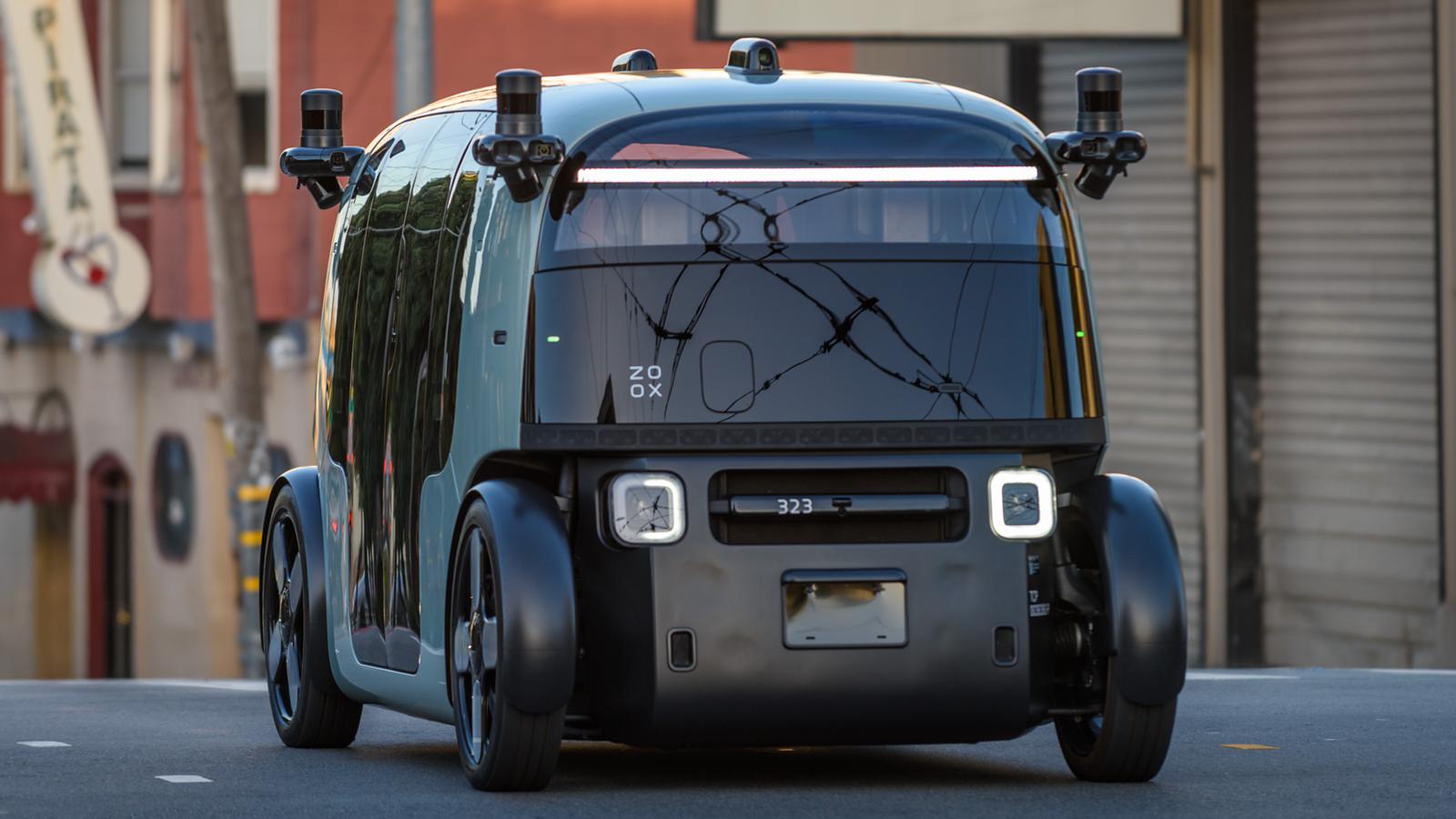
The vehicle that pulled up to riders on the Las Vegas Strip on August 10 has no steering wheel, no pedals, no mirrors, no windshield in any conventional sense, and no driver's seat — four passengers face each other in a symmetrical carriage that drives equally well in both directions. What it does have, for the first time, is a meter running. Zoox, the robotaxi company Amazon bought in 2020, began charging for rides that Monday — its first commercial revenue after a decade of engineering, per CNBC and TechCrunch.
The paperwork behind that fare is the real milestone. On July 30 the National Highway Traffic Safety Administration granted Zoox the first commercial exemption ever issued for a purpose-built robotaxi — relief from eight separate Federal Motor Vehicle Safety Standards that assume a human is driving, covering everything from windshield wipers and defrosters to mirrors, sun visors and manual brake controls. The exemption runs two years, through July 31, 2028, and permits Zoox to deploy up to 2,500 vehicles per year, with what the agency calls an enhanced oversight structure, mandatory incident reporting and safety-data collection. A prior exemption, granted last August, allowed only free demonstration rides. This one allows a business.
The distinction matters beyond Zoox. Waymo and Tesla both operate retrofitted conventional vehicles — cars that comply with the standards because they still have wheels and pedals a human could use. Zoox chose the harder road of designing the driver out entirely, betting that a purpose-built carriage would win on cost, cabin space and safety once regulators allowed it. For six years that bet looked like a liability. As of July 30, it is a moat: the only company in America with federal permission to sell rides in a vehicle that could not legally exist yesterday.
We are honored to receive the first-ever commercial exemption for a purpose-built robotaxi from NHTSA, enabling us to begin charging for our service.
That was chief executive Aicha Evans's statement on the grant. NHTSA administrator Jonathan Morrison framed the decision as "removing unnecessary barriers to innovation" while keeping "strong enforcement oversight" — as clear a signal as the agency has sent about how the current administration intends to treat autonomous vehicles.
Comfort-tier pricing, toaster-shaped supply
The service itself is still boutique. Zoox operates roughly 50 vehicles split between Las Vegas and San Francisco, per CNBC; Vegas coverage spans the Strip and destinations like AREA 15, Topgolf and Resorts World. Fares are structured like ride-hail — base plus distance plus time, locked in before booking, with destination fees for the airport and big venues — and land at a comfort tier above UberX, by third-party estimates roughly 20 to 40% above standard ride-hail rates. Free rides continue in San Francisco and Austin while state approvals catch up; California requires separate permits before anyone charges a dollar there.
The economics of the pod start to show at fleet scale. A vehicle with no driver's position seats four in the space of a compact car, charges between shifts at a depot, and never splits a fare with a human. Zoox has been deliberately quiet about unit costs, but the design logic is the same one Amazon applied to warehouse robots: purpose-built beats retrofitted once volume arrives, and the 2,500-per-year exemption cap is now the only thing standing between the company and volume.
But the ambitions compounded fast this week. On Thursday, Nevada regulators approved permits for up to 8,000 robotaxis in Clark County from Tesla, Waymo and Uber — and Uber's 1,000-vehicle fleet will be supplied partly by Zoox, under a March agreement that was the first time Amazon's unit agreed to put its pods on someone else's platform. Zoox also holds its own separate 100-vehicle Nevada permit. Amazon now has three simultaneous paths into the robotaxi market: its own app, its own permit, and a seat inside the biggest demand aggregator in the industry.
Five hundred cities, five-pound boxes
Two days before Nevada's vote, Amazon made the airborne half of the strategy concrete: Prime Air drone delivery will expand from 11 sites in seven states to nearly 500 US cities and towns by the end of 2026, per the company's August 19 announcement — a six-fold jump, with Chicago, Atlanta, Cleveland, Syracuse and Boise next in line. The service carries items up to five pounds — which Amazon says covers more than 60% of frequently bought products — as fast as 30 minutes, free for Prime members on orders over $50, $2.99 below that, $4.99 without Prime. Each site covers about 175 square miles. The company says it has already flown hundreds of thousands of deliveries this year, thousands per day.
"Customers already turn to Amazon for fast Same- and Next-Day Delivery, and Prime Air provides them an even speedier option when they need it," Prime Air vice president David Carbon said in the announcement. Behind the marketing line sits a regulatory beachhead assembled over a decade: FAA air-carrier certification, beyond-visual-line-of-sight approval in 2024, and the MK30 drone — quieter, longer-ranged, rain-tolerant — in service since late 2024. Jeff Bezos promised drone delivery on 60 Minutes in 2013 and was mocked for it through years of false starts and a shuttered California site. Andy Jassy's latest shareholder letter set the current targets: drone coverage reaching 30 million customers by year-end, and 500 million packages a year by 2030.
The logistics endgame
The competitive scoreboard is genuinely contested. Alphabet's Wing, partnered with Walmart, currently operates the largest US drone-delivery network and expanded into Phoenix, Philadelphia and the Bay Area in June; Zipline is scaling alongside. In robotaxis, Waymo dominates on miles and Tesla on headlines, and Zoox's 2,500-per-year federal cap is a real ceiling. Skeptics also keep receipts: Prime Air's incident file includes an October collision with a crane boom in Arizona, and a 175-square-mile site is, in the end, a seven-and-a-half-mile circle — hundreds of them will be needed for the coverage the press release implies.
What makes Amazon different from every other player in either race is that it does not need rides or deliveries to be businesses on their own. It needs them to be inputs. The company is spending roughly $200 billion on capital this year — most of it on AI data centers, but the logic is the same across the portfolio: own the infrastructure, remove the marginal human cost, and let scale do the arguing. A robotaxi that pays for itself hauling tourists between casinos is also a rolling test fleet for the delivery vans that follow. A drone network built for five-pound parcels is a standing option on every pharmacy, grocer and same-hour commerce category that fits in a shoebox.
For twenty years, Amazon's moat has been measured in fulfillment centers and delivery vans — capacity rivals could see and count. The August version of the moat is harder to photograph: a federal exemption no competitor holds, a fare meter running in a vehicle no one else can legally sell rides in, and airspace approvals accumulated while the industry watched the calendar. None of it is large yet. All of it compounds. That has always been the most dangerous sentence in retail.
The near-term test is prosaic: can Zoox actually manufacture at its permitted ceiling, and can Prime Air's 500-city map survive contact with local noise complaints, weather, and the FAA's evolving beyond-visual-line-of-sight rulebook? Amazon has missed self-imposed deadlines in both programs before. But the direction of regulatory travel — a first-of-its-kind NHTSA exemption, a cooperative FAA, a Nevada board approving robotaxis by the thousand — has never been this favorable, and Amazon has never been this ready to spend into it.
TNN Analysis is Torbrook News Network's original-reporting desk. Figures are drawn from NHTSA's exemption order, Amazon and Zoox announcements, and reporting by CNBC, TechCrunch, Bloomberg, Axios and the Federal Register as cited.