
Five men arrested near RAF Fairford, the US bomber base used in the Iran war, are held on suspicion of preparing terrorist acts — a law built to stop a plot before anything happens
Five men arrested near the Gloucestershire airfield used by American bombers in the Iran war are being held on suspicion of preparing a terrorist act. The offence is built to let police stop a plot before anything happens, which is why the law says so much and the authorities, so far, have said so little.
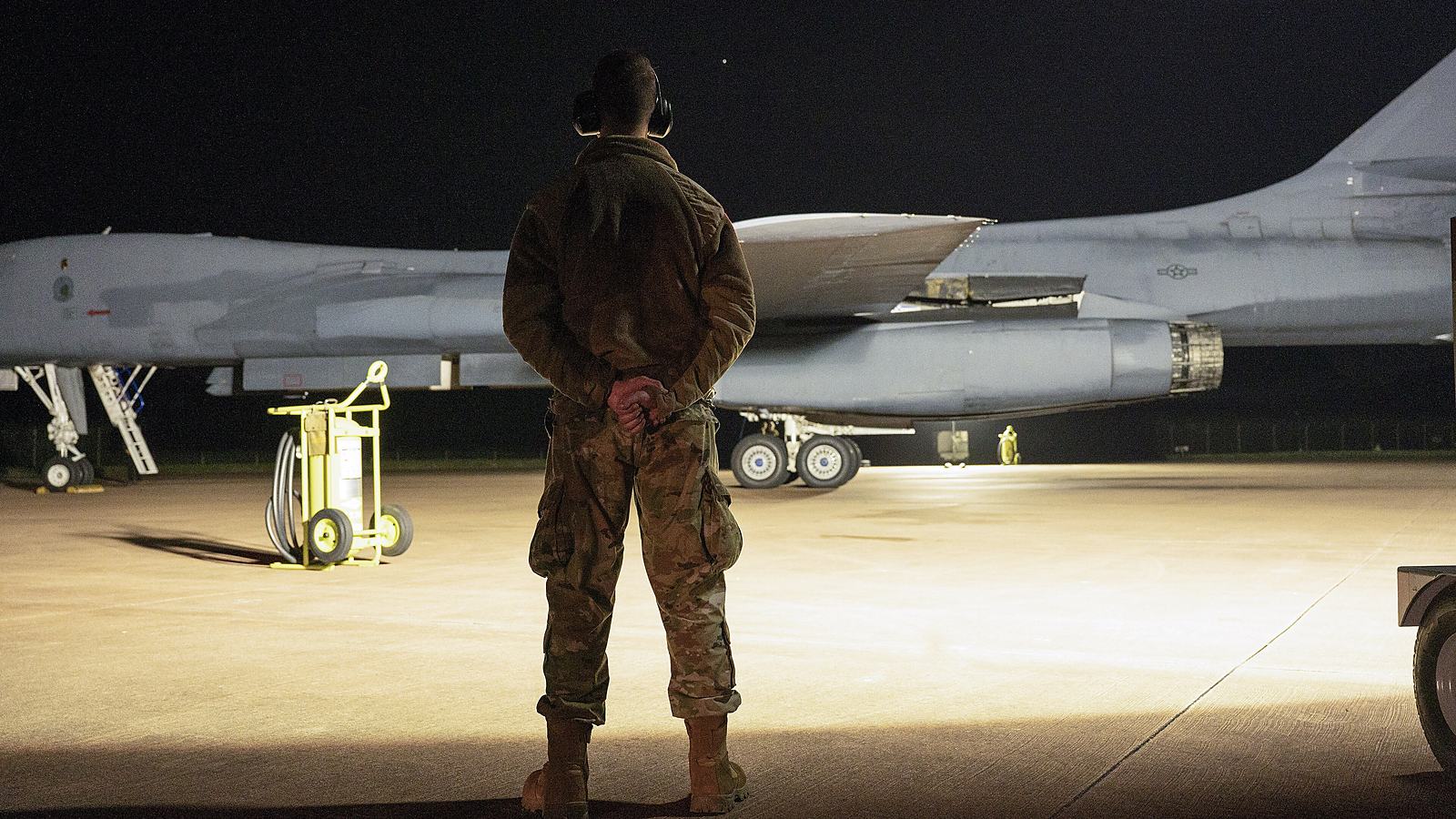
The detail that changes how Sunday's arrests near RAF Fairford should be read is not the bomb disposal robot or the evacuated village. It is the offence the five men are now being held for. According to Counter Terrorism Policing, as reported by the local outlet Wiltshire 999s and by NPR, the men were first arrested on suspicion of Explosives Act offences and then "further arrested on suspicion of preparation of a terrorist act," contrary to Section 5 of the Terrorism Act 2006. That law is designed for use before any attack takes place, and it says more about the investigation than Sunday's aerial footage.
Gloucestershire Police said officers received a call at about 12:45 a.m. about three suspicious vehicles that appeared to be travelling towards the base, according to ABC News and NBC News. Armed officers arrested five men in the Whelford area, a village next to the airfield. The Army's explosive ordnance disposal team then examined the vehicles inside a 400-metre cordon, and around 85 households were evacuated as a precaution, police said. Nobody has been charged, the men have not been named, and police have not said whether explosives were found.
All five are, in law, suspects and nothing more. This piece is about the machinery they are now inside, not about what they may have done.
What "preparation" means in law
The statute is short. Under Section 5, a person commits an offence if, with the intention of committing acts of terrorism or assisting others to do so, "he engages in any conduct in preparation for giving effect to his intention," according to the text published on legislation.gov.uk. The second subsection adds that it does not matter whether the intention and preparations relate to one particular act, acts of a particular description, or "acts of terrorism generally." The maximum penalty on conviction is life imprisonment.
Two features matter. First, the offence is complete at the point of preparation. Prosecutors do not need an attack, an attempt, or even a chosen target. Second, the conduct can be ordinary on its face; what makes it criminal is the intention behind it, so evidence of purpose carries the case.
That structure explains the timing. A preparation offence lets police intervene at the earliest defensible moment, when the public risk of waiting is highest and the evidence of intent may still be incomplete. Arrest first, build the case second, is the design, not a sign that something went wrong.
The second legal lever is time. Counter-terrorism laws allow UK police to hold suspects for up to 14 days before charge, CNN reported. NPR contrasted that with the 24-hour limit for a standard arrest without an extension application. The longer window is not automatic; extensions must be sought. Within it, investigators must charge, release or bail.
Why the base matters
Fairford is not an ordinary airfield. It is a Royal Air Force station operated by the U.S. Air Force under an agreement dating from the 1950s, and it hosts the headquarters of the 501st Combat Support Wing and serves as a forward operating location for Air Force Global Strike Command, according to the Associated Press report carried by Fortune. Its long runway suits heavy bombers, and it was used in the 1991 Gulf War and the 2003 Iraq war.
This year it became the main British launch point for the U.S. war on Iran. Britain did not join the U.S.-Israeli war that began on February 28, and initially refused a request from President Donald Trump to use British bases, AP reported. Days later, then-Prime Minister Keir Starmer agreed to let the U.S. use them for what he called "defensive" operations against Iranian missiles and launch sites. American B-1 and B-52 bombers have since flown from Fairford, according to AP and ABC News.
That permission made the base a named target in Tehran's rhetoric. In July, Iran's Islamic Revolutionary Guard Corps warned Britain that "any base used to invade Iranian territory is our legitimate target," Iran's semiofficial Tasnim news agency reported, according to NBC News, which said the warning cited bomber flights from Fairford. Local Cotswold District councillor Tristan Wilkinson told Reuters, as quoted by CNBC, that there had been "a specific threat about six weeks ago from the Iranians on this base," followed by increased surveillance.
None of that establishes a link to Sunday's arrests, and the authorities have been careful to say so. Al Jazeera reported that officials have not tied the arrests to Iran or said the base was the target. CNBC, citing a source familiar with the investigation, reported that an Iranian-linked motive was considered most likely, with a Russian sabotage operation or an Islamist plot also being examined. That is one unnamed source describing lines of inquiry, not a finding.
Two accounts of how it started
There is a visible tension in the public record over how the arrests came about. Police describe a call from the public. Richard Ocone, an assistant chief constable at Gloucestershire Police, said the arrests followed information from residents soon after midnight, CNN reported.
The American president described something longer. Speaking to reporters in Illinois, Trump called the arrests "fantastic" and said the U.S. and Britain had been watching the suspects, ABC News reported.
"We had them under investigation. They were looking to do big damage to our fort," Trump told reporters. "We had them under view for a long time, and we got them." (As reported by ABC News and NPR.)
Both things could be true: a long-running intelligence interest and a late-night call that forced the timing. But no British authority has confirmed any prior surveillance, and the contrast in tone is itself instructive. British officials have said almost nothing of substance, and the reason is legal. Under Schedule 1 of the Contempt of Court Act 1981, criminal proceedings become "active" from an initial step such as an arrest, and from that moment publications that create a substantial risk of serious prejudice to a future trial can be contempt. A president speaking in Illinois sits outside that regime; British ministers, police and newspapers do not.
Prime Minister Andy Burnham's statement reflected that constraint. He called the incident "deeply concerning" for residents and urged people "not to speculate while the authorities establish the full facts," according to ABC News and NBC News. Vicki Evans, the senior national coordinator for Counter Terrorism Policing, said only that the investigation was in its "early stages" and that "five men remain in custody," CNN and Al Jazeera reported.
The precedents at British air bases
Fairford has been the scene of criminal cases tied to wars before. In March 2003, at the start of the Iraq war, protesters broke into the base and damaged vehicles and equipment used to support B-52 bombers, according to the account of the case known as the Fairford Five. Two of the defendants were acquitted in 2007 after arguing they were trying to prevent war crimes, and another was cleared after a jury twice failed to reach a verdict. Juries, not officials, decide what intent the evidence proves.
The closest recent comparison is at RAF Brize Norton in Oxfordshire. On June 20, 2025, activists from Palestine Action entered the base and sprayed red paint into the engines of two Voyager refuelling aircraft, Al Jazeera reported at the time. The government then proscribed the group under the Terrorism Act 2000 from July 5, 2025, after the House of Commons voted 385 to 26; the Court of Appeal upheld the ban in June 2026, and the Supreme Court has agreed to hear a further appeal later this year.
The cases differ in kind: Brize Norton involved claimed property damage by a named protest group, while Sunday's arrests involve a suspected preparation offence, no named group and no act alleged to have occurred. They sit against a raised baseline: the Joint Terrorism Analysis Centre lifted the UK national threat level from substantial to severe, meaning an attack is "highly likely," on April 30, 2026, according to the government's announcement.
The case for caution, and against it
There is a reasonable counter-argument to all this restraint. Residents were moved from their homes, controlled detonations were heard near Whelford according to CNN, and armoured vehicles appeared at the gates of RAF Lakenheath and RAF Mildenhall, Reuters witnesses reported via CNBC. When a foreign president is describing the plot, official silence at home can look like a public left uninformed about a threat on its doorstep.
The answer the British system gives is that the silence is temporary and has a purpose. Preparation cases are won or lost on intent, and intent is exactly what pre-trial publicity most easily distorts. The 14-day clock, the court oversight of detention and the contempt rules are all designed to push the argument into a courtroom where evidence can be tested. The durable point from Sunday is that a law built to stop attacks early also requires everyone else to wait, and that the five men in custody are, for now, suspects in an investigation that police themselves say has barely begun.
This analysis rests on statements from Gloucestershire Police and Counter Terrorism Policing as reported by ABC News, CNN, NPR, NBC News, Al Jazeera, CNBC/Reuters, the Associated Press via Fortune and Wiltshire 999s; the statutory text of the Terrorism Act 2006 s.5 and the Contempt of Court Act 1981 Sch. 1 on legislation.gov.uk; the UK government's April 30, 2026 threat-level announcement; and prior reporting on RAF Brize Norton, Palestine Action's proscription and legal challenges, and the Fairford Five. The suspects have not been charged or named. Whether explosives were found, the motive, any link to Iran or another state, and any prior surveillance are unconfirmed by British authorities. The claim of long-running surveillance comes from President Trump, and the Iran-linked line of inquiry from a single unnamed source cited by Reuters. The threat level is given as announced in April; TNN found no later change.