
Ten years after American fired him, Scott Kirby has United a hair behind Delta — and hundreds of lie-flat seats in storage for a Boeing jet that still isn't certified
United ordered the seats in 2018 for a plane that was supposed to fly in 2020. It has 167 of the aircraft on order and expects the first in the summer of 2027. Kirby has spent the past year floating mergers with both Delta and American; both said no. "Everything I say," he told CNBC, "would require a willing partner."
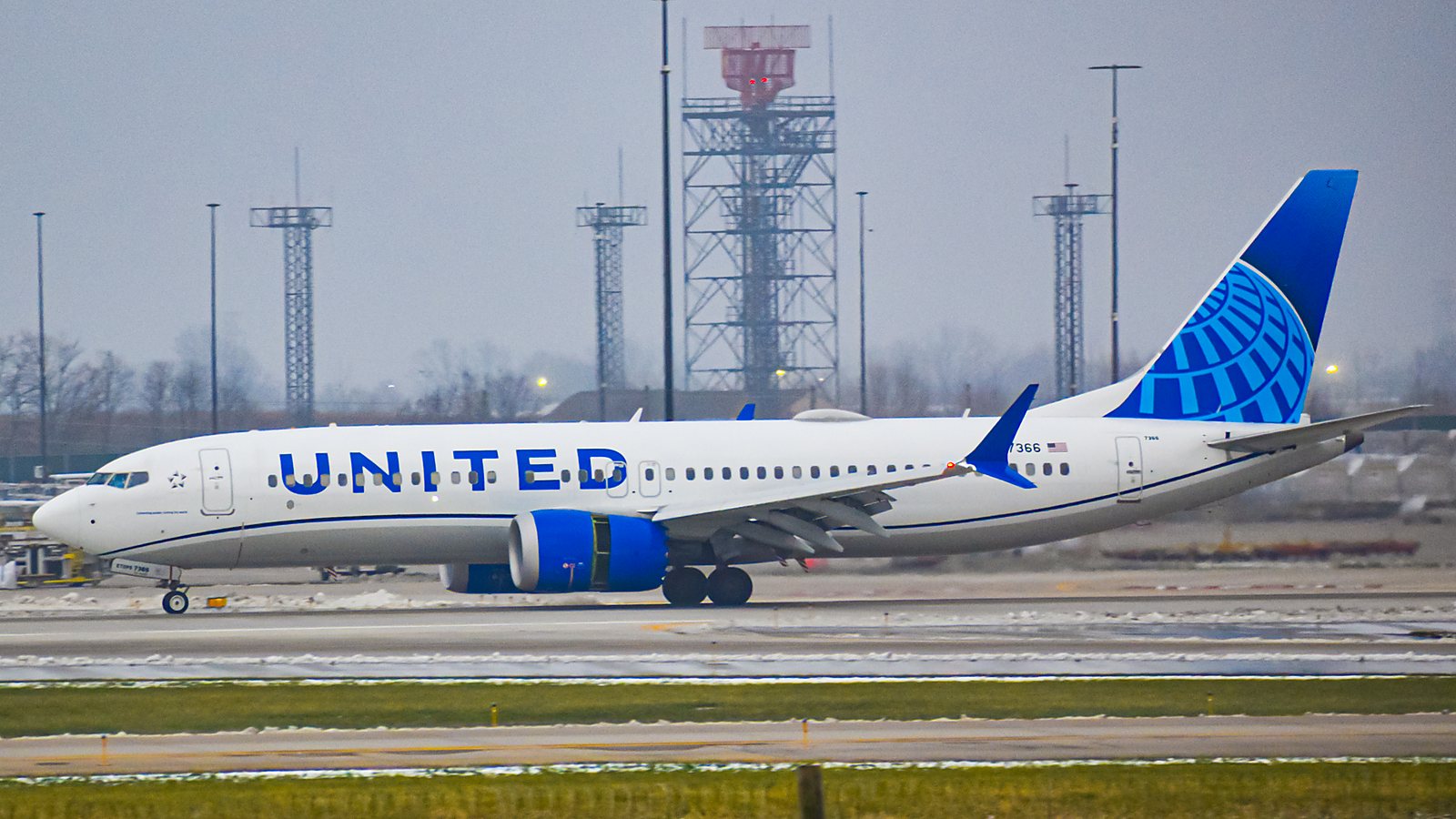
In August 2018, at an aviation conference in Denver, the then-president of United Airlines told a room of reporters what the new Boeing 737 MAX 10 was going to do for his airline: lie-flat premium seats, on profitable transcontinental routes, on a single-aisle jet. The plane was supposed to enter service in 2020.
Eight years later the seats are in a warehouse and the plane is still not certified. "We got a bunch of lie-flat seats that we don't know what to do with," Scott Kirby, now United's chief executive, told CNBC this month at Newark Liberty International Airport. "They don't fit on other airplanes."
It is a small problem inside a very good decade, and it is a useful way to see the constraint that governs the whole industry. United has 167 MAX 10s on order according to its most recent quarterly filing, and now expects the first of them in the summer of 2027 — seven years late. Boeing's delays on both the MAX 7 and the MAX 10 followed a redesign of the aircraft's engine anti-icing system, undertaken while the manufacturer was under intense regulatory scrutiny after years of safety and production failures. The smallest variant, the MAX 7, was finally approved earlier this month, with Southwest expecting to fly it in the first half of 2027. The largest is expected to follow.
United did not wait. It refitted a subfleet of Airbus A321neos with 20 of its newly designed Polaris suites plus premium economy and other new seating, branded the aircraft the "Coastliner," and put them on the transcontinental routes the MAX 10 was meant to serve. The dimensions do not match between the two aircraft, so the stored seats remain stored, and United has not said what the MAX 10 interior will look like or where the planes will fly. When it drew up the original plan, the airline did not yet sell a premium economy cabin at all.
A decade of compounding
The anniversary is worth noting because of how the decade began. American Airlines fired Kirby as its president in August 2016; United announced it had hired him for the same job days later — a securities filing landing almost on top of American's announcement of his departure. "I joke that most people take a few weeks, a couple months between jobs," he said. "I took 60 seconds."
He is careful about the obvious framing. "Everyone thinks I do, but no, I don't," he said of believing in revenge. "I compete aggressively." His first act at United, he says, was to go through money-losing routes with a highlighter. The company was then considering closing its bases at Los Angeles International and Washington Dulles; Kirby stopped it, and both stayed. Last month he flew up from his son's soccer camp in Brazil for a day to stand in the Oval Office and unveil a $22.5 billion revamp of Dulles.
Promoted to chief executive in May 2020, into the worst crisis the industry has ever had, he now runs the second-most profitable large U.S. carrier. The second-quarter scoreboard is the cleanest summary of where the three legacy airlines stand: Delta earned $1.6 billion, United $805 million, American $71 million. United's revenue rose 16 percent to $17.67 billion, unit revenue was up 12.1 percent, and premium revenue rose 16 percent — with basic economy up 11 percent, loyalty up 11 percent and cargo up 23 percent. Pre-tax earnings were $1.0 billion at a 5.8 percent margin, achieved in a quarter when fuel expense rose $2.3 billion, or 84 percent year over year, of which the airline recovered about half.
The premium arms race
That premium line is the strategy, and it is now the industry's. Last week American — which spent a decade insisting seatback screens were not worth their weight or cost, on the theory that passengers would bring their own devices — reversed itself. It will install 4K seatback displays on new Boeing and Airbus deliveries starting in 2028, with retrofits, Bluetooth audio and USB-C charging across all cabins, and installations complete in the early 2030s.
"The technology has advanced so much from when we made this decision more than a decade ago," American's chief customer officer, Heather Garboden, said. "Ultimately, when you have customer preference and customer satisfaction improvements, that also generates revenue." American is also adding first-class seats to its A321neos and to its own 737 MAX 10s, whose deliveries remain years away, and more extra-legroom seating fleetwide. The economics are not subtle: a round-trip from Kennedy to Dallas Fort Worth was recently $447 in coach and $1,161 in first.
The strategic point is that United and Delta got there first and are now compounding the advantage — better cabins draw brand-loyal flyers, brand-loyal flyers sign up for co-branded credit cards, card economics fund more cabins. American's chief executive, Robert Isom, has said closing the profit gap runs through exactly the same channel: more premium seats, better lounges, a stronger network.
The merger that isn't
Kirby's answer to the industry's structural limits has been to propose removing one. Over the past year he floated combinations with both Delta and American. He approached Delta and was turned down, as The Wall Street Journal reported last month; Delta's president, Peter Carter, told CNBC in June that he sees no merger or acquisition in the airline's future. American publicly rejected an offer this spring. "At the end of the day, we spend time looking at things that have a chance of happening," Isom said. "We don't spend a lot of time pursuing impossibilities."
Antitrust lawyers and stock analysts were, without much hesitation, skeptical. Four carriers already control more than three-quarters of U.S. flight capacity, the product of two decades of consolidation. Kirby's rebuttal is that the objections rest on an outdated premise: "All of the objections are ... based on a premise that the airline industry is a commodity." He argues United and Delta have differentiated themselves on network, cabin and product, and that the industry regulators are policing is not the one that exists.
He says he is still not interested in buying a smaller airline such as JetBlue — "That's still the case" — and concedes the obvious constraint on all of it: "Everything I say would require a willing partner."
Holes in the map
What a merger would fix, in Kirby's telling, are two specific gaps. United is thin in South America and thin in the U.S. Southeast, and there is nowhere sensible left to build a hub. "Those are two places that are holes for United that are hard to fix on a stand-alone basis," he said. The best gateway to South America is Miami, where American held more than 60 percent of passenger enplanements in fiscal 2025.
The nearer-term expansion is at Kennedy, where United returns next year at the earliest through a partnership with JetBlue — American's former partner. Kirby wants more than a foothold. "We got a bunch of irons in the fire to try to find ways to do it," he said, raising the possibility of acquiring slots from carriers not flying profitable routes there. United already leads U.S. carriers in international flying, and this week brings its annual route announcement, the airline's yearly exercise in adding improbable dots to the map — Ulaanbaatar and Bilbao among recent additions.
Our employees often ask me like, 'What keeps you awake at night,' and I tell them, 'nothing.' My job is to set the company up so none of you ever have to have a sleepless night worrying about your jobs.
The gap between that and daily operations is where the next decade will be judged. In the first half of this year United ranked behind both Delta and Alaska Airlines, now merged with Hawaiian, on on-time arrivals, according to Transportation Department data. Kirby's answer is artificial intelligence tools for employees and customers, which he says will improve reliability — a large promise in a business subject to weather, congested airports and mechanical failure. "I firmly believe in no excuses, and so we don't make excuses," he said.
He says his goal is that United never furloughs again, and that when the time comes he hopes to "know when to retire and do it gracefully." In the meantime there are 167 undelivered aircraft, a warehouse of seats built for none of them, and a competitor in Atlanta still making twice as much money.
Quotations from Scott Kirby are from a CNBC interview conducted this month between Manhattan and Newark Liberty International Airport, published August 23; MAX 10 order and delivery details are from CNBC's reporting and United's most recent quarterly filing. Second-quarter results are United's reported figures for the quarter ended June 30, 2026, with comparative profit figures for Delta and American as reported by CNBC.