
The government told the Supreme Court a 250-person crew is working 20 hours a day and the White House ballroom is 65 percent finished. Roberts let them keep going
Chief Justice John Roberts issued a one-sentence administrative stay on Friday, hours before a district judge's injunction was to take effect. The National Trust for Historic Preservation says the administration is trying to outrun judicial review by finishing the building before any court can rule on whether it was ever allowed to start.
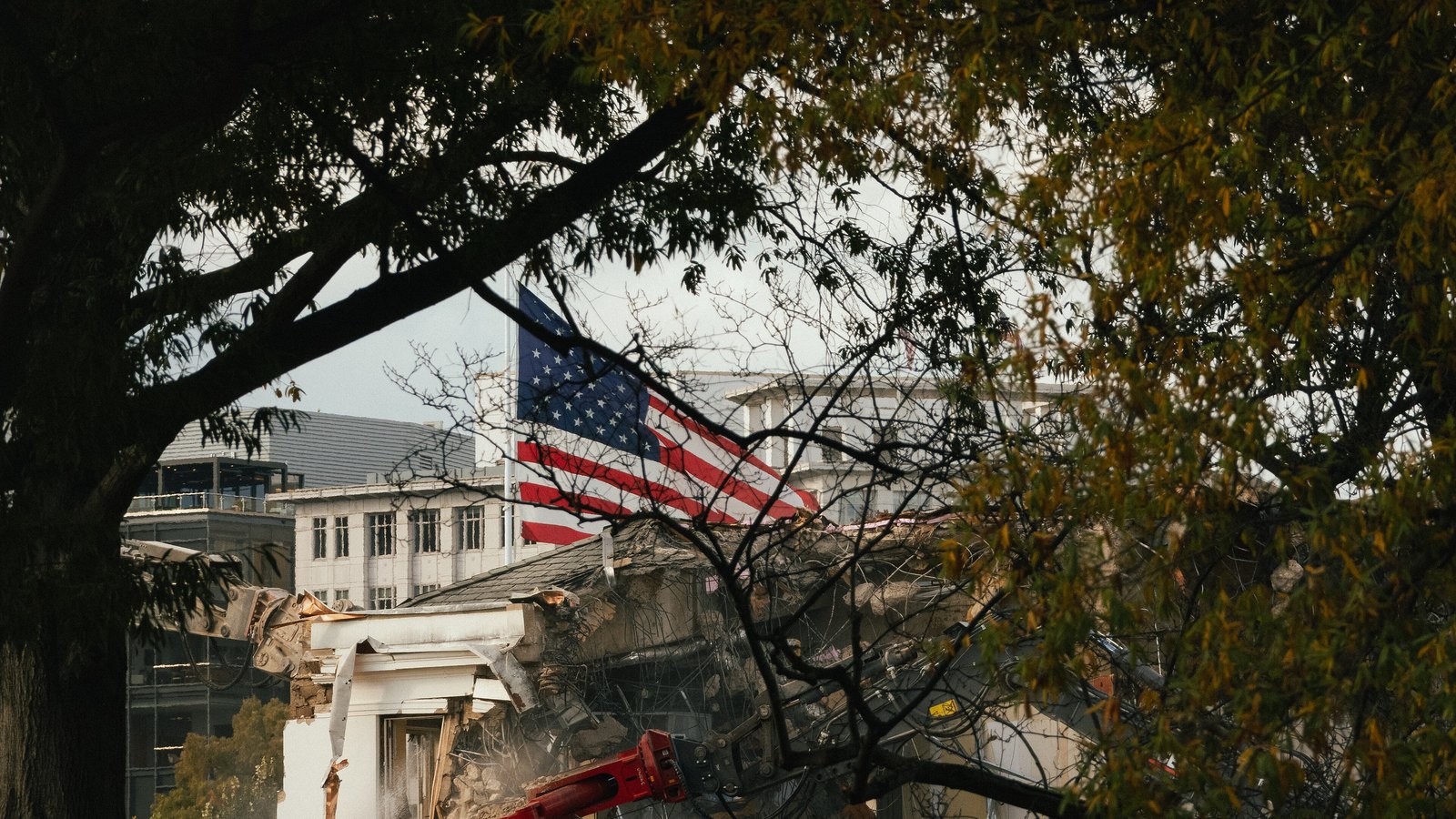
The most consequential sentence filed at the Supreme Court this month was not written by a justice. It was written by Solicitor General D. John Sauer, and it described a construction schedule: "a 250-person crew working 20 hours a day, 7 days a week to keep the Project ahead of schedule and under budget." As of last week, Sauer told the justices, the White House ballroom was "65% complete in its entirety, and moving quickly toward total completion."
On Friday afternoon, hours before a district court injunction halting above-ground work was due to take effect, Chief Justice John Roberts issued a one-sentence administrative stay keeping that injunction on hold. The crews did not stop. The order gave no indication of when the full Court might rule on the government's underlying request, and an administrative stay is exactly what its name says — a pause to buy the justices time, not a decision on anything.
How a demolition became a Supreme Court case
In the autumn of 2025, the administration tore down the East Wing of the White House without notifying Congress, clearing the ground for a 90,000-square-foot ballroom — a footprint slightly smaller than one and a half football fields — projected to cost $400 million or more. In December, the National Trust for Historic Preservation went to federal court in Washington seeking to pause construction until the project obtained the approvals and authorisation it argued were required.
Senior US District Judge Richard Leon issued an order prohibiting most above-ground construction while allowing underground work on security features — bomb shelters and bunkers — to continue. That order has never actually taken effect. It was held in abeyance while the government appealed, and the DC Circuit affirmed it on August 7 while giving the administration fourteen days to seek relief from the Supreme Court, which kept the order on hold and the construction running. The government filed on August 14 and asked for an "immediate" administrative stay. Roberts granted one a week later, on the day Leon's order would finally have bitten.
The government's efforts to foil judicial review and arrogate Congress's exclusive powers should not be rewarded with a stay.
The argument about pace
That line comes from Tad Heuer of Foley Hoag, arguing for the National Trust in a brief filed last Tuesday. His claim is that the administration is trying to "outrun judicial review" — fast-tracking the whole project so it can eventually tell a court that the building is "beyond the point of no return" and that intervention would be pointless. A stay, on that reading, does not preserve the status quo. It manufactures a new one.
This is the structural problem in every emergency application about construction, and it has nothing to do with ballrooms. Litigation over whether a thing may be built runs on a timescale of years. Building it runs on a timescale of months, and faster if you put 250 people on site around the clock. A court that declines to stop work while it thinks is not staying neutral; it is quietly deciding the case, because the remedy it was considering evaporates as the concrete cures.
The government's filings turn the same fact around. Sauer told the justices that Leon's ruling would "halt the ongoing construction of the integrated military complex, including a totally secure ballroom space, at the East Wing of the White House, which is vitally required by national security." Progress and urgency are offered as reasons the Court should not intervene, which is precisely what the Trust says is wrong with them.
There is a reason courts normally have an answer to this and did not use it here. The usual remedy for a defendant who races to moot a case is that the work is done at the defendant's own risk: build if you like, but if you lose, you unbuild. That threat disciplines ordinary developers because tearing down a finished structure is merely expensive. It does not discipline this project, because no court is realistically going to order a wing of the White House demolished a second time, and everyone involved in the litigation knows it.
Two legal questions, neither yet answered
The administration's first argument is that the National Trust has no legal right to sue at all — no standing. It is the cleanest possible off-ramp: a Court that agrees never has to say whether the project was lawful, and the ballroom is finished as a matter of procedure rather than of merits.
The second concerns Congress. The DC Circuit majority concluded that a project of this kind requires congressional authorisation. The government responds that Congress has already given it, twice over — by empowering presidents "to make 'alteration[s]' and 'improvement[s]' to the White House," and by "broadly authoriz[ing] the Executive to construct buildings in national parks." Whether a 90,000-square-foot addition built on the footprint of a demolished wing counts as an alteration, or as a new building requiring its own authorisation, is the question the case exists to answer, and Friday's order did not touch it.
The national security framing is the third element, and the most novel. The government does not describe the project as a ballroom in its filings; it describes an "integrated military complex, including a totally secure ballroom space." That characterisation matters, because courts extend considerably more deference to executive judgments about security than to executive judgments about entertaining. Judge Leon's order tracked the distinction precisely — it allowed underground work on bomb shelters and bunkers to proceed while barring most above-ground construction, which is a judicial way of saying that the security rationale covers part of the project but not all of it.
The $400 million figure sits outside the legal argument entirely and is largely why the dispute carries political weight. The National Trust's case does not turn on the cost, or on who is paying it, but on whether the project needed congressional authorisation and historic-preservation review before the first excavator arrived. Those are separate objections, and they have been fused in public debate — which tends to help the government, because an argument about money is one an administration can win with a press release.
The reaction was about everything except the law
President Trump posted on Truth Social within hours. "We are grateful for the Decision of the United States Supreme Court," he wrote. "The Military/Ballroom Complex being built on the hallowed grounds of the White House, which is so vital for National Security, will be THE GREATEST OF ITS KIND!"
Senate Minority Leader Chuck Schumer answered on X in the same register. "The MAGA Supreme Court is rubber stamping Trump's vanity-driven, gilded corruption," he wrote. "As costs skyrocket, the administration is wasting money on an endless and illegal war, corporate giveaways, and Trump's pet projects." He promised Democrats would "continue to fight this flagrant waste of taxpayer money relentlessly in the courts."
Both statements treat a procedural pause as a verdict, which it is not. Roberts, who has primary responsibility for emergency applications from the DC Circuit, granted a stay of the kind that is granted routinely and reversed regularly. The full Court can lift it. What neither statement acknowledges is that the practical effect is identical to a win for the government either way, because every week the stay holds is a week of construction that cannot be undone.
There is precedent for presidents rebuilding the house they live in, and the government leans on it. Truman gutted the mansion to its exterior walls between 1949 and 1952; Theodore Roosevelt built the West Wing in 1902; the East Wing itself dates from 1942. What the historical examples share, and what the Trust says is missing here, is a public authorisation trail — appropriations, commissions, congressional committees that knew what was being done before it was done. The dispute is less about whether a president may alter the White House than about whether he may do it first and explain afterwards.
What is actually at stake
The East Wing stood for eighty-three years and housed, among other things, the offices of first ladies and the entrance through which the public toured the building. It was demolished without notice to Congress. Whether that was permissible, and whether what replaces it required anyone's approval, are questions about the limits of executive authority over a building that is simultaneously a residence, an office, a national historic site and a security installation.
They are also questions with a shrinking window. Sauer's own filing puts completion within reach: 65 percent done last week, at 140 crew-hours a day. On that trajectory the ballroom will be finished long before the Supreme Court hears argument on whether it should have been begun.
The National Trust's case is not really that the courts should tear a building down. It is that a government which cannot be stopped in time cannot meaningfully be reviewed at all — and that the remedy for a project built without authorisation cannot be that it was built too quickly to challenge. On Friday, that argument lost a week. There are not many weeks left in it.
Filing details are drawn from SCOTUSblog's reporting of August 21 and from the parties' briefs as described there; quotations from the president and Senator Schumer are as reported by CNBC.