
The Supreme Court blocked Missouri's Republican-drawn congressional map with no noted dissents, hours after a judge cleared the way for a contempt hearing against the state's chief election officer
Missouri will use its 2022 districts in November, not the map that would have made the delegation 7-1. For two days the secretary of state was subject to two binding and directly contradictory court orders. The state's strongest argument — that it was too late to change — was created by its own eight-month delay.
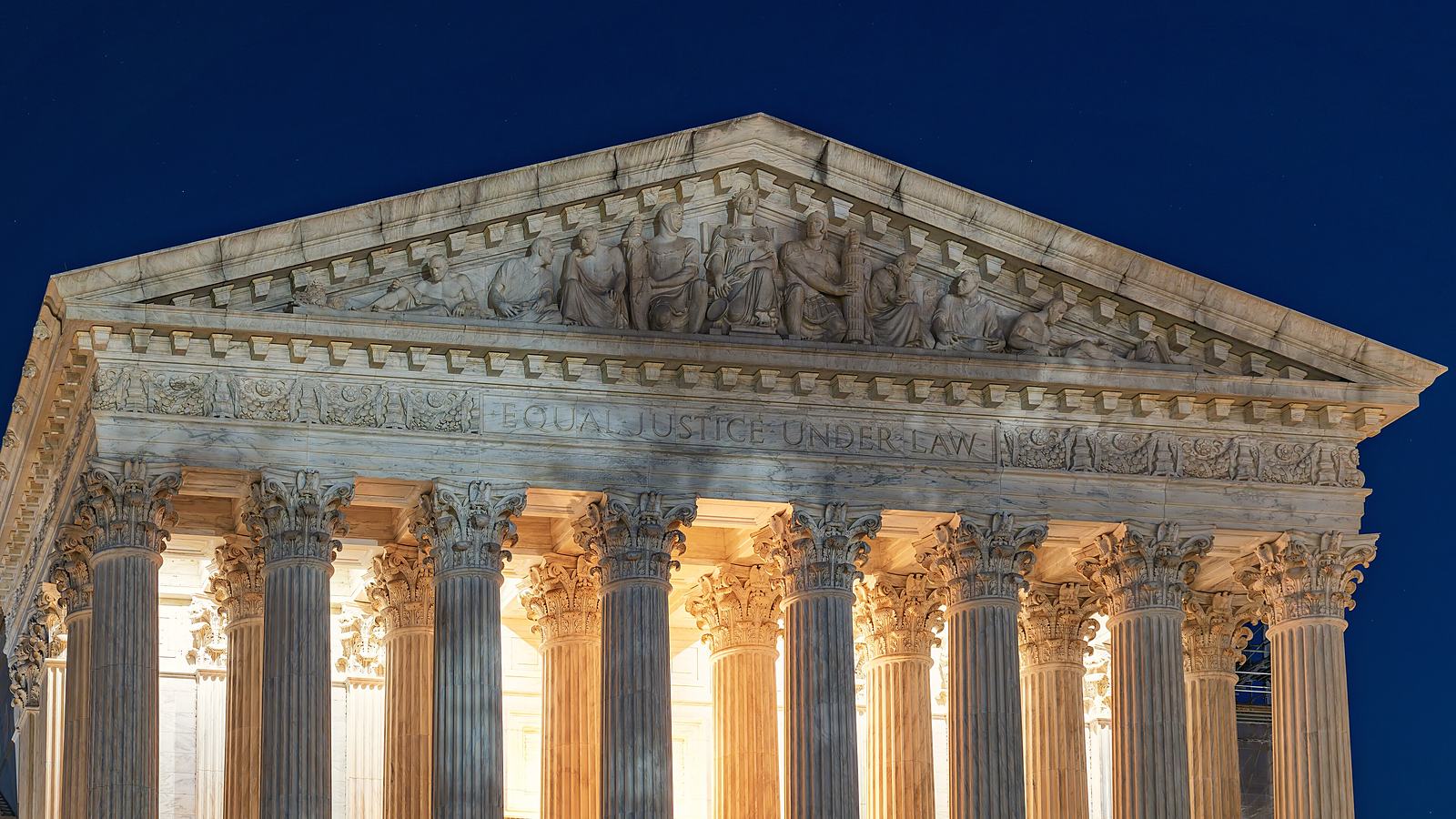
The Supreme Court's order on Thursday was three things at once, and only one of them was about a map.
In an unsigned order with no noted dissents and no explanation, the Court blocked Missouri from using its newly drawn congressional districts in November's midterm elections. Secretary of State Denny Hoskins must use the map passed in 2022, after the last census. The Court gave no reasons, which means the only thing that can be read from it with confidence is the absence of a recorded dissent — on a question this contested, in a Court whose emergency docket is normally fractured, nobody publicly objected.
The second thing it was: a rebuke of a federal district judge. The third: the resolution, for now, of a situation in which one state official was under two binding court orders that told him to do opposite things.
The seat at stake
Missouri's House delegation currently runs six Republicans to two Democrats. The map the state legislature enacted last year targets one of the Democratic seats — the Kansas City-based district held by Representative Emanuel Cleaver — by shedding parts of it into neighbouring districts and stretching what remains out into rural Republican territory. The intended result is a 7-1 delegation, a gain of one seat.
One seat sounds modest until it is set against the arithmetic of the House, where control has repeatedly turned on margins in the low single digits. Missouri was the second Republican-led state, after Texas, to redraw its districts after President Trump urged Republicans last year to redraw House maps to their advantage ahead of the midterms — a mid-decade redistricting round that has since spread to states on both sides, with California countering through a ballot measure of its own.
Two courts, one official, opposite instructions
What made Missouri distinct was not the map. It was the collision.
The Missouri Supreme Court ordered Hoskins not to use the new map and to run the election on the post-census districts. US District Judge Stephen Clark, a Trump appointee, ordered on Tuesday that Hoskins use nothing other than the new map. Both orders were binding. They could not both be obeyed.
The state's high court then ordered Hoskins to appear at a contempt hearing on Thursday for having instructed local election authorities to use the new districts. State attorneys representing him asked Judge Clark to halt that hearing. He declined. Hours before the Supreme Court's order landed, a federal judge allowed the contempt proceeding to go forward.
This is a genuinely unusual posture, and it is worth being precise about why. Federal and state courts routinely disagree about federal questions, and there is a well-worn hierarchy for resolving that. What is not routine is for an individual officeholder to be simultaneously commanded and forbidden to do the same act by two courts with power to punish him, with an election calendar running underneath. Whatever Hoskins did on Wednesday, he was in contempt of something.
The argument that undid itself
Minutes before the Court ruled, lawyers for Hoskins and the state filed a brief arguing that changing the congressional map now would be "extraordinarily burdensome," given that Missouri's August primary elections had already been conducted on the new districts. The challenge, the state said, was "seeking to destabilize" the midterms and risked the "disenfranchisement of hundreds of thousands of voters."
That is a serious argument, and it draws on a real doctrine: federal courts have long been reluctant to change election rules as an election approaches, on the theory that late judicial intervention confuses voters and administrators more than the underlying defect does. In the abstract, a state that has already run a primary on a map has a strong claim to finish the cycle on it.
The difficulty is how Missouri came to have already run that primary.
Opponents of the redistricting collected hundreds of thousands of signatures to force a statewide referendum on the new districts, and submitted them in December. Hoskins did not act on the petition for roughly eight months. He rejected it in August — on the same day as Missouri's primary — asserting that a referendum petition could not be used for congressional redistricting. The delay is what allowed the primary to be conducted on the new districts in the first place.
The new districts never became law and were suspended retroactively to the December submission of the petition.
That was the substance of the Missouri Supreme Court's ruling last week, and the retroactivity is the whole ballgame. If the districts were suspended from December, then they were not law in August either — and the primary that the state now cites as the reason it is too late to change was itself run on a map that had no legal force. The state court also ordered Hoskins to place the redistricting referendum on the November ballot, which he did.
Courts are generally unwilling to let a party benefit from a difficulty it created. Missouri's best argument on Thursday was that the calendar had run out. The calendar ran out during eight months in which the state's own chief election officer was sitting on the petition that would have stopped the clock.
What the Court did not say
None of this appears in Thursday's order, because Thursday's order says almost nothing. It is unsigned, unexplained, and carries no recorded dissent. That is characteristic of the emergency docket and it is why reading intent into it is a mistake. The justices did not say why they blocked the map, did not endorse the Missouri Supreme Court's retroactivity holding, and did not address the state's disruption argument.
Nor is this the first time the Court has turned Missouri away this week. Justice Brett Kavanaugh, who handles emergency matters arising from the state, rejected an earlier request without referring it to the full nine-member Court and without offering an explanation. The Court then declined on Tuesday to hear an appeal of the state court's decision. Judge Clark issued his conflicting order moments later.
The word doing the most work in Thursday's order is "temporarily." A panel of the Eighth Circuit Court of Appeals is currently overseeing an appeal of Clark's order, and late Thursday Clark refused to stay it. The underlying litigation is not over. What the Supreme Court settled is which map is used in fifty-odd days, not who was right.
The counter-argument
The case for Missouri deserves stating on its merits rather than being waved past. Hundreds of thousands of voters did cast primary ballots under the new districts, and those voters were not responsible for the secretary of state's timetable. Election administration is a physical process — precinct assignments, ballot printing, poll books, mailings — and reversing it late genuinely does produce errors that fall on ordinary people. A principle that late changes are disfavoured exists because late changes cause real harm, not because courts are indifferent to unlawful maps.
There is also a legitimate objection to the mechanism the other way. If a state court can retroactively suspend a duly enacted statute back to the date a petition was filed, that is a considerable power, and one that could be used against either party's map in a future cycle. Missouri's opponents won on a theory that is not obviously narrow.
The durable point
Missouri voters will now do two things in November. They will elect a House delegation under the 2022 districts, and they will vote on a referendum about the districts that were supposed to replace them. The second vote is the one the original petition asked for in December, and it is happening ten months later than it might have because the official responsible for processing it did not.
The redistricting fight will continue in the Eighth Circuit and probably return to Washington. But the part of this episode most likely to matter beyond Missouri has nothing to do with either map. It is the demonstration that an election official can be placed under contradictory binding orders from a state and a federal court simultaneously, in the weeks before a national election, and that nothing in the system prevents it — the collision simply persists until somebody higher up chooses. This time, somebody did, in an unsigned paragraph, with no explanation and eight weeks to spare.
This report is based on the United States Supreme Court's order of Thursday, September 10, 2026, on filings by the Missouri secretary of state, on rulings of the Missouri Supreme Court and of US District Judge Stephen Clark, and on reporting by Al Jazeera, the Associated Press and CBS News. The Supreme Court's order is unsigned and gives no reasoning; no inference about the justices' legal views should be drawn from it, and the absence of noted dissents does not establish that the decision was unanimous. The order is temporary and the underlying appeal remains before the Eighth Circuit Court of Appeals. Characterisations of the disfavouring of late changes to election rules describe a general judicial practice, not a doctrine the Court invoked here.