
Walmart erased $80 billion in a day after its slowest US sales growth since 2020. It beat on revenue and profit — the warning was in the carts
America's largest retailer fell almost 10% on Thursday, its worst session in four years, after comparable US sales grew just 2.6% against the 3.8% Wall Street expected — the first comp miss in at least five years. The culprits: $4.10 gasoline, federal drug-price caps, and a shopper who is still showing up but buying less each trip.
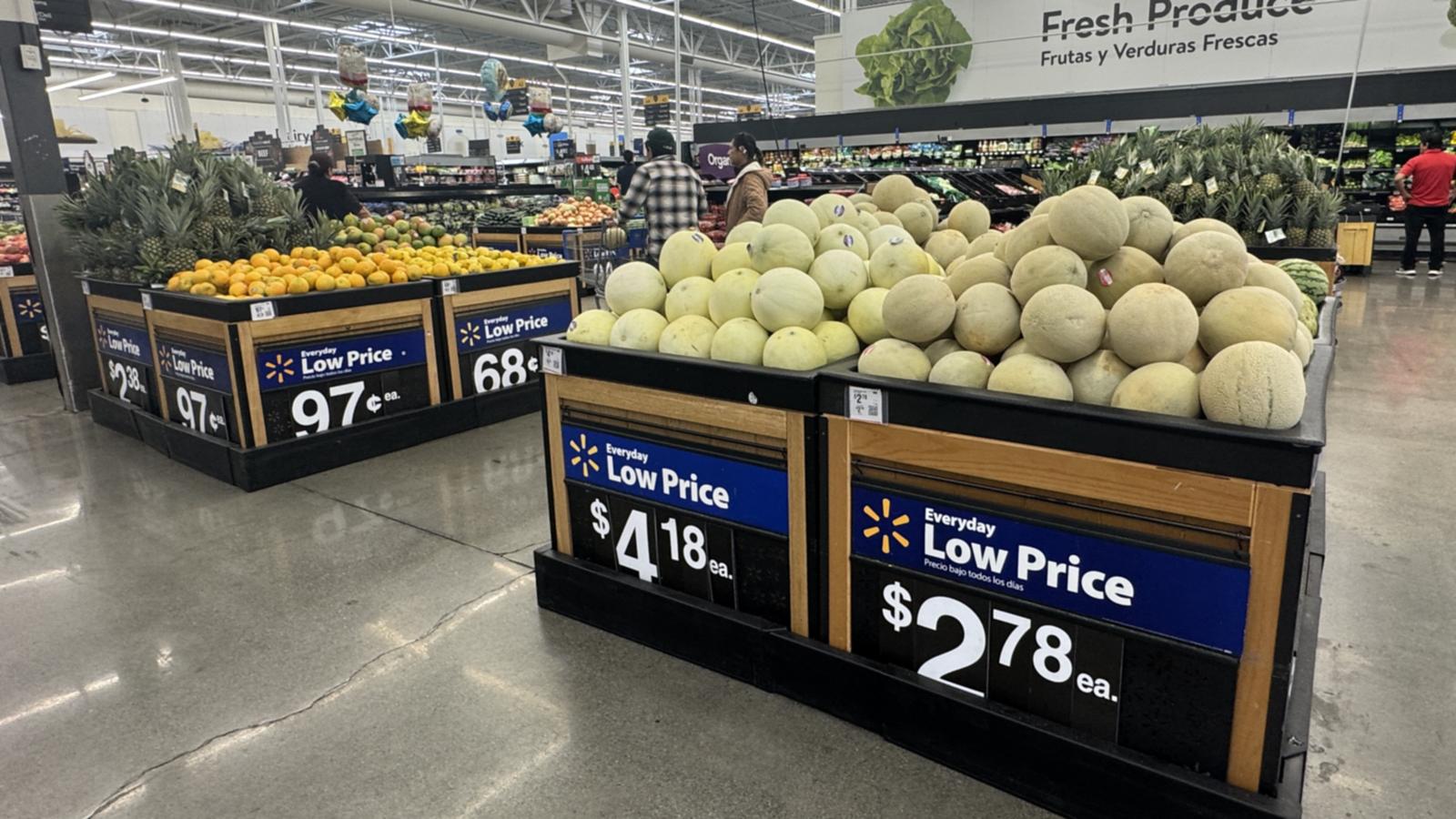
By the traditional scoreboard, Walmart's quarter was fine. Revenue of $187.9 billion beat expectations. Adjusted earnings of 81 cents a share cleared the consensus by seven. Full-year guidance was actually raised. And the stock had its worst day since May 2022 anyway — down as much as 10% intraday to a nine-month low, closing off 9.8% at $102.65 and erasing roughly $80 billion in market value, per Reuters. When the market punishes a beat that hard, it is not grading the quarter. It is grading the signal.
The scale of the reaction had no modern precedent for this stock. Walmart had not fallen this hard in a single session in more than four years, and it entered the week as one of 2026's dependable defensive trades — the place money hid while bond yields chewed through the AI complex. In one premarket release, the hiding place became the headline risk.
The signal was one line deep in the release: comparable US sales, excluding fuel, grew 2.6% against the 3.8% analysts expected — Walmart's slowest comp growth since 2020 and, per Reuters, its first comparable-sales miss in at least five years. For a company whose defining virtue is that its numbers never surprise anyone, the miss itself was the news. "For the consumer economy, this is like Nvidia posting a slowdown," Annex Wealth Management's Brian Jacobsen told Reuters — a line that explains why the damage was not confined to one ticker.
Where the growth went
Decomposing the miss turns up two specific holes, neither of them about shoppers abandoning Walmart. The first is the pharmacy counter: new federal caps on Medicare drug prices, including the GLP-1 weight-loss drugs that had been a growth engine, carved roughly 80 basis points out of the comp, per the company — strip out pharmacy and comps ran 3.4%. The second hole is the gas pump. With AAA's national average at a record-for-the-season $4.10 a gallon — a direct export of the Iran war's oil premium — customer traffic growth halved from last quarter, to 1.5%, and growth in the average ticket slowed to 1.1% from 3.1% a year ago. Walmart itself projected roughly $2 billion in extra fuel-related costs.
Neither hole is Walmart's fault, which is precisely what unnerved investors. A merchandising problem can be fixed by a merchant; Walmart employs the best in the business. A comp dragged down by federal price-setting and a war premium in crude is a macro problem wearing a store apron — and it is aimed at every retailer whose customer pumps their own gas, which is most of them.
When fuel prices increase and get above $4, perhaps there's a psychological impact to that. Consumers are making trade-offs.
Chief financial officer John David Rainey's line on the earnings call, via Reuters, is the quote the whole market took home. The country's largest retailer, with a customer file that spans 90% of American households, said out loud that four-dollar gasoline has crossed from an expense into a behavior — fewer trips, smaller baskets, trade-offs. That is the sentence that repriced the consumer-discretionary complex, not the 81 cents.
A guide down, wearing a raise
The outlook compounded the miss. Third-quarter earnings guidance of 62 to 64 cents landed well under the roughly 68 cents the Street carried — the near-term number investors actually trade. The full-year raise that accompanied it (sales up 4 to 5% in constant currency, adjusted EPS of $2.80 to $2.87) leaned partly on a one-time helper: a $2.9 billion tariff-refund benefit that flattered operating income by double digits this quarter, with management saying the remaining refunds will be plowed into price cuts — rollbacks on 11,000 products and counting. Underlying operating growth, the company argued, sat at the top of its guidance anyway. The market heard: the clean number is October's, and it's soft.
New chief executive John Furner — a 30-year company veteran delivering only his second earnings report since succeeding Doug McMillon in February — reached for the long game. "Our team delivered another good quarter," his release said; on the call he argued that growing unit volumes "would translate to share gains over time." The businesses that carry Walmart's margin story kept sprinting regardless of the comp: e-commerce up 23%, advertising up 38%, membership income up 17%. Jefferies called the company still "operating from a position of strength." UBS's Michael Lasser, staying bullish, conceded the print "should flame the debate." Wells Fargo cut its target to $120 from $140 and kept its overweight.
The Target problem
What made Thursday's drop sting more was Wednesday's tape. Target — the chain that spent three years as Walmart's cautionary tale — posted comparable sales up 3.8% against a 2.4% estimate, beat on revenue at $26.5 billion, and raised its full-year outlook. For one week at least, the roles reversed: the turnaround story out-comped the juggernaut. The divergence carries information. Target skews discretionary and suburban; Walmart's comp leans hardest on the lower-income shopper for whom $4 gas is a line item, not an annoyance. If Target is accelerating while Walmart decelerates, the squeeze is not retail-wide — it is concentrated at the bottom of the income ladder, exactly where Walmart's next percentage point of comp growth lives. As Logan Capital's Sarah Henry put it to Reuters, the company's "main bullet in the arsenal is to be the lowest cost provider" — a bullet that matters most, and earns least, when customers are rationing.
None of this is a demand collapse, and the sell-off should not be read as one; 190 million weekly customers did not go anywhere, revenue grew almost 6%, and the balance sheet bought back $5.1 billion of stock in six months. What Thursday repriced was perfection. Walmart entered the print near $910 billion, at a multiple that assumed the comp machine never misfires. It misfired by 1.2 percentage points, for reasons — war-priced gasoline, legislated drug prices — largely outside the store. The bellwether is still ringing. It just rang, for the first time in five years, in a minor key: the American consumer is employed, spending, and watching the gas pump like it's 2022 again. Every retailer reporting between now and the holidays will be graded against that sentence.
The next read on that sentence comes quickly. August retail sales land in mid-September, the Fed meets the same week with the bond market already fighting the Treasury over long yields, and the holiday-quarter guides start arriving in November. Walmart has survived every version of the squeezed American consumer since 1962, usually by being the beneficiary of the trade-down. Thursday's tape asked a harder question: what happens to the trade-down trade when even its destination slows? Eighty billion dollars was the market's first estimate of the answer.
TNN Analysis is Torbrook News Network's original-reporting desk. Figures are from Walmart's Q2 FY2027 earnings release of August 20, 2026 and reporting by Reuters, CNBC, Bloomberg and Yahoo Finance as cited; the Wells Fargo target change is via secondary reporting.