
Dick's own stores grew 4.9 percent and the stock still fell 20 percent. The damage came entirely from the 2,478 Foot Locker shops it bought last year
Second-quarter sales rose 53 percent because there is a second company inside the numbers now. That company's comparable sales fell 3.6 percent, its segment lost $31.9 million, and management cut the full-year operating income outlook by roughly a quarter of a billion dollars. Executive chairman Ed Stack blamed a footwear market that turned promotional as the quarter went on.
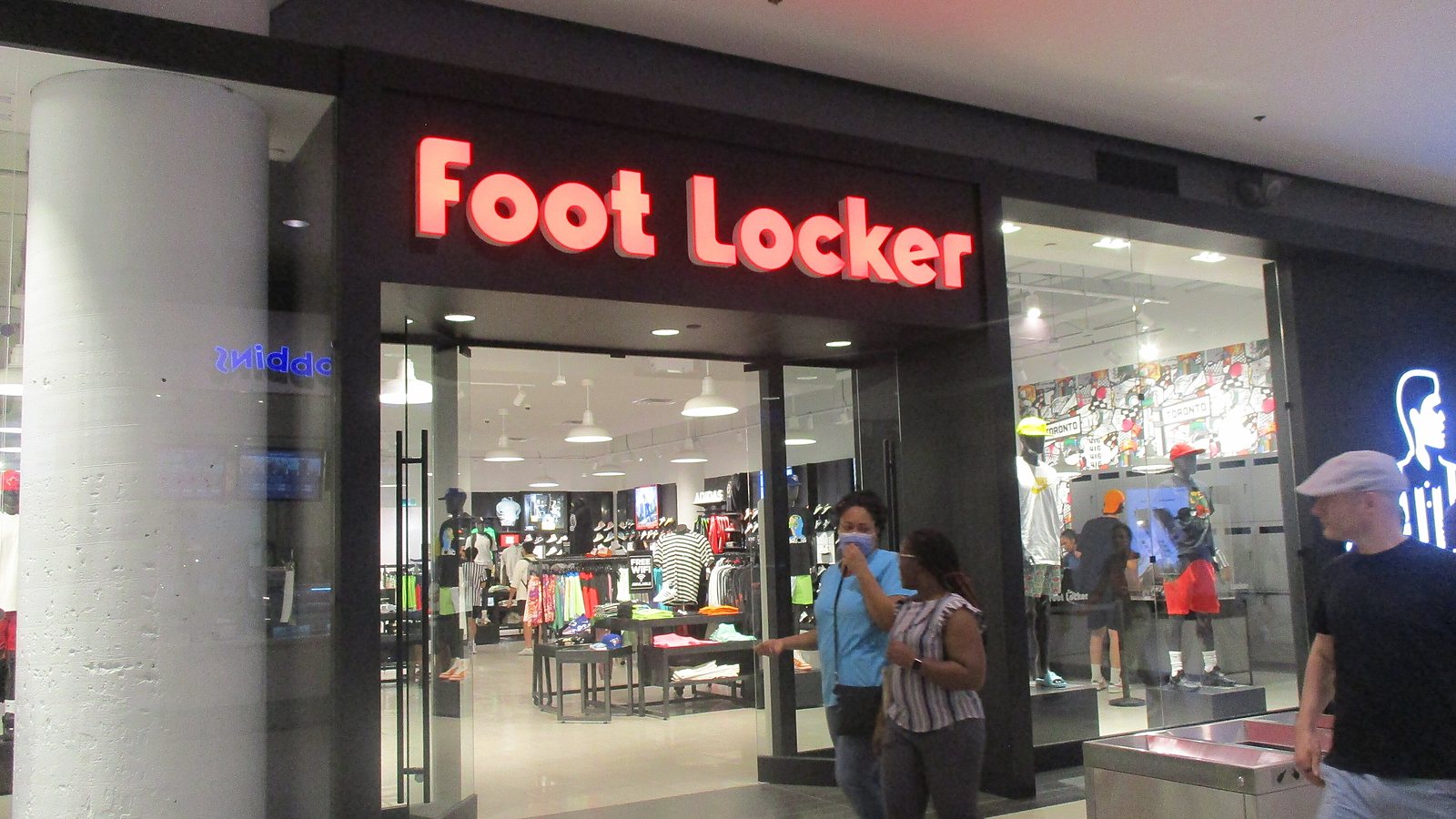
There is a version of Tuesday morning's Dick's Sporting Goods results that reads as a good quarter. Comparable sales at the company's own stores rose 4.9 percent, driven by growth in both average ticket and transactions, with what management called broad-based strength across categories and a particularly strong showing around the FIFA World Cup. Consolidated net sales rose 53.2 percent to $5.59 billion. The company received $59 million in tariff refunds and another $2.1 million in related interest income.
The stock fell about 20 percent in morning trading anyway, at one point changing hands near $142 on volume that ran orders of magnitude above normal. The reason is the other business inside the report — the one Dick's paid $2.4 billion for in 2025, and which is now large enough that its problems are the company's problems.
One company, two very different quarters
Dick's now reports as two segments. The DICK'S Business covers the namesake stores plus Golf Galaxy, Going Going Gone!, Public Lands and the GameChanger software platform. The Foot Locker Business covers Foot Locker, Kids Foot Locker, Champs Sports, WSS and atmos — 2,478 stores as of August 1, after 27 openings and 110 closures during the fiscal year.
Proforma comparable sales for that second business declined 3.6 percent in the quarter, and its international operations in Europe and Asia Pacific fell 3.3 percent. The segment posted an operating loss of $31.9 million. Consolidated operating margin came in at 7.9 percent, down from 12.4 percent a year earlier, when there was no Foot Locker in the numbers at all.
The headline arithmetic follows from that. Earnings per diluted share were $3.50 on a GAAP basis, against $4.71 in the same quarter last year. On a non-GAAP basis, adjusting for acquisition-related items, the figure was $3.53 against $4.38. Analysts surveyed by LSEG had expected $3.76 on revenue of $5.65 billion. Net income fell to $315 million from $381 million.
Part of the per-share decline is not operational at all: Dick's issued 9.6 million shares to fund the Foot Locker acquisition, and those shares dilute every quarter's earnings from here forward whether or not the acquired stores perform. That is the ordinary cost of buying a company with equity. It only becomes conspicuous when the thing you bought is losing money.
What actually went wrong in footwear
Ed Stack, the executive chairman, gave the clearest account of the quarter's turn. As the period progressed, he said, conditions across portions of the athletic footwear and apparel marketplace became "increasingly promotional," and Dick's chose to stay competitively priced rather than protect margin — a decision that costs money immediately and defends share over time.
This environment had a more significant impact on the Foot Locker Business given its greater exposure to legacy footwear silhouettes and greater dependence on footwear launch and retro product.
That sentence is the whole thesis of the miss. Foot Locker's business model rests on a particular kind of demand: limited releases, retro reissues and the launch calendar that turns a shoe into an event. When brands ship fewer launches, or when the ones they do ship land softly, there is no substitute revenue waiting behind them. Stack said both happened — there were fewer launches in the quarter, and the launches that did arrive "performed below both industry and our expectations."
The contrast with the Dick's stores is instructive. A big-box sporting goods retailer sells footwear alongside apparel, team sports equipment, golf clubs, camping gear and everything a youth soccer season requires. When one category goes promotional, the others carry the quarter. A mall sneaker chain has no such ballast. It is a single category with a single demand driver, and this quarter that driver stalled.
It is also worth noting what flattered the quarter. The $59 million of tariff refunds, received against duties paid in a prior year under the emergency-powers tariff regime, is real cash but not recurring revenue, and it lands in a period when the underlying result was already short. Strip it out and the gap to expectations widens rather than narrows. The World Cup effect works the same way in reverse: a tournament that lifted team-sport and apparel sales through the summer is not available to lift the second half.
The guidance cut is the real news
Companies miss quarters. What moves a stock 20 percent is the revision that follows. Dick's lowered its full-year consolidated net sales outlook to a range of $21.9 billion to $22.2 billion, from $22.1 billion to $22.4 billion. It cut consolidated operating income guidance to between $1.45 billion and $1.55 billion, from a prior range of $1.69 billion to $1.81 billion — roughly $250 million removed from the midpoint of expected full-year profit.
Crucially, management left the DICK'S Business comparable sales outlook untouched at 2.5 to 4.0 percent growth. Every dollar of the reduction is attributed to the acquired chain, whose proforma comparable sales outlook fell to a range of negative 2.0 percent to flat. Full-year GAAP earnings per diluted share are now guided to $10.94 to $11.94.
That split is the company's argument and its problem at the same time. The argument is that the core retailer is healthy and gaining share; the problem is that investors bought a company whose management chose to attach a struggling one to it, and the market prices the combination, not the better half.
A turnaround with a clock on it
There is a technical detail in the release that will matter more in three months than it does today. Foot Locker will not enter the company's quarterly comparable sales calculation until the fourth quarter of fiscal 2026, once its stores have completed their fourteenth full month under Dick's ownership, and will not enter full-year comparable sales until fiscal 2027. Until then, everything reported about it is proforma — calculated as though the acquisition had happened at the start of the periods being compared.
Proforma numbers are honest, but they are also a form of grace period. From the fourth quarter, the acquired stores stop being a separate story told alongside the results and become part of the headline comp that every retail analyst tracks. A turnaround that is still negative by then will not be presentable as somebody else's arithmetic.
The balance sheet gives management time to work. Inventory stood at $3.6 billion for the Dick's business and $2.0 billion for Foot Locker; Dick's own inventory was up 6 percent year over year, a modest increase against 4.9 percent comp growth. There were no borrowings outstanding under the revolving credit facility. The company repurchased 0.7 million shares in the first half at an average price of $196.38 — a reminder, at Tuesday's price near $142, that buybacks are not always well timed — and has $3.0 billion of authorisation remaining. The quarterly dividend was raised to $1.25 a share from $1.2125.
Capital expenditure tells you where the confidence is. In the first 26 weeks, gross capital spending ran $603.2 million on the Dick's business against $140.2 million on Foot Locker. The company is still building House of Sport locations, still investing in GameChanger and its retail media network, and spending on the acquired chain at roughly a fifth of that rate across a store base four times larger.
The question the acquisition was meant to answer
When Dick's announced the deal in 2025, the rationale was international reach and scale against competitors — a way to matter more to Nike, Adidas and On, and to reach shoppers in mall and urban formats that a suburban big-box chain does not serve. None of that logic is disproven by one promotional quarter. Foot Locker's own comparable sales had been running considerably worse before the acquisition; its international decline of 3.3 percent this quarter compares with 10.3 percent in the same period a year earlier.
But the reason Foot Locker was available at $2.4 billion is precisely the exposure Stack described on Tuesday: dependence on launch and retro product, in a market where the brands control the launch calendar and increasingly sell direct to the same customer. Buying the chain does not change who decides how many pairs of a hyped sneaker exist, or where they go first.
Lauren Hobart, the president and chief executive, framed the quarter as a temporary setback against an intact strategy. "While we are taking a more cautious view of the balance of the year," she said, "we remain highly confident in the strength of the DICK'S Business and our long-term opportunity at Foot Locker." Both halves of that sentence were tested on Tuesday. The first held. The second is what the market spent the morning repricing.
Financial figures are from Dick's Sporting Goods' second-quarter results for the 13 weeks ended August 1, 2026, released August 25. Analyst expectations are as surveyed by LSEG and reported by CNBC. Share-price moves are intraday and as reported during Tuesday's session.