
SpaceX raised $75 billion in history's biggest IPO — selling rockets, Starlink, AI and X in one stock
In February, SpaceX swallowed xAI — Grok, the X platform and all — in the largest private merger ever. In June it went public in the largest IPO ever, raising $75 billion at a $1.77 trillion valuation. Since then: revenue up 90 per cent, $18 billion of quarterly capital spending, only one profitable business, and a stock that round-tripped fifty per cent. An analysis of what the public actually bought.
SpaceX listed on Nasdaq in June 2026; figures below come from its prospectus and first earnings report as covered by Bloomberg, CNBC, Reuters and TechCrunch, plus official NASA and Space Force statements. Where outlets conflict, the discrepancy is noted. Sections marked as analysis are identified as such.
On June 12, SpaceX ended its two-decade run as the world's most coveted private company with the largest initial public offering in history: 555.6 million shares at a self-set, take-it-or-leave-it $135, raising $75 billion at a $1.77 trillion valuation, with an unusual 30 per cent of the public shares reserved for retail investors. The stock closed its first day up 19 per cent, around $161 — a $2.1 trillion company, instantly among the half-dozen most valuable on Earth.
What listed was not the rocket company of popular imagination. Four months earlier, in what CNBC — which reviewed the deal documents — called the largest private merger ever, SpaceX had acquired xAI in an all-stock deal valuing the AI lab at $250 billion inside a $1.25 trillion combination — bringing Grok, its Colossus data centres, and the X social platform under the same roof as Falcon, Starship and Starlink. The public was offered, in one ticker, rockets, satellites, artificial intelligence and a social network — governed by one man holding, per Reuters, more than 80 per cent of the voting power.
The first report card
August 4 brought the first earnings report, and it drew the company's economics in sharp lines. Revenue was $7.8 billion, up roughly 90 per cent year over year; the net loss, $541 million, was less than half what analysts feared. The 2025 baseline from the prospectus: $18.7 billion of revenue and a $4.9 billion loss. Backlog stands at $47.5 billion.
The structure underneath: only Starlink makes money. The satellite-internet division grew revenue 66 per cent and carries the company; the AI unit and the space business proper run at a loss — the latter unsurprising for a division funding Starship, the former burning at frontier-lab rates. And the capital spending is in a category of its own: roughly $18 billion in a single quarter, up from under $3 billion a year earlier, most of it AI infrastructure, with the finance chief guiding to similar levels for two more quarters.
The market's verdict has been appropriately violent: down about 50 per cent from the June peak by late July as the capex sank in, then back above the $135 offer price this week — a full round trip in nine weeks, with insider lock-up releases now beginning to test the float.
Starlink, the business that pays for the dream
Starlink reached 12 million subscribers by June, with some 10,400 satellites in orbit, and its expansion has moved from households to fleets: United's aircraft fleetwide, roughly 500 jets for British Airways' parent, 230 for Emirates, 850 for Lufthansa's group. Direct-to-phone service is live with carrier partners, and trade reporting describes plans for a full U.S. wireless offering blending satellite and terrestrial coverage. Elon Musk's framing on the earnings call was maximal, as usual: "It's not out of the question that at some point, Starlink will deliver a majority of the world's internet."
Starship at the edge of orbit
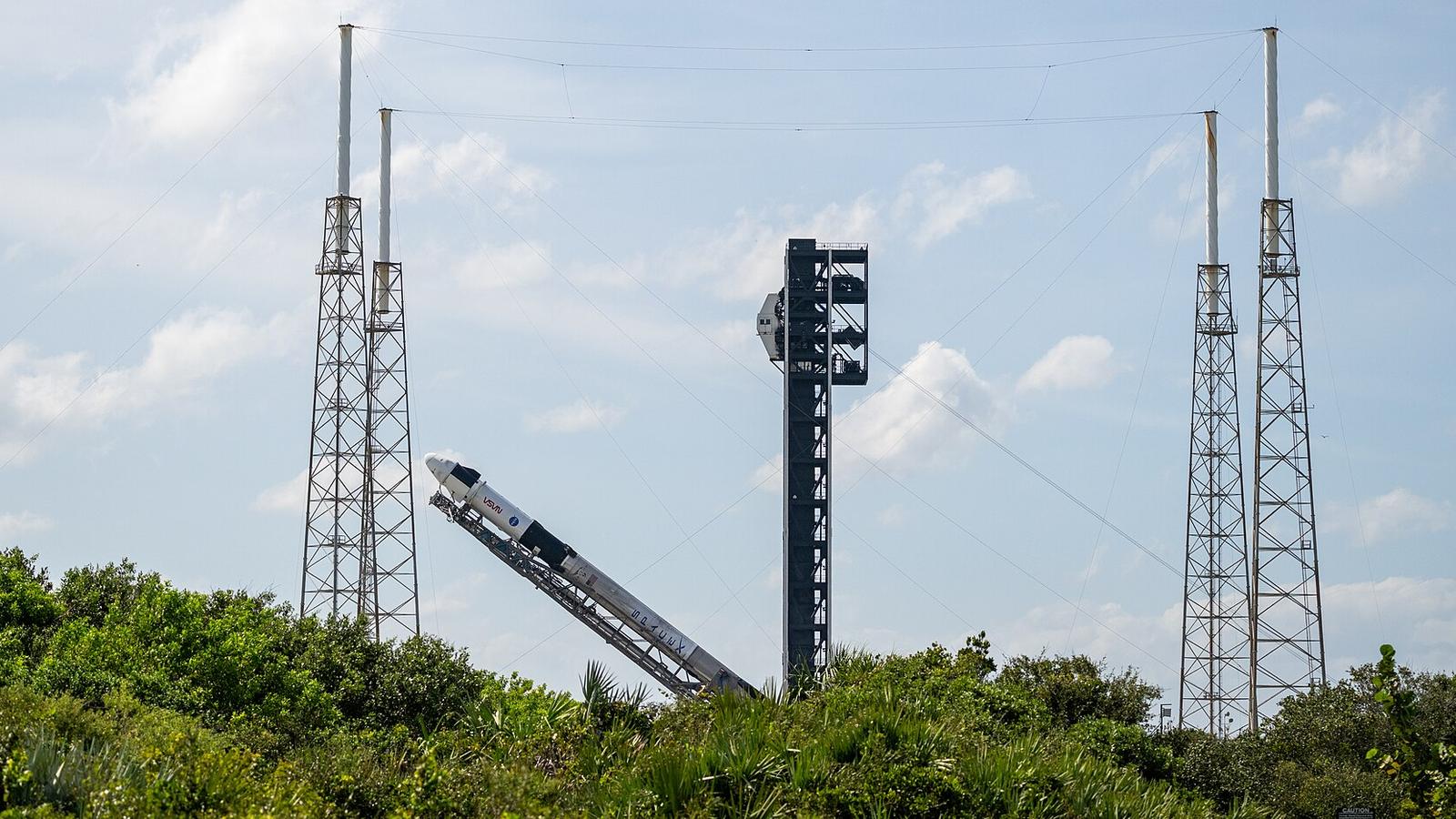
The rocket side enters autumn at its most consequential moment since 2020. Falcon set another record — 165 launches last year, roughly three a week. Starship survived a brutal 2025 — three consecutive upper-stage losses in the spring — then closed the year with two successes, debuted its larger V3 configuration in May, and in July deployed the first twenty full-size Starlink V3 satellites. The next flight, targeted for the coming weeks, is slated to be the first full orbital mission and the first attempt to catch the returning ship with the launch tower's arms.
NASA's patience, meanwhile, has already produced consequences: last October the agency reopened the Artemis III lunar-lander contract to competitors after Starship's delays, and its administrator — Jared Isaacman, confirmed 67–30 in December after a withdrawal-and-renomination saga — now points to an Artemis III launch in 2027. Gwynne Shotwell, on the earnings call: "We want to put boots on the ground — boots on the moon — in 2028." Mars has slipped accordingly: the November 2026 uncrewed window Musk once gave even odds is now widely treated as 2028's business. The defence ledger grew regardless: SpaceX holds Golden Dome missile-defence contracts including a $4.2 billion Space Force award for threat-detection satellites, inside a programme Congress's budget office prices at $1.2 trillion.
Analysis: what the public bought
The following section is analysis, drawn from the reported facts above.
Strip the spectacle and the investment case is three stacked bets. The first — Starlink — is proven: a compounding, profitable utility with a plausible path to being the world's largest ISP. The second — Starship — is a call option on the cost of mass to orbit collapsing, now weeks from its orbital exam. The third — xAI — is a frontier AI lab consuming Starlink's profits and then some, folded into the company months before the IPO at a valuation its new public shareholders never got to negotiate.
That last clause is the governance story in miniature. The merger, the self-set IPO price, the 80-plus per cent voting control, compensation reportedly tied to Mars milestones and market caps in the several trillions — every major economic decision at the sixth-largest company in America is, structurally, one person's to make. Reuters put it plainly: only Elon Musk can fire Elon Musk. Half a million retail investors took the offer anyway, with eyes open; the 50 per cent drawdown and recovery in their first two months was a fair preview of the ride.
The honest summary is that SpaceX is the era's thesis stated as a single stock: that rockets, satellites, AI and media are one integrated bet on the same future, best held in one pair of hands. Nothing about the first quarter as a public company disproved it — revenue is compounding, the losses were smaller than feared, and the machine keeps launching. Nothing proved it, either. The proof is scheduled: a tower catch, a lunar landing, an AI business that someday charges more than it burns. The public bought the world's most expensive to-do list, from the only company with a credible record of doing.
Sources
- CNBC and TechCrunch, June 11–12, 2026 — the IPO: $135 fixed price, 555.6M shares, $75B raised, $1.77T valuation, ~30% retail allocation, first-day close near $161 (~$2.1T); CNBC, August 10, 2026 — the recovery above the offer price.
- CNBC-reviewed deal documents and wire factboxes, February 2, 2026 — the all-stock xAI acquisition: xAI at ~$250B inside a ~$1.25T combination, including Grok and the X platform; SpaceX's earlier $2B xAI investment (WSJ/Reuters, July 2025).
- Bloomberg and Reuters, August 4–5, 2026 — first public earnings: revenue $7.8B (up ~90%; one outlet reported 92%), net loss $541M, ~$18B quarterly capex with two more such quarters guided, $47.5B backlog, Starlink +66% and sole profitable unit; prospectus 2025 figures ($18.7B revenue, $4.9B loss) as covered at listing.
- Company disclosures via Bloomberg — 12M Starlink subscribers (June 2026); airline deals as announced by United, IAG, Emirates and Lufthansa (2025–26); U.S. wireless plans per trade press, attributed as reports.
- SpaceX/FAA flight records as compiled in launch logs — the 2025 V2 failures and recoveries, V3 debut (May 2026), Starlink V3 deployment (July 2026), and the planned first orbital flight and ship catch; Musk and Shotwell remarks from the August 4 call via Bloomberg and Space.com.
- NASA statements and wide coverage, October 2025 — Artemis III lander reopened to competitors; AP/Reuters, December 17–18, 2025 — Isaacman's 67–30 confirmation; Isaacman remarks, July–August 2026 — 2027 launch confidence.
- Reuters, May 29, 2026, and Space Force announcements — the $4.16B threat-detection contract and Golden Dome awards; Congressional Budget Office, May 2026 — the $1.2T programme estimate.
- Reuters, April 2026 — Musk's 80%+ voting control and the compensation structure tied to Mars milestones (figures vary by outlet and are attributed as reported); WSJ, August 10, 2026 — Tesla–SpaceX merger speculation, noted as speculation.
Figures are in U.S. dollars as reported. IPO proceeds are per CNBC ($75B); year-over-year growth is stated as roughly 90% because outlets differ; Starlink's historical segment split varies between prospectus summaries and is omitted. Artemis dates reflect a stated 2027 launch and 2028 surface framing that officials have used inconsistently. Mars window plans are aspirations, not schedules.