
Trump and Xi end a three-day Washington summit with two pandas, 100,000 student places, a two-month trade truce extension and an AI hotline — and no movement on Taiwan, Iran or chips
Xi Jinping's first visit to Washington in 11 years produced a B-2 flyover, a state dinner seated with Jensen Huang, Elon Musk and Tim Cook, and a Chinese readout that talks of cooperation on AI. The measurable outcomes fit in a paragraph. The disputes that brought the two men together are exactly where they were on Wednesday.
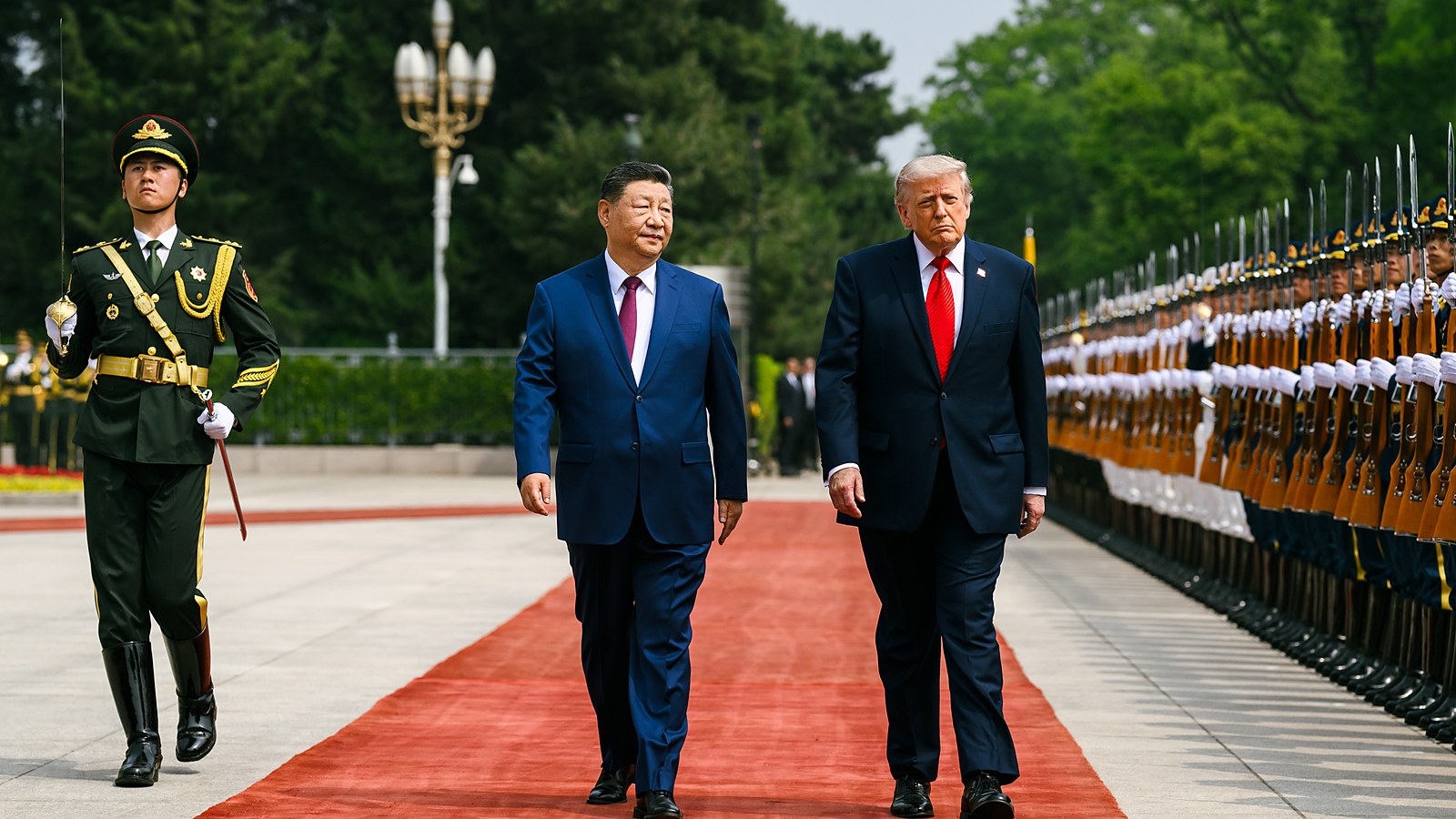
The cleanest way to measure a summit is to list what can be counted afterwards. By that standard, Xi Jinping's three-day state visit to Washington, which ended on Friday, produced four things: two giant pandas for Zoo Atlanta, an invitation for 100,000 American students to study in China, a two-month extension of a trade truce that was due to expire in November, and an agreement to open a hotline for notifying each other of artificial-intelligence safety incidents. Everything else was ceremony, and there was a great deal of ceremony.
That is not the same as saying the visit failed. Xi had not set foot in Washington in 11 years, and the leaders of the two largest economies met for the second time in four months without incident, which after the tariff war of 2025 is itself a change of state. But it is worth being precise about what was agreed, because the pageantry was designed to make it look like more.
What was actually agreed
The trade truce is the most consequential item and the least impressive. Treasury Secretary Scott Bessent said the two sides had extended the arrangement that suspends the steepest tariffs each country imposed on the other, but only until January. A truce that needed a state visit to survive two more months is a truce neither side is confident in. The United States Trade Representative, Jamieson Greer, said details of the trade negotiations would be released on Monday, which means the substance, if there is any, is still being written.
The AI hotline is genuinely new. Bessent discussed a "U.S.-China AI dialogue" with his counterpart He Lifeng the weekend before the summit, including a channel for incidents "up to a national security level," and both sides have now agreed to open one. The comparison everyone reached for was the Cold War red telephone between Washington and Moscow. Aalok Mehta of the Center for Strategic and International Studies told CNBC that what emerged was "an intent to continue dialogue, along with a hotline of some sort for emergencies," and that the hotline could become "a robust tool when paired with a proper incident reporting system." There is no incident reporting system yet.
The pandas and the students are the oldest tools in the Chinese diplomatic kit, and they were deployed with precision. Xi said two pandas, Ping Ping and Fu Shuang, from a research base in Chengdu would arrive in Atlanta "in the coming days." The student invitation, 100,000 places, is a round number offered at a moment when American universities are losing Chinese enrolment and Chinese universities are short of American students. Neither commitment costs Beijing anything it values.
What was not agreed
Taiwan. According to the Chinese readout, Xi urged Trump to oppose Taiwanese independence and to handle the issue prudently. Trump has already postponed approval of a $14 billion arms package for the island and described arms sales as "a very good negotiating chip," language that alarms Taipei precisely because it treats the island's defence as fungible. The White House had not released its own summary of the talks by Friday, so the American position on Taiwan after the summit is known only through Beijing's account of it.
Iran. This was the item Washington wanted most. China is Iran's largest trading partner, and the United States has been at war with Iran alongside Israel since February, with the Strait of Hormuz effectively closed for most of that time. Trump wanted Xi to use that leverage. Xi backed a return to a ceasefire and eventual peace talks, but the Chinese readout offered no specifics on reopening the strait and no commitment to pressure Tehran. Beijing gets the benefit of appearing constructive without spending anything.
Chips. American export controls on advanced Nvidia processors remained, by CNBC's account, a sticking point, and there is no sign either side moved. The dinner seating told its own story: Nvidia's Jensen Huang, AMD's Lisa Su, Apple's Tim Cook and Elon Musk were at the presidential table, with OpenAI's Sam Altman and Greg Brockman, Google's Sergey Brin and Microsoft's Satya Nadella elsewhere in the room. Anthropic was not on the list. The companies that sell into China were seated closest to the two men who decide whether they can.
It should be a race of catching up with one another, not a wrestle in which one either wins or loses.
That was Xi, in remarks reported by Al Jazeera, urging "healthy" competition "kept within bounds" and warning against the "Thucydides Trap," the academic shorthand for a rising power and an established one sliding into war. Trump's own framing was personal: "From the time of my first election in 2016, President Xi and I have forged a friendship, a truly great friendship, actually, built on mutual respect and the vital interests of our people." Asked for details of the meeting, he told reporters: "We had a great meeting."
The AI conversation, as far as it went
The most striking thing about the AI discussion is how much both sides agreed to rule out. Trump posted on Thursday morning that "Super Intelligence (SI)," his adopted term for the technology, "will be a big topic of discussion, but I want to leave it exactly where it is. That is China's position also." Both governments had already rejected the idea of guardrails or a slowdown, which Sam Altman and Anthropic's Dario Amodei had publicly called for. The summit did not revisit that.
What the Chinese readout does contain is a set of principles. Xi said the two countries "may have competition, but they may cooperate even more" on AI, that it "must be kept under human control," and that the two sides could "jointly prevent the misuse and abuse of AI." Trump, per the same readout, said the two sides should "maintain dialogue and strengthen cooperation on AI." Those are the sentences of two governments agreeing to keep talking, and the hotline is the only mechanism attached to them.
The reception at home
The pageantry irritated the people it was presumably meant to impress. Senator Roger Wicker, the Republican chairman of the Armed Services Committee, opposed the "lavish welcome" and pointed to the Chinese Communist Party's record. Republican senators, The Hill reported, were dismayed by the embrace of Xi given China's reported support for Iran during a war in which Americans are fighting. Senator Rand Paul took the opposite view: "Talk more, war less." Democrat Chris Van Hollen accused Trump of "ingratiating himself with authoritarians."
Semafor drew the comparison that will linger. Japan's prime minister, the leader of the closest American ally in the region, arrived in Washington earlier this year to an empty tarmac and pressure over her country's currency. Xi got a planeside ceremony, a B-2 flyover, a Nixon-era toast and a bald-eagle statue. Allies notice the difference in treatment between themselves and the adversary they are asked to help contain.
The counter-argument
The case for the summit is that substance was never the point. The two governments have working-level channels for trade, and the truce extension shows they are functioning. What a state visit does is lower the temperature at the top, and that has value in a year in which the United States is at war in the Gulf and the two navies operate within sight of each other in the Taiwan Strait. A meeting that produces pandas and a hotline is a meeting that did not produce a crisis, and Xi's language about competition "kept within bounds" is the language of a leader who wants the status quo to hold.
There is also the China-side argument, made in an Al Jazeera analysis on Friday, that Beijing came out ahead precisely by conceding little: it offered diplomatic cover on Iran without military entanglement, extended a truce that costs it nothing, and watched Washington press its own allies harder than it pressed Xi. For governments across the Gulf and South Asia that are being asked to choose sides, the summit showed which side is cheaper to stand near.
The durable point is that the two governments have now met twice in four months and agreed, both times, to keep meeting. That is a floor, not a result. The tariff truce runs out in January, the Taiwan arms package is still unapproved, the strait is still closed, and the AI hotline has nobody yet trained to answer it. Monday's trade details will show whether anything was written down. Until then the summit's measurable output is two pandas, and they have not arrived either.
This report is based on the Chinese government's readout of the talks as reported by CNBC, statements by Treasury Secretary Scott Bessent and USTR Jamieson Greer, White House guest lists and remarks reported by CNBC, NPR, Semafor, The Hill and Al Jazeera, and public statements by Senators Wicker, Paul and Van Hollen. The White House had not published its own readout of the summit as of Friday afternoon; the American account of the Taiwan and Iran discussions is therefore known only through Beijing's summary. Details of the trade arrangement are due on Monday and may change the assessment of the truce extension.