
Apple's new Mac mini ships the first 2-nanometre chip it has ever made, and starts at $899 — $300 more than the same machine cost in June
Tuesday's unannounced launch put the M6 in the Mac mini and an M5 Ultra in the Mac Studio, with 512GB of unified memory and Thunderbolt clustering aimed squarely at people running frontier AI models on their own desks. The engineering argument is memory bandwidth. The commercial argument is that memory now costs enough to move Apple's entry price twice in three months.
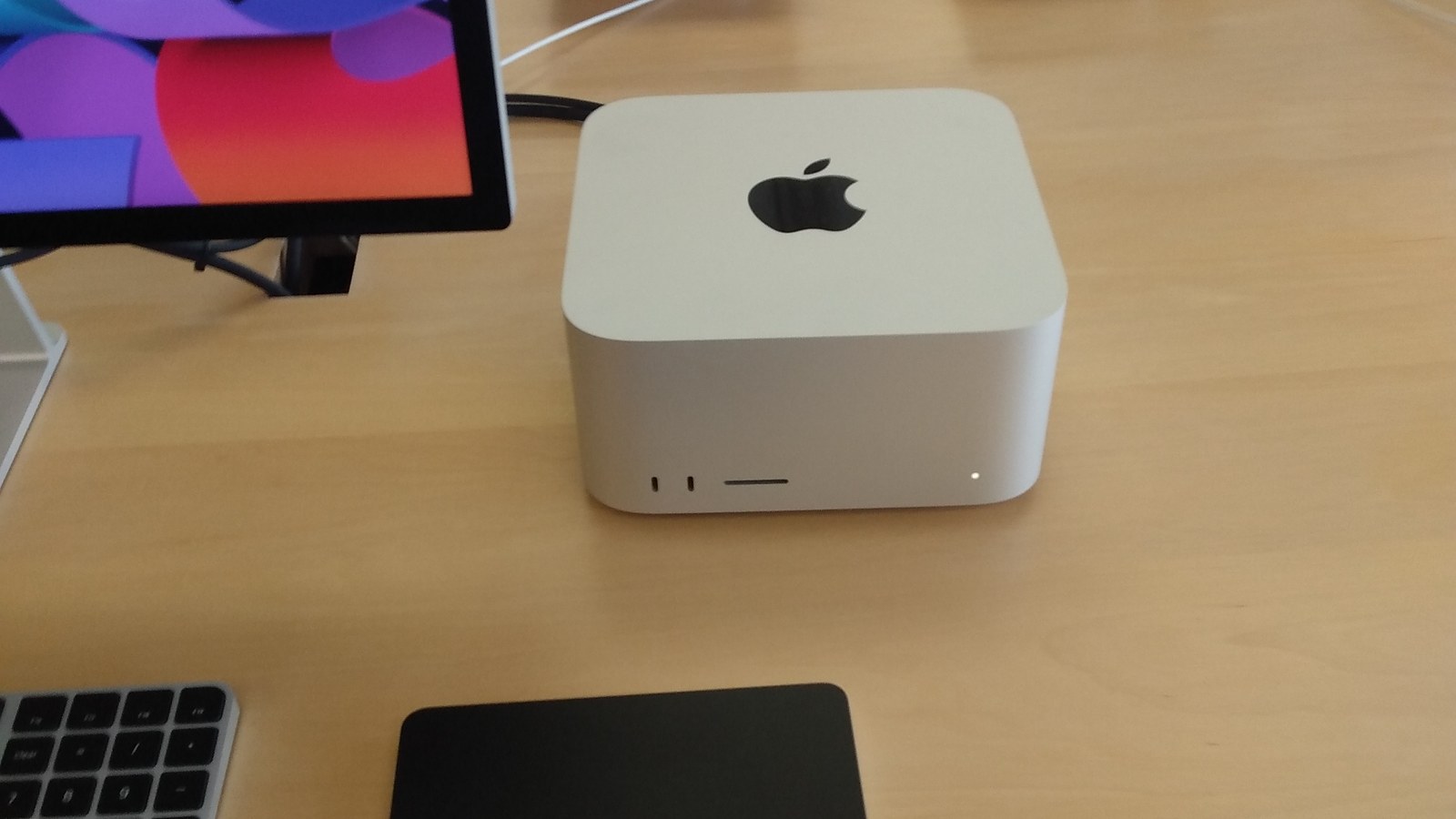
Apple does not usually launch desktop computers by press release in late August, three weeks before an iPhone event. On Tuesday it launched two. The Mac mini gets the M6 and M5 Pro; the Mac Studio gets the M5 Max and an all-new M5 Ultra. Both went up for pre-order the same morning in 30 countries, with delivery beginning September 22.
The timing is the first thing worth reading. An iPhone announcement absorbs all available attention; putting desktops out ahead of it signals that Apple wants these machines judged on their own terms rather than as an afterthought at a keynote. The company's framing makes the reason plain. This is not a productivity refresh. It is a bid for the desk of anyone who runs AI models locally.
The M6 is Apple's first 2-nanometre chip
The Mac mini is now the first Apple computer to ship an M6-generation processor, manufactured on a 2-nanometre process at Taiwan Semiconductor Manufacturing Company. It carries a 12-core CPU and a 12-core GPU — two more cores each than the M4 it replaces — with Neural Accelerators built into every GPU core for the first time on this machine, plus what Apple describes as a dual 16-core Neural Engine.
Apple's claimed gains are up to 4x faster AI performance, 2x faster graphics and storage, and 40 percent faster CPU performance against the M4 Mac mini. Standard unified memory is 16GB, configurable to 32GB, with bandwidth up to 170GB/s. In the benchmark Apple chose to lead with — large language model prompt processing in LM Studio — it claims up to 4.8x the speed of the M4 machine.
The step up, the M5 Pro, brings an 18-core CPU, up to a 20-core GPU with third-generation ray tracing, up to 64GB of unified memory and 307GB/s of bandwidth, along with three Thunderbolt 5 ports. Apple says LLM prompt processing runs up to 4x faster than on the M4 Pro version. Johny Srouji, the company's chief hardware officer, described the small machine as suited to "always-on, deskside agentic computing" — a phrase that would have meant nothing on a Mac mini page two years ago.
The Mac Studio is the real statement
The Mac Studio with M5 Ultra scales to a 36-core CPU, an 80-core GPU — the largest Apple has built — and 512GB of unified memory running at 1.2TB/s, half again the bandwidth of the previous generation. Apple claims 4.3 times the peak AI compute of the M3 Ultra it replaces, and 9.8 times that of the M1 Ultra.
Those numbers matter less than the memory figure. Running a large model locally is not primarily a compute problem; it is a problem of holding the model's weights somewhere the processor can reach them quickly. On a conventional workstation, that means graphics cards with a few dozen gigabytes each and a great deal of engineering spent moving data between them. Apple's unified memory architecture puts the whole pool in one place, and 512GB is enough to hold model weights that would otherwise require a rack.
The company is also leaning on Thunderbolt 5 and RDMA to let multiple Mac Studios be clustered into a single shared memory pool. Four machines, Apple says, deliver up to 3x the inference throughput of one. Alongside that it is shipping Core AI, a new framework for building and deploying models on Apple silicon, next to the existing open-source MLX.
Mac Studio lets users run massive models entirely on device with complete privacy — without counting tokens or worrying about rising cloud costs.
That line from Apple's announcement is a competitive positioning statement dressed as a feature description. Every frontier lab bills per token. Every enterprise running inference through an API is paying a metered rate that rises with usage and falls outside its own security perimeter. Apple is selling the alternative: a fixed capital cost, no per-query billing, and data that never leaves the desk.
Why desktops became strategic
Developers building autonomous agents have gravitated toward dedicated Mac minis rather than cloud instances, because an agent that runs continuously on a machine you own has predictable cost and no cold starts. AI researchers experimenting with local models have gravitated toward the Mac Studio for the memory. Neither is a large market by Apple's standards. Both are influential ones, and both are populated by the people who decide what the rest of the industry buys next.
It is also a rare position of genuine differentiation. Apple's silicon advantage in the phone market has narrowed as competitors caught up; in on-device inference, the unified memory design gives it something no standard PC configuration replicates at the price. Nvidia's data-centre parts are faster and cost vastly more. A workstation with equivalent usable memory for model weights is not a $5,499 machine.
The Mac Studio's connectivity has been rebuilt around the same idea. It carries up to six Thunderbolt 5 ports at 120Gb/s, storage on a PCIe Gen 6 architecture that Apple says doubles read and write speeds, Wi-Fi 7 and Bluetooth 6 for the first time via the in-house N1 chip, support for up to eight displays, and genlock over USB-C for frame-accurate synchronisation with professional cameras. The M5 Ultra's media engine has twice the video encode and decode blocks of the M5 Max, enough for 33 simultaneous streams of 8K ProRes 422. With the Mac Pro discontinued earlier this year, this is now the top of Apple's desktop line, and it has to serve both the film-post market and the AI one.
The price is the other headline
The Mac mini now starts at $899, up $100 from the model it replaces. That comparison undersells the move. Earlier this summer the entry Mac mini went from $599 to $799, an increase Apple attributed to memory costs. In roughly three months, the cheapest new Mac mini has gone from $599 to $899 — a 50 percent increase on a machine whose $599 price was, for two generations, one of the strongest arguments for buying a Mac at all.
The Mac mini with M5 Pro starts at $1,699. The Mac Studio with M5 Max holds at $2,499, unchanged. The M5 Ultra configuration starts at $5,499, against $5,299 for the outgoing M3 Ultra version — a $200 rise for a chip a full generation newer. Configurations with 512GB of unified memory do not arrive until late October. Education pricing runs $100 to $400 below each tier.
Read together, the pricing has a logic: hold the line at the professional end, where the memory bandwidth story justifies the ask, and let the entry machine absorb the cost of the memory it now has to carry. Apple has been unusually direct in attributing that to component costs, which is what a company says when it expects the pressure to persist.
There is a strategic cost to it as well. The $599 Mac mini was a conversion device — the cheapest legitimate route into the Mac ecosystem, and the machine most often recommended to someone switching from Windows. At $899 it competes differently, and against a broader field of small-form-factor PCs, many of which now ship neural processing units of their own.
The memory pressure is not Apple-specific, and that is the wider point. The same buildout that makes a 512GB desktop worth advertising has bid up high-bandwidth memory across the industry, pulling supply toward data-centre customers who will pay almost anything for it and leaving consumer devices to compete for what is left. A laptop, a games console and a phone all now carry the cost of a capacity shortage created by inference demand. Apple happens to be the manufacturer most willing to say so out loud.
What to watch after September 22
The machines arrive with macOS 27, which carries the next generation of Apple Intelligence and the reworked Siri that Apple has been promising through two difficult product cycles. That software is where the on-device pitch either lands or does not; hardware capable of running frontier models locally is only interesting if the operating system gives ordinary users a reason to. The developer-facing case — Core AI, MLX, local fine-tuning, agents that run on a box under a desk — is already proven by the people who buy these machines today.
The commercial question is narrower. Desktops are a small fraction of Apple's revenue, and this launch will not change that. What it signals is where the company thinks its silicon advantage is most defensible at a moment when the iPhone's is not, and how much of the memory-cost shock now moving through the entire computing industry it intends to pass to customers. On Tuesday's evidence, the answer to the second question is most of it.
Specifications, performance claims and pricing are from Apple's newsroom announcements of August 25, 2026. Apple's performance comparisons are the company's own, measured against the prior-generation machines named in each claim. Manufacturing process and market context as reported by CNBC.