
The US struck Iranian launchers on Larak Island and Iran hit back at bases in Jordan and the UAE, breaking a month-long pause and pushing Brent crude above $90
CENTCOM said it had finished clearing sea mines from the Strait of Hormuz last week. Within days a supertanker had struck two of them and US forces were bombing the launchers preparing to lay more. The asymmetry in that sentence is the whole war.
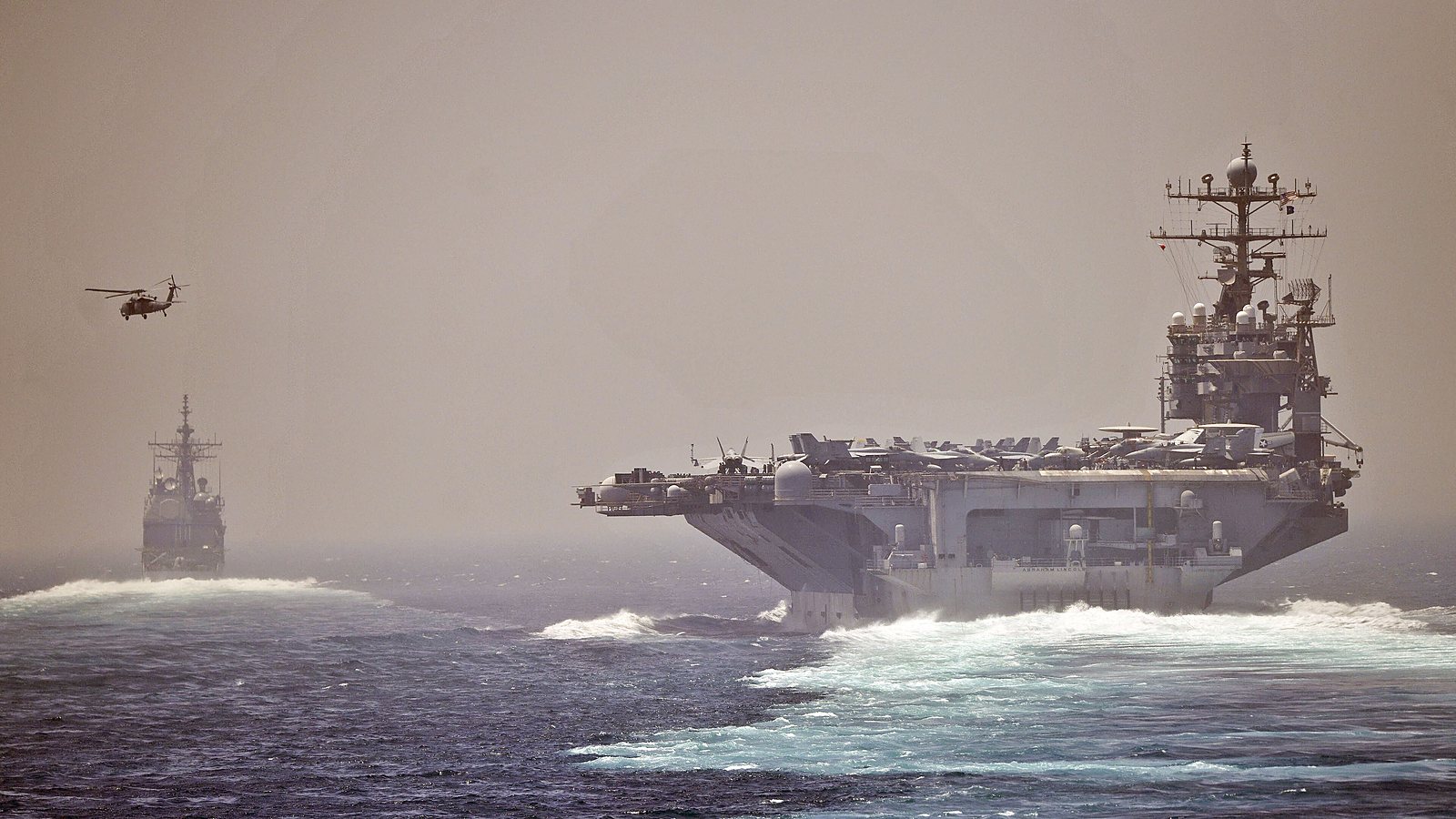
Last week the commander of US Central Command, Adm. Brad Cooper, announced that American forces had finished clearing sea mines from the international shipping routes of the Strait of Hormuz. It had taken weeks. By Sunday night US aircraft were striking two Iranian rocket launchers on Larak Island because, CENTCOM said, the Revolutionary Guard was observed preparing to fire more mines into the same water.
That is the shape of the sixth month of this war. Clearing a minefield is a slow, dangerous, capital-intensive operation conducted by a small number of specialised vessels. Laying one is a rocket on a truck. The Strait of Hormuz can be closed faster than it can be opened, and nothing that has happened since February has changed that arithmetic.
What happened
US forces struck the two launchers late on Sunday, in the first publicly acknowledged American attack on Iranian positions since July 29. "Islamic Revolutionary Guard Corps forces were observed preparing to launch rockets with sea mines into the Strait of Hormuz," Navy Capt. Tim Hawkins, a CENTCOM spokesperson, said in a statement. Larak is a small Iranian island in the strait that the Guard uses to monitor vessel traffic near the port of Bandar Abbas.
The Guard said the strike killed and wounded soldiers and civilians; initial reports put it at two Iranians killed and two injured, with one Guard navy officer named among the dead. Iran's Mehr news agency reported that Iranian air defences downed a US MQ-9 drone over the strait.
Retaliation came within hours. Iran fired ballistic missiles at the US-operated King Hussein and Al Azraq air bases in Jordan, and at American forces in the United Arab Emirates. Iranian state television said the strikes destroyed "technical and repair infrastructure, as well as the enemy fighter deployment sites", inflicting "heavy damage".
The claims on the receiving end are considerably more modest. Reuters cited a US source saying all incoming missiles aimed at US forces in Jordan were intercepted with no significant impact. Jordan's armed forces said they shot down eight missiles that entered Jordanian airspace, and did not say whether anything got through. The UAE denied Iranian reports that its al-Minhad Air Base had been hit by missiles, but confirmed it intercepted drones over its territorial waters launched from Iran.
The number that matters more than the strikes
The military exchange is the news. The shipping figure is the story.
According to the independent tracking agency Tanker Trackers, crude oil exports through the Strait of Hormuz over the past seven days averaged 3.8 million barrels per day. During the formal ceasefire period earlier in the conflict — which in practice lasted about 25 days — the figure was 9.8 million.
That is a waterway operating at under 40 per cent of its recent wartime peak, without anyone having formally closed it. The White House position is that the US now controls the strait and vessels may transit freely. That claim is heavily contested, and the traffic data is the contest: shipowners, insurers and charterers are voting with hulls, and they are not persuaded.
Supply risk will persist and oil inventories will continue to deplete in the coming weeks and months. The Iranian crisis has likely changed the security status quo in the Middle East.
The mechanism is insurance more than it is naval power. A tanker does not need to be sunk to be removed from the market; it needs only to become uninsurable, or insurable at a premium that makes the voyage uneconomic. Mines are exceptionally good at producing that condition, because their effect is probabilistic and their location is unknown. A cleared channel that was cleared last week is not a cleared channel today, and every underwriter knows it.
The tanker that proved the point
On Monday the Revolutionary Guard said a supertanker had caught fire and been disabled in the southern part of the strait after striking two naval mines. The Guard's framing was explicit: the vessel had not complied with Iran's rules for passage. It warned that other ships violating those rules would meet the same fate, and told vessels to follow its navigation regime.
A second tanker was struck by an unidentified projectile on Saturday while transiting inbound along the southern lane near the Omani coast, according to the UK Maritime Trade Operations Centre, which reported no casualties and advised caution.
Underneath both incidents is a jurisdictional claim. Iran maintains that entry into the strait without its authorisation is illegal, and has been directing traffic into a northern lane close to its own coast. Maritime law provides for freedom of navigation through a waterway shared between Iran and Oman. Oman and Iran have reportedly agreed on a single permitted route, but Iran has attached preconditions before opening it and the US has not stated a position. In the meantime, a captain choosing between the northern lane and the southern one is choosing between two different sets of people who might sink them.
Kharg, and a video
President Donald Trump extended his threats on Sunday evening to Kharg Island, Iran's principal oil export terminal, posting to Truth Social what appeared to be an artificial-intelligence-generated video of a large oil facility being destroyed by missiles, with the caption that it is "going to be blown to smithereens!"
There was no indication of any attack on Kharg, which lies about 410 miles west of Larak. Hamid Bovard, head of the state-run National Iranian Oil Company, dismissed it: "Trump's tweets are laughable and conditions in Kharg are calm." He said workers were continuing to repair damage from earlier attacks on the island.
The distinction is worth holding onto, because a synthetic video of a strike that did not occur is not a small thing in a market that reprices on headlines. Kharg is the terminal through which the overwhelming majority of Iranian crude has historically been exported. A genuine strike on it would be a different category of escalation from hitting two launchers on an island. Traders had to price the threat without being able to verify the image — which is, presumably, some of the point.
What the market did
Brent crude rose about 3 per cent on Monday to just under $91 a barrel. US West Texas Intermediate gained about 3.6 per cent to roughly $86.36. Those are meaningful moves, but they are not panic moves — which itself is informative. Six months into a war that has halved traffic through the world's most important oil chokepoint, a resumption of direct US-Iran fire is worth three per cent.
The reason is that the supply disruption is already in the price. Iranian crude exports have been at zero for some time. The market has spent half a year adjusting to a Hormuz running at reduced capacity. What Monday repriced was not the loss of barrels but the probability that the disruption extends further into the future than the curve assumed.
The sharper squeeze is one level down the chain. Goldman Sachs noted that rising strikes on refineries across the Middle East and in Russia have further constrained already-stretched global refining capacity, pushing refined product margins to new highs. Crude is a headline; diesel and jet fuel are what actually reach consumers and central bank inflation forecasts.
The diplomacy that is not happening
Iranian President Masoud Pezeshkian, speaking in Kyrgyzstan alongside Indian Prime Minister Narendra Modi at a Shanghai Cooperation Organisation meeting, said Iran still wants a negotiated end to the war, that its continuation "serves neither our interests nor those of the region or humanity", and that the American side "has not fulfilled its commitments". He also said Iran would "never remain silent in the face of any aggression". Iran's foreign ministry said the US and its allies bear "full responsibility" for the escalation.
Both things are being said because both are true of Tehran's position: it wants out, and it will not be seen to be driven out. Pezeshkian's other objective in Kyrgyzstan was Chinese investment. China, Iran's principal oil customer, has publicly opposed Washington's new sanctions campaign, announced last week under the name Operation Economic Outcast.
That campaign is about to meet resistance closer to home. A G20 finance ministers' meeting in the US is expected to produce a clash over American demands that more countries sanction Iran or face punitive measures themselves. Germany's finance minister, Lars Klingbeil, facing difficult regional elections, is expected to press for a diplomatic conclusion, citing the war's inflationary effect.
The durable point
The stated American objective has narrowed considerably. At the outset, senior US and Israeli officials described the goal as toppling the Iranian government. Six months on, that government is still there, and the administration's focus has shifted to reopening a waterway.
It is a more achievable aim, but it is not achievable by force alone, and Sunday demonstrates why. The US can clear the strait. It cannot keep it clear against an adversary that can re-mine it from a truck on an island, and it cannot compel a shipowner to believe that it is clear. The strait reopens when Iran decides it is open. Everything else is the price of establishing that.
This report is based on statements from US Central Command, Iranian state media as reported by Reuters, NPR, The Guardian and CNBC, the UK Maritime Trade Operations Centre, and shipping data published by Tanker Trackers. Casualty claims from both sides are unverified and mutually inconsistent; the damage assessments attributed to Iranian state television have not been independently confirmed, and neither has the US account of interception rates. Oil prices are as of Monday trading and had not settled at the close. The vessel struck by mines has not been publicly identified.