
No talks, no strikes, no exit: Trump threatens an 'economic D-Day' against any country trading with Iran as a fresh carrier reaches the Arabian Sea
The 60-day negotiating window lapsed this week without a deal. Brent crude has climbed to $94, Iran's oil exports have collapsed below 300,000 barrels a day, and the USS George Washington arrived Wednesday to relieve a carrier whose crew has spent more than 260 consecutive days at sea. An analysis of a standoff in which both capitals believe time is on their side.
Six months into the war with Iran, the United States finds itself in a condition that is neither war nor peace. The two countries are not seriously negotiating, and for the moment they are not shooting at each other either — what the New York Times this week described as an uneasy in-between state that could harden into stalemate or tip back into open fighting. The question its correspondents posed on Wednesday is the one every government watching the Gulf is now asking: who blinks first?
President Trump's answer, delivered on Truth Social on Tuesday, was to promise what he called the "most crushing economic operation" ever mounted against Iran — "an ECONOMIC D-DAY," in his phrasing. The declared targets are not Iranian ships or missile sites but the world's banks, airports, exchange houses and ship registries: "ANY country that allows its financial institutions, businesses, airports, or government entities to provide any type of lifeline to Iran will itself face TREMENDOUS Economic Consequences," the president wrote, per Al Jazeera and Bloomberg. Named enforcement priorities include oil smuggling, currency swap lines, cash transfers and front companies.
What tool the White House intends to use is less clear than the volume of the threat. In January, Mr Trump signed an order threatening a 25 per cent tariff on countries that trade with Iran; whether that tariff was ever implemented remains unresolved, and analysts quoted this week frame the current threat as a revival of the same instrument. The harder legal constraint, trade lawyer Shantanu Singh told Al Jazeera, is that no country can embargo another's trade outright without UN Security Council authorisation — the president's real weapon is unilateral: cutting offenders off from the American financial system. Frederic Schneider of the Middle East Council on Global Affairs put the ceiling on the strategy plainly: "Sanctions do raise the cost of trading with Iran, but they cannot end it."
How the standoff was built
The road here runs through the most violent year in the two countries' history. American strikes hit Iran's nuclear sites in June 2025 and the IAEA withdrew its inspectors; UN snapback sanctions returned in September. When Oman-mediated talks collapsed over Washington's demand that Iran end all uranium enrichment, the United States and Israel attacked on February 28 — striking Fordow, Isfahan and Natanz and decapitating Iran's command structure. Supreme Leader Ali Khamenei was killed in an Israeli strike on his Tehran compound, along with the armed forces chief of staff, the IRGC commander and the defence minister. His son, Mojtaba Khamenei, succeeded him. Iran retaliated against US bases and regional sites, and closed the Strait of Hormuz.
A Pakistani-brokered pause in April led to a 14-point memorandum of understanding signed on June 17, opening a 60-day window for talks on Hormuz navigation, Iran's nuclear and missile programmes, and sanctions relief. That window lapsed this week with no agreement. Mr Trump says no formal talks are under way, though he claims a backchannel to the Revolutionary Guard that bypasses both mediators and Iran's political leadership. Asked about timing on Fox News, he was unhurried: he has, he said, no time schedule for a deal.
The oil ledger
The economic war is already well advanced. Iran's crude exports fell below 300,000 barrels a day in May, the lowest level in six years, according to tanker-tracking firm Kpler — down from 1.3 to 1.5 million barrels a day before the war, worth roughly $115 million a day. Non-oil trade between March and August ran to about $15 billion of exports against $17 billion of imports, down 24 per cent year on year. Iran's official statistics put inflation above 40 per cent; more recent independent estimates cited by Bloomberg run closer to 80 per cent, and the rial has fallen roughly 30 per cent further this year after losing nearly half its value in 2025.
The reason the pressure campaign now aims at third countries is that Iran's remaining trade runs almost entirely through them. China bought more than 80 per cent of Iran's shipped oil in 2025, averaging 1.38 million barrels a day, with cargoes rebranded as Malaysian or Indonesian and settled in yuan through intermediary traders. The US Treasury sanctioned a Chinese refinery for Iranian oil purchases as early as April 2025 — a signal that Washington is willing to reach into China's energy sector even as it tries to preserve a fragile tariff truce with Beijing.
| Iran's main trading partners | Approximate annual trade |
|---|---|
| China | $14.5bn in goods, plus the bulk of Iran's crude exports |
| Iraq | $10–12bn, including $4–5bn of Iranian natural gas |
| UAE | $6.6bn non-oil trade; suspended all transactions Aug 19 |
| Turkey | $5–7.3bn |
| Russia | $4.8bn (first 11 months of 2025) |
| India | $1.63bn, down from $17bn in 2018–19 |
Figures compiled from a Reuters factbox and Al Jazeera and National reporting; ranges reflect differing reference years across sources.
The first mover came quickly. On the same day as Mr Trump's announcement, the United Arab Emirates suspended all financial and economic transactions with Iran, citing the detection of a "missile threat" that Tehran dismissed as a false-flag operation. Oil markets have made their own judgement about where this is heading: Brent crude touched $94 a barrel on Wednesday, a fifth straight day of gains and the highest price of the month, with West Texas Intermediate at $88.
The Navy's endurance problem
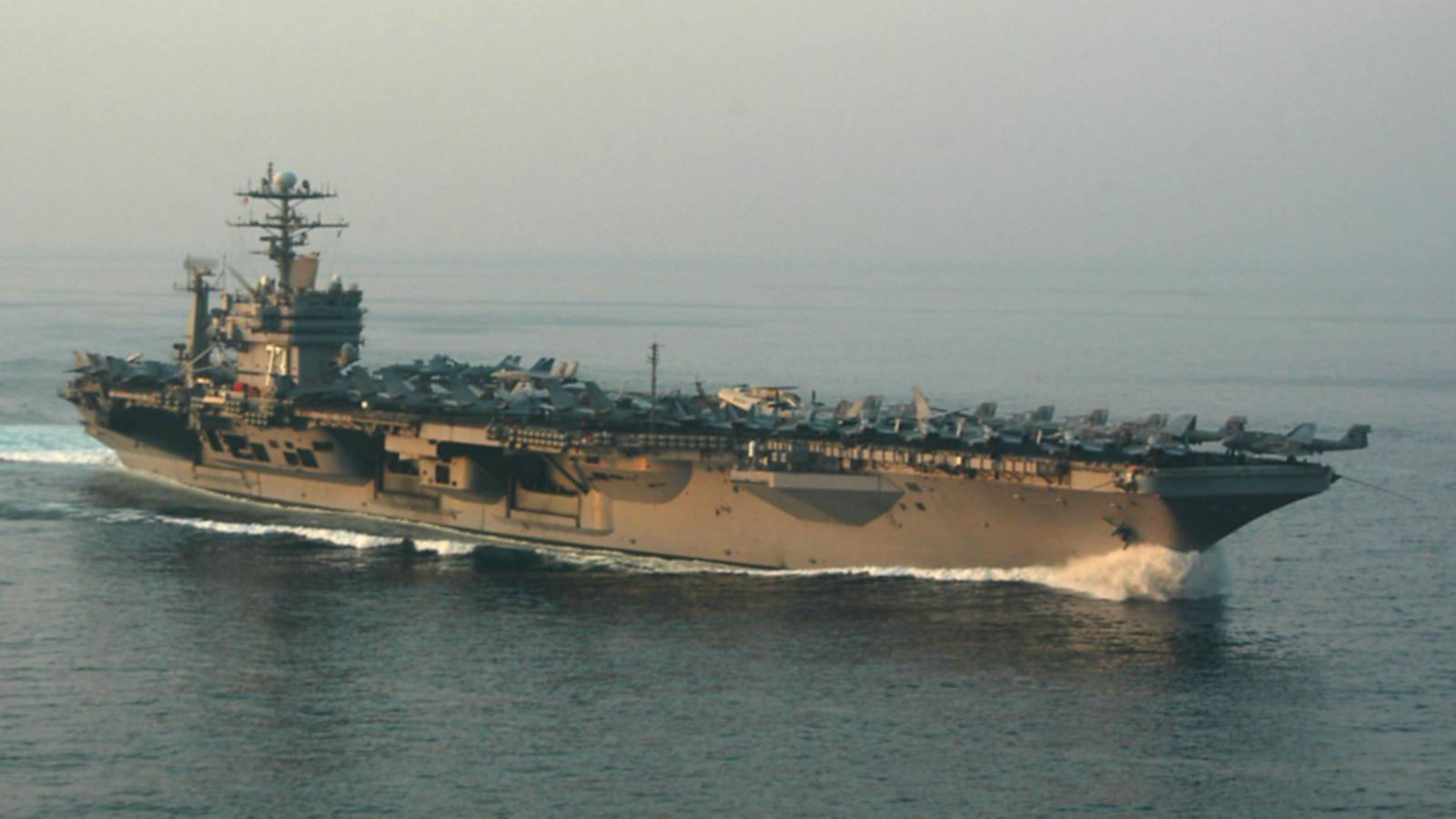
The military instrument behind the blockade is showing strain. The USS Abraham Lincoln, which has run the bombing campaign and the blockade of Iranian ports, left San Diego last November and has now spent more than 260 consecutive days at sea — a US Navy record for the longest stretch without a port call, on what is normally a 30-to-45-day rhythm. Reporting by Al Jazeera and Stars and Stripes has described food and hygiene shortages aboard, failing air conditioning, water contamination and a mounting mental-health crisis among the roughly 5,000 crew, including reported attempts by sailors to jump overboard. The Navy disputes that characterisation, saying it has "not observed an increase in suicidal ideations or attempts aboard the ship"; the administration has waved the reports away as wartime austerity. Democratic lawmakers call the deployment emblematic of a war begun without a plan for ending it.
Relief arrived on Wednesday, when the USS George Washington entered the Arabian Sea on what Central Command insists is a scheduled rotation. The arithmetic behind the reassurance is less comfortable. The George Washington is the Navy's only forward-deployed carrier, home-ported in Japan; pulling it from the South China Sea leaves the United States without a single carrier in the Western Pacific, and it joins the USS George H.W. Bush in a multi-carrier posture off Iran. Bloomberg reported this week that the campaign has strained munitions stocks even as it has, in six months, eliminated most of Iran's senior leadership without producing anything resembling surrender.
The Strait of Hormuz, through which roughly a fifth of the world's oil normally moves, remains effectively shut to routine traffic. Central Command says it has escorted some 1,300 ship passages through the waterway; maritime intelligence data recorded a single transit on August 16 against a pre-war norm of around 73 a day. Talks between Oman and Iran on managing transit have continued — Tehran says an understanding has been reached on the transit route's map — and Mr Trump has threatened further strikes if the strait is not reopened.
Why isolation may not isolate
The deeper problem with an embargo-by-threat is that Iran's two most important partners sit on the UN Security Council with vetoes in hand. China's foreign ministry answered Tuesday's announcement by repeating that more sanctions would "not help to solve the issue"; Chatham House's Yu Jie assesses that the threats will not alter Beijing's trading relationship with Tehran. Russia, bound to Iran by a 20-year strategic partnership treaty signed in January 2025, did $4.8 billion of trade with it in the first 11 months of last year and has reportedly shipped drone components, ammunition and explosives across the Caspian. Iran, for its part, is building the plumbing of a sanctioned economy: seeking membership of the BRICS development bank, courting yuan- and barter-based settlement, and expanding Caspian ports and rail links.
Washington's leverage is real but concentrated in one place: the dollar. China's big state banks have historically complied with US sanctions to protect their dollar-clearing access, which is why the threat bites at the bank level even if independent refiners keep buying discounted crude. The collision point arrives within weeks — Xi Jinping is due in the United States next month, carrying both the tariff truce and the Iranian oil trade in the same briefcase.
Who blinks first
Behind the economics sits the unresolved nuclear file. The IAEA's last full accounting, in February, put Iran's stockpile at 440.9 kilograms of uranium enriched up to 60 per cent and a further 184 kilograms at 20 per cent — most of it believed stored in a tunnel complex at Isfahan, uninspected since the strikes. American and Iranian officials alike say enrichment has not resumed; the agency's director general says there is no evidence of a bomb programme, but calls the combination of a near-weapons-grade stockpile and no inspector access a cause for serious concern.
Each side has now stated its theory of victory. Tehran's is endurance: foreign minister Abbas Araghchi answered the sanctions threat by warning that "doubling down on failed policies will only bring further defeat — and enmity of Iranians." Washington's is strangulation: that what six months of bombing could not extract, a $94 barrel and a severed banking system will. The International Crisis Group's Ali Vaez offered the darker reading — that the economic warfare may be less an alternative to renewed military action than a prelude to it. On that question, for now, both sides are content to wait.
This analysis draws on reporting by the New York Times, Bloomberg, Reuters, Al Jazeera, CNN, CBS News, the Washington Post, Stars and Stripes, and IAEA and Congressional Research Service documents. Figures are as reported on August 20, 2026; where sources conflict, ranges or both figures are given.