
World's oldest shipwreck found off Turkey's Kekova Island: amphorae dated to 4,400–4,700 years ago, from the age of Egypt's pyramids, with no wood left to carbon-date
Turkey's culture ministry says jars recovered 30 metres down near Kekova come from an Early Bronze Age ship that was carrying goods made in the Jordan Valley. The claim would push the oldest known wreck back by several centuries — and it rests entirely on the shape of the pottery.
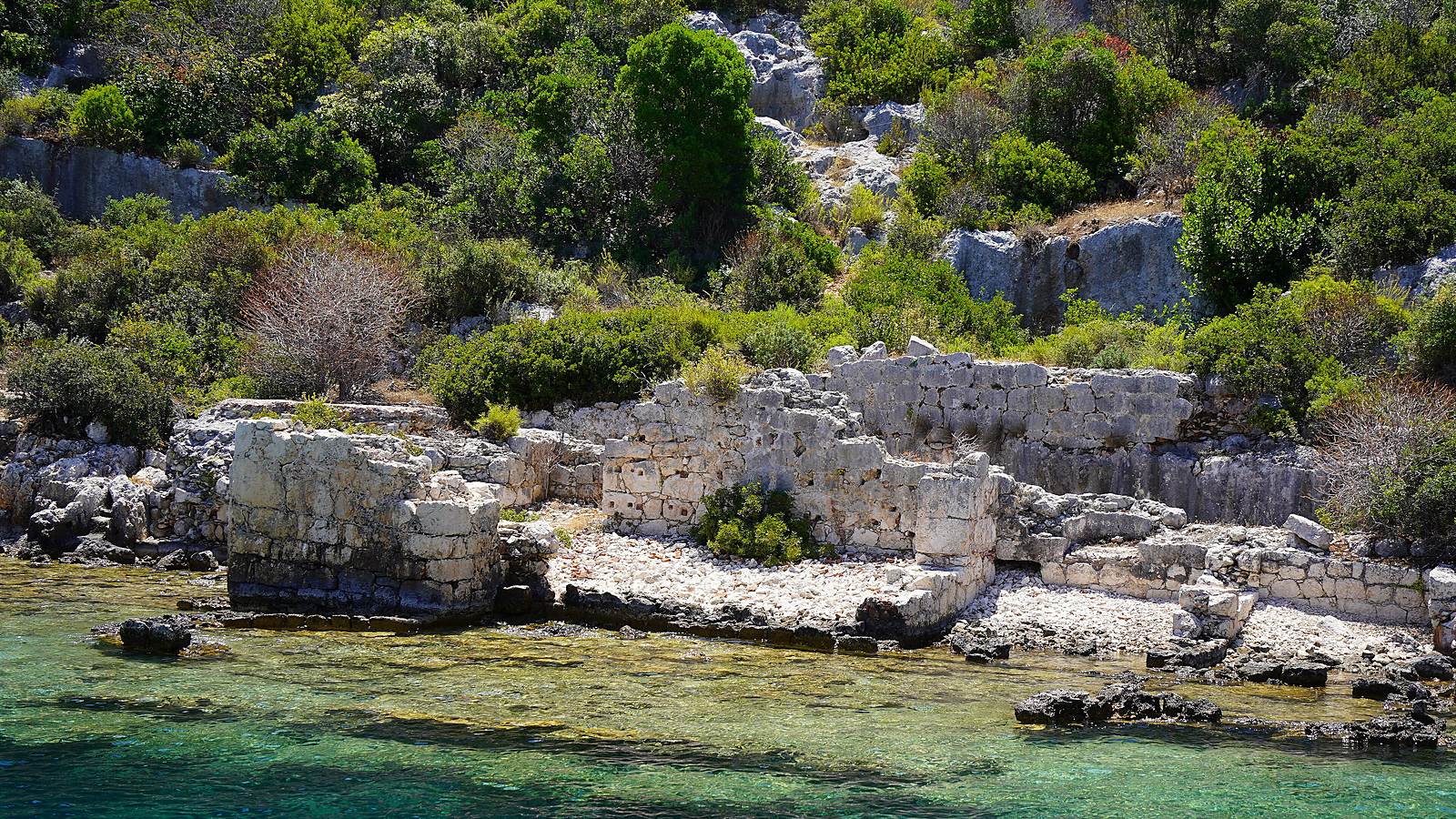
There is no ship. That is the first thing to understand about what Turkey announced on Wednesday as the world's oldest shipwreck. Nothing of the hull survived 4,700 years on the seabed off Kekova Island. What survived is the cargo: more than 30 ceramic storage jars and three stone anchors, lying on an underwater slope about 30 metres below the surface in Antalya province. Everything that is now being claimed about the vessel — its age, its route, its trade — has been read out of those jars.
Turkey's Culture and Tourism Minister, Mehmet Nuri Ersoy, announced the find in a post on X, describing it as evidence of "the world's oldest shipwreck". According to the ministry, the amphorae date from 4,400 to 4,700 years ago, placing the wreck in the Early Bronze Age — the era in which Egypt was building the pyramids at Giza.
If that dating holds, the Kekova wreck sits several centuries ahead of the site that has held the title until now. The oldest previously known shipwreck was found near the Greek island of Dokos in 1975, and the Hellenic Institute of Marine Archaeology dates its ceramic cargo to around 2200 BC, according to The National. It is also roughly a thousand years older than the famous Uluburun wreck, found off the same Turkish coast near Kaş, which sank around 1300 BC carrying copper, tin and glass.
A wreck that was nearly dismissed as recent
The most striking part of the story is how close the site came to being filed away as unremarkable. Hakan Öniz, the Akdeniz University archaeologist who directed the excavation, told the BBC that when his team first found the wreck four years ago, the jars appeared to be only a century or two old.
"We later became excited when we saw the same amphora forms in a publication on Egyptian archaeology and returned to the site. Indeed, they were similar to those found at the Giza pyramids in Egypt." — Hakan Öniz, excavation director, to the BBC
The amphorae have a distinctive profile — two handles, a ridge around the middle and a flat base — and Öniz recognised it in published finds from Giza. The team made a follow-up dive and then invited Karin Sowada, an archaeologist at Macquarie University in Australia and a specialist in exactly this class of vessel, to examine the material. Öniz told CNN the group "reached a consensus" and that the team is "generally confident" the wreck is the oldest in the world.
He also told CNN that the evidence is not only ceramic: "It is not just the amphorae; the anchors and other artifacts found at the shipwreck site also point to the same centuries." That is a stronger statement than the team's own published work makes, a point that matters later.
How you date a ship that has no wood
The usual tool for dating an ancient wreck is radiocarbon analysis of the timber. Uluburun's keel was cedar, and a sample from it gave archaeologists a firm anchor for when the ship was built. Kekova has no timber. The wood has long since been eaten or dissolved, so radiocarbon dating of the vessel itself is not possible.
What remains is typology: the comparison of an object's form and decoration with securely dated examples found elsewhere. It is the oldest method in archaeology and still one of the most reliable for pottery, because ceramic styles changed in recognisable ways and were often traded in large numbers. A Jordan Valley jar of a particular shape turns up in a dated Egyptian tomb; the same shape on the seabed is very likely from the same period.
But typology gives a range, not a date — hence 4,400 to 4,700 years rather than a single figure — and it dates the jars, not the sinking. An amphora could be decades old by the time the ship that carried it went down. Sowada told the BBC that the jars may also have been emptied and reused, so the residues inside them may reflect more than one voyage.
That cuts in both directions. Reuse could make the jars older than the voyage, which would push the true sinking date later within or beyond the range. But a full cargo of one consistent type, all matching the same securely dated Egyptian parallels, is hard to explain as an accident of old stock. The more jars that share the profile, the tighter the argument becomes — which is why the count of more than 30 matters as much as any single piece.
What the clay says about Bronze Age trade
The most significant scientific result may turn out to be the clay analysis rather than the headline claim. According to Ersoy, "clay analyses indicate that the amphorae were probably produced in workshops in the Jordan Valley." Similar jars have been found near the pyramids at Giza, Saqqara and Abusir, at Troy in north-western Turkey, and on Crete.
That geography is the point. A jar made in the Jordan Valley, of a type known from Egyptian royal cemeteries, found in a wreck off Anatolia, is direct physical evidence of goods moving by sea between the Levant, Egypt and the Aegean world more than four millennia ago. Researchers believe the ship departed a port on the Levantine coast and was heading for Troy — the mound at modern Hisarlık — or Crete when it went down.
A preliminary study by Öniz and Ceyda Öztosun, published in the Journal of Maritime Archaeology in July, concluded the ship had been travelling from east to west. The National reports the vessel is estimated to have been about 10 metres long — a coastal trader, not a great merchantman.
The cargo itself is still being identified. The jars are thought to have carried olive oil or wine, but Sowada told the BBC she was surprised by how much material had survived inside them; some were still intact and contained a glossy, viscous residue. Analysis is continuing to establish whether that residue is oil, wine, tree resin or something else.
The butter churn and the goats
One jar does not fit the pattern. It carries nine marks and has two holes in its body, and the ministry says it may have been used as a churn for making butter or cheese. Researchers have taken that a step further, suggesting the crew may have kept goats on board and produced dairy food at sea during long passages.
It is an appealing detail and it should be read as a hypothesis. A perforated vessel has more than one possible use, and a churn does not by itself prove live animals were aboard. But if the residue analysis confirms milk fats, it would be an unusually intimate glimpse of how Early Bronze Age sailors fed themselves — the kind of daily-life evidence that cargo manifests and royal inscriptions never record.
The case against calling it settled
The claim deserves the caution its own authors have built into it. The dating depends on pottery alone, the wood is gone, and the July paper noted that the three stone anchors found nearby had not yet been conclusively linked to the vessel — a more careful position than the confident framing of Wednesday's announcement. A scatter of jars on a slope can, in principle, come from more than one event.
There is also a definitional question. A wreck site is normally identified as a single ship by a coherent concentration of cargo, fittings and hull. If Kekova's jars and anchors are confirmed as a single assemblage, the claim is strong. If the anchors prove unrelated, the case narrows to a cluster of very old amphorae, which is significant but not the same thing as a dated ship.
None of that makes the find small. Even at the lower bound of 4,400 years, Kekova is older than Dokos's 2200 BC date, and the Jordan Valley provenance stands independently of the debate over what exactly sank.
What happens next
The excavation, which began in earnest this year under the Antalya Museum Directorate after two jars were raised for study in 2024 and 2025, is continuing. Residue analysis will tell archaeologists what the ship carried; further work on the anchors will tell them whether they belong to it. Ersoy said the finds will eventually be shown at the planned Mediterranean Underwater Archaeology Museum in Antalya.
The durable point is less about a record than about method. The world's oldest shipwreck, if that is what it is, was almost overlooked because its jars looked ordinary — and was recognised only because an archaeologist happened to read the right report on Egyptian pottery. The seabed off southern Turkey, which has already given up Uluburun, may hold other sites that look recent until someone checks.
This report is based on statements from Turkey's Ministry of Culture and Tourism and Minister Mehmet Nuri Ersoy, and on reporting by Al Jazeera and Anadolu, CNN, the BBC (as cited by Al Jazeera and The National), The National and Türkiye Today, including quotes from Hakan Öniz and Karin Sowada. The 4,400–4,700-year date is a typological estimate from the amphorae; no radiocarbon date of the vessel exists. The link between the anchors and the wreck, the cargo identification and the dairy-churn interpretation are all preliminary and subject to ongoing analysis. Descriptions of Öniz's academic rank differ between outlets.