
The 2026 Nissan Leaf: The Car That Started the EV Era Becomes a Crossover and Switches to the Tesla Plug — Rated 5/10
Nissan's third-generation Leaf abandons the hatchback shape, arrives in Canada with only the 75-kWh battery, and adopts a native NACS port for Supercharger access. Prices open at $44,998. The Torbrook rating: 5/10.
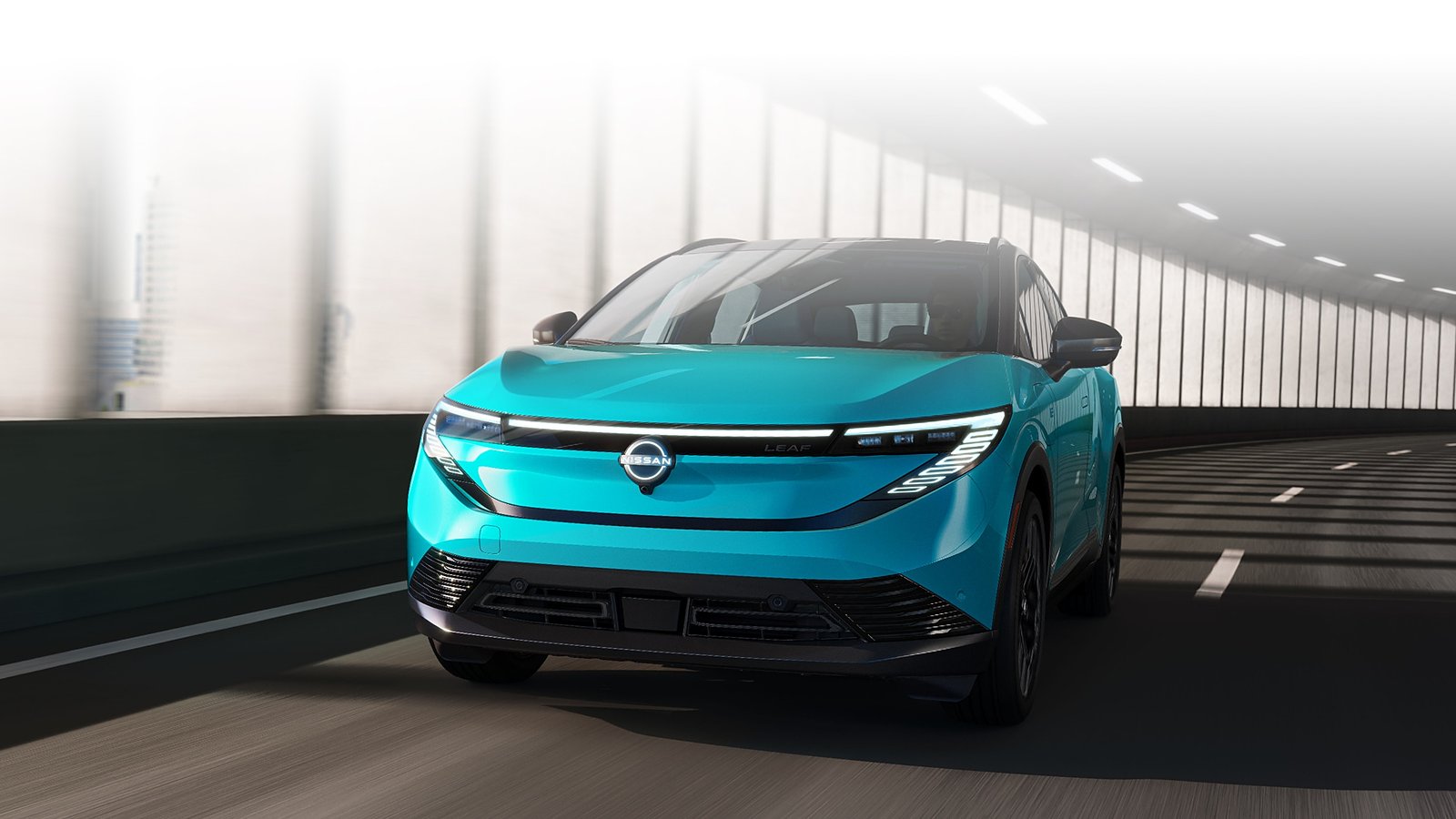
The third-generation Leaf is a different shape of car. Nissan Canada now describes it as a fully electric subcompact SUV with seating for five, and the company's own materials say it was designed as a crossover — a raised, fastback-roofed body in place of the upright hatchback that carried the nameplate for fifteen years.
Canada gets three trims and one battery. The S+ opens the range at $44,998, followed by the SV+ at $47,998 and the PLATINUM+ at $52,798, with freight and pre-delivery inspection adding $2,095. The smaller-battery base LEAF S sold in other markets is not being brought to Canada for this model year — a Nissan Canada spokesperson confirmed the decision publicly — which means every Canadian car uses the 75-kilowatt-hour liquid-cooled pack and its 160-kilowatt motor, rated at 214 horsepower and 261 pound-feet of torque.
Nissan's published range figures fall as equipment rises: up to 488 kilometres for the S+, 463 for the SV+ and 417 for the PLATINUM+.
The most consequential change is the socket. The new Leaf carries a native NACS fast-charging port on the passenger-side fender, giving it access to the Tesla Supercharger network with Plug and Charge as standard, alongside a separate J1772 port on the driver's side for home and Level 2 charging. Nissan quotes a 10-to-80-per-cent DC fast charge in about 35 minutes at a peak rate of 150 kilowatts, with a 7.2-kilowatt onboard charger for alternating current. Vehicle-to-load output is 1,500 watts.
Inside, the S+ runs a pair of 12.3-inch displays while the SV+ and PLATINUM+ upgrade to twin 14.3-inch screens, with Google built-in available. ProPILOT Assist is standard on every grade, as is Safety Shield 360, and the car adds a 3D Around View Monitor with Invisible Hood View. Nissan also claims two firsts here: motorized flush door handles, a production first for the company, and an electrically dimming panoramic roof it describes as a segment first. Cargo space is 20 cubic feet behind the second row and 55.5 with the seats folded.
Some history is worth stating, because it is the reason this car matters at all. Nissan launched the original Leaf in December 2010 as the first mass-market all-electric car, and roughly 700,000 have been sold worldwide across the nameplate's life. Nissan Canada frames the new model against exactly that legacy, noting the Leaf helped launch the mainstream electric movement fifteen years ago.
A 5/10 from the Torbrook Rating Agency places the new Leaf at the midpoint of our scale. The specifications above are Nissan's; the score is ours.
The TNN Rating is a private, independent assessment issued by the Torbrook Rating Agency, TNN’s automotive review desk. Vehicles are scored out of 10 on engineering, usability, value and transparency. Ratings cannot be bought.