
The Dodge Charger Is Now Two Completely Different Cars Wearing One Badge — and Dodge Keeps Mixing Them Up — Rated 9/10
A twin-turbo inline six making up to 550 horsepower, and a battery-electric Daytona with a button that adds 40 more. Both are Chargers, both are sold here, and Dodge Canada lists them across three different model years. The Torbrook rating: 9/10.
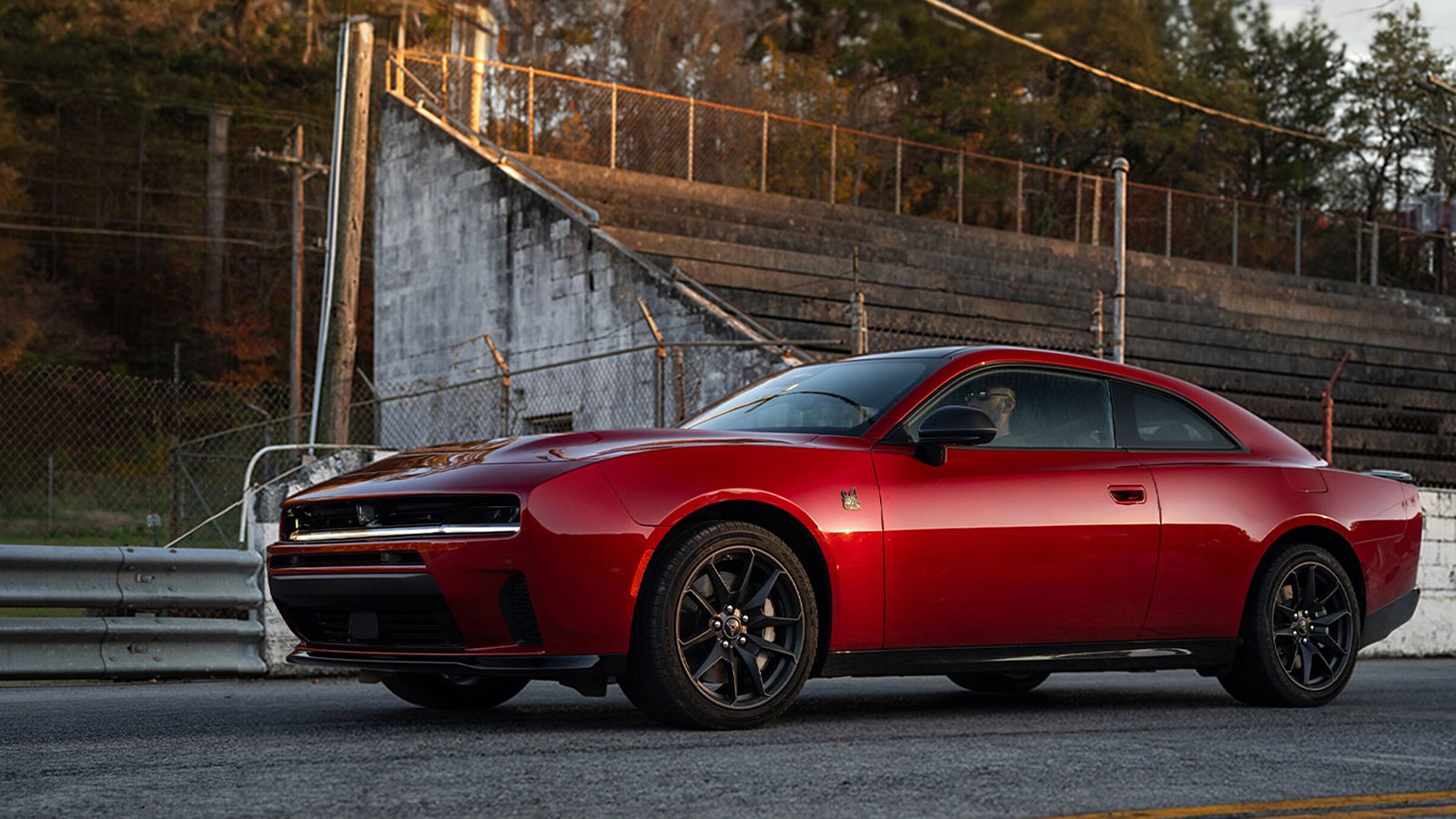
The Charger nameplate now covers two entirely different cars, and any honest review has to separate them before it does anything else. One is petrol, powered by a twin-turbocharged inline six. The other is the Charger Daytona, which is battery-electric. They share a body shell and almost nothing else.
Dodge Canada does not make this easy. The petrol car is listed as both a 2026 and a 2027 at the same time, with a year toggle on its own page. The electric Daytona is still on a 2025 page whose copy promises models arriving in the first half of 2025 and whose configurator button points at a 2024 build tool. Worse, the petrol car's performance page drops the electric Daytona's 670-horsepower figure into the same engine comparator as the petrol engines, and at least one photograph is published under both names. The confusion is Dodge's, not the reader's.
Take the petrol car first, because it is the one most Canadians will buy. The 3.0-litre twin-turbocharged inline six — Dodge calls it the Sixpack — makes 420 horsepower and 469 pound-feet in standard-output R/T form and 550 horsepower and 531 pound-feet in the high-output Scat Pack, through an eight-speed automatic and all-wheel drive with a rear-drive mode. For 2026 the range runs a two-door R/T at $62,390, a two-door Scat Pack at $72,390 and a four-door Scat Pack at $75,390; the 2027 lineup adds the four-door R/T at $65,390 and, unusually, carries every price over unchanged.
Those prices need a warning label. Dodge Canada's advertised figure includes freight and surcharges and is then reduced by unitemised manufacturer discounts. The same trims appear in Dodge's own comparison tool at $70,385, $79,885 and $82,885 — roughly $7,995 higher across the board. Both numbers come from Dodge; only one appears in the advertising.
The electric Daytona is the more radical machine and the more confusingly priced. In the single two-door form Canada gets, it produces 456 horsepower, or 496 with PowerShot — a steering-wheel button that releases 40 extra horsepower — and reaches 97 km/h in 4.7 seconds. A 100.5-kilowatt-hour battery gives it 441 kilometres of Natural Resources Canada-rated range, and it retains the Fratzonic chambered exhaust, the synthesised sound system that lets an electric car announce itself. Dodge advertises it from about $50,326. Its own comparison tool prices the same car at $82,790 before discounts, of which only $8,000 — manufacturer incentives plus government rebates — is itemised. The remaining thirty-odd thousand dollars of discount is not explained anywhere.
Both cars share a genuinely practical shell. Each is a five-seat liftback rather than a booted sedan, with 644 litres of cargo space and 1,059 with the rear seats folded, on a 3,073-millimetre wheelbase. Each runs a 10.25-inch digital instrument cluster and a 12.3-inch Uconnect 5 touchscreen, with adaptive cruise control, forward collision warning with active braking, lane management, blind-spot detection and parking sensors standard. The electric car weighs 2,585 kilograms, some 400 more than the petrol one.
One number is missing from both. Dodge Canada publishes no acceleration figure at all for the petrol R/T or Scat Pack, and when it does quote times for the electric cars it measures to 97 km/h rather than 100 — so the Daytona's 4.7 seconds is not directly comparable to a European or Japanese rival's figure.
The history is the point of all this. The Charger arrived in 1966, and the 1969 Daytona bolted on a pointed nose cone and a 23-inch rear wing purely to win stock-car races — Buddy Baker drove one to the first officially recorded 200 mph lap in NASCAR history at Talladega in March 1970. Sixty years later Dodge has attached that name to an electric car and revived the Super Bee badge on a turbocharged six. A nameplate built on displacement now carries the brand's downsizing and its electrification at the same time.
A 9/10 from the Torbrook Rating Agency is among the highest marks this desk has given, for a car that took the least fashionable idea in the industry and built two credible versions of it. The specifications above are Dodge's; the score is ours.
The TNN Rating is a private, independent assessment issued by the Torbrook Rating Agency, TNN’s automotive review desk. Vehicles are scored out of 10 on engineering, usability, value and transparency. Ratings cannot be bought.