
Mayfair House Hotel & Garden Earns a 9.5 From the Torbrook Rating Agency
The highest score in this series. A hotel that publishes its original architect, its original year, what the restoration cost, who did it, and the square footage of every suite type it sells.
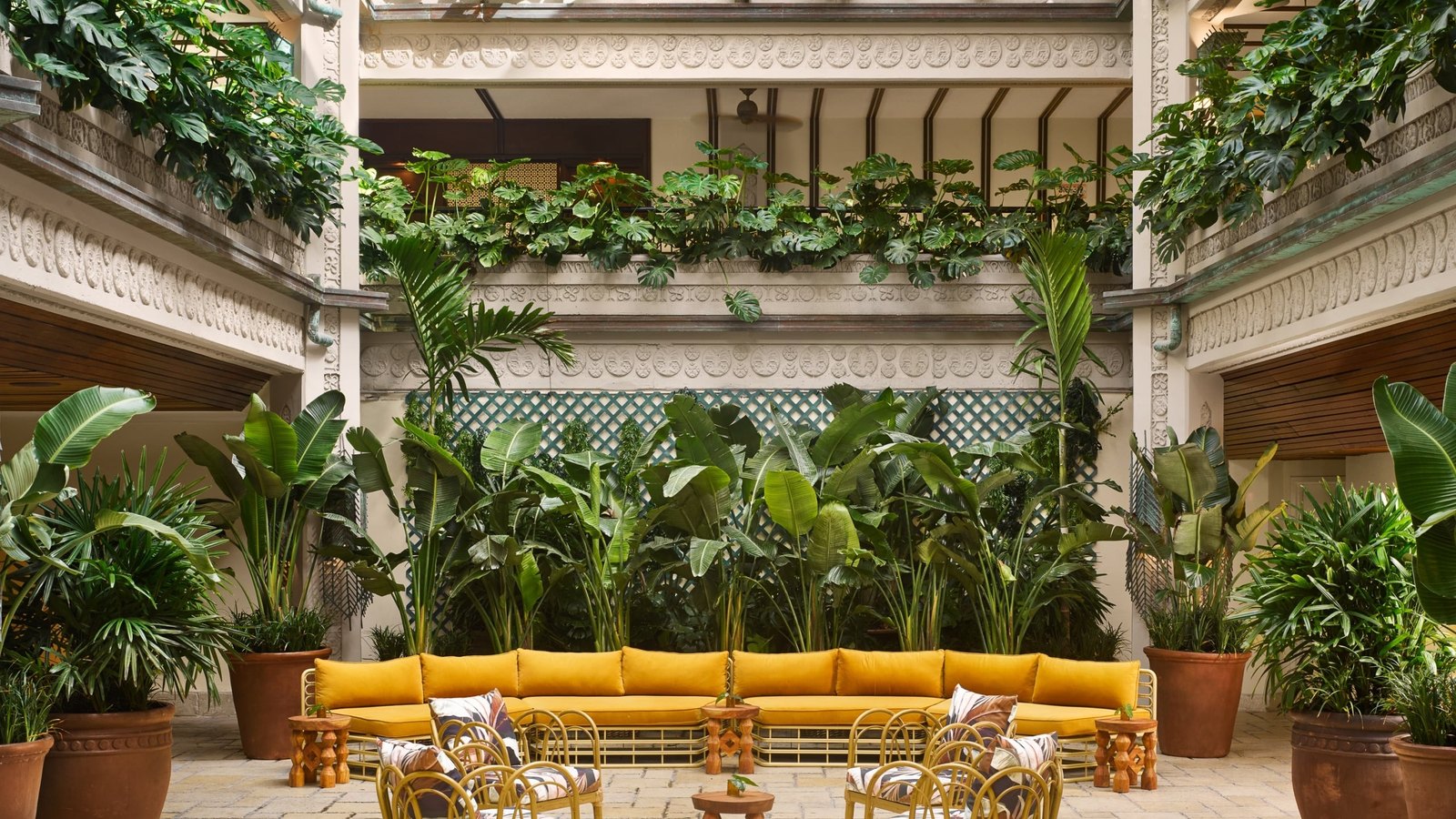
Mayfair House Hotel & Garden has been rated 9.5 out of 10 by the Torbrook Rating Agency, TNN’s business review desk. It occupies 3000 Florida Avenue in Coconut Grove, and it is the highest-scoring business in this Florida series.
It earns that position on provenance, which is a category most hotels handle by inventing one.
The building opened in 1985 as the Mayfair Hotel & Spa, designed by the Miami architect Kenneth Treister — a deeply idiosyncratic piece of work, all carved detail and planted terraces, and one of the few buildings in Miami that could not have been built anywhere else. In August 2021 the Canadian asset manager Brookfield brought in the New York interior designer Matthew Goodrich, and after a $50 million revitalisation the all-suite Mayfair House Hotel & Garden reopened in August 2022.
Every element of that sentence is published by the property itself: the original year, the original architect, the ownership behind the works, the designer engaged, the sum spent, the reopening date, and the stated intention to honour Treister’s vision rather than erase it. Hotels routinely describe themselves as reimagined or reborn without naming a single one of those facts. Naming all seven is the single most transparent act in either of these two series, and it is what places this file at 9.5.
The room programme is published with the same discipline. There are eight suite types, ranging from 500 to 1,124 square feet, and the stated design principle is that each is conceived as a small private home — with its own terrace and its own living, dining and sleeping areas, reached from the hotel’s main courtyard rather than from an internal corridor. That is a checkable promise. A guest can arrive, look at the suite, and establish whether it is true.
The courtyard access matters more than it sounds. It is the feature of Treister’s original plan that made the building unusual in 1985, and preserving it through a $50 million renovation — rather than converting to conventional corridors, which would have been cheaper and would have added keys — is the clearest evidence that the restoration language is meant literally.
The food and beverage is handled with unusual honesty for a hotel. Rather than absorbing the restaurants into the hotel brand, the property attributes them: Mayfair Grill and Sipsip were brought by the local hospitality group Lost Boy & Co. Mayfair Grill runs an open-hearth, wood-fired menu drawing on the Sonora region of Mexico. Both of its recurring services publish their days and their times — brunch on Sundays from 11:00 a.m. to 3:00 p.m., and happy hour Tuesday to Saturday from 5:00 p.m. to 7:00 p.m. — which is more than most hotel restaurants manage. A wellness programme runs alongside them.
The rest of the property is a rooftop and pool with daybeds, and a collection of curated art from local and international artists. Coconut Grove — Miami’s original artist colony — is treated as part of the offer rather than as a postcode, and the hotel’s guest-facing material points outward to the neighbourhood rather than trying to contain the visit inside the building.
The property carries a Condé Nast Traveler Gold List designation for 2026 and appeared on the Travel + Leisure It List of best new hotels for 2023. Those are recorded as external designations by named publications, and they are noted here rather than scored.
The deductions are few, which is why the score is where it is.
The first is rates. No indicative rate is published anywhere — the same deduction applied to every hotel in this series, and the same reason: the Agency scores what a business chooses to disclose, and a property this forthcoming about square footage has decided not to be forthcoming about price.
The second is a small inconsistency. The hotel describes three globally-inspired culinary outlets and names two of them, Mayfair Grill and Sipsip. The third is referenced and not identified, which leaves a guest counting restaurants rather than reading about them.
The third is structural rather than a fault, and it is the reason this file does not reach the ceiling. A single point of assessment cannot establish consistency across an all-suite property of this scale. The Agency reserves its highest marks for businesses small enough, or observed often enough, that consistency can be spoken to; a hotel with eight suite types and three food and beverage outlets is neither, however well documented.
In category terms, Coconut Grove supports a small number of serious hotels and this is the one with the deepest local roots — a 1985 landmark by a Miami architect, restored rather than replaced, with its restaurants run by a Miami group. Against national luxury brands operating in the same market, that is a position built on something that cannot be franchised.
Three changes would move this score toward the ceiling. Publishing an indicative or seasonal starting rate would remove the only significant disclosure gap. Naming the third culinary outlet alongside the other two would take a word. And a second and third assessment, over time, would let the Agency say something about consistency that a single reading cannot.
The Treister connection is worth explaining for readers outside Miami. Kenneth Treister designed the Mayfair as a piece of highly ornamented, hand-detailed architecture at a moment when the prevailing commercial style was doing the opposite, and the result has been divisive for forty years. A restoration that keeps his carved detail, his planted terraces and his courtyard circulation is a commercial risk: the cheaper and safer move would have been to strip the building back to a neutral shell. Choosing not to, and then saying so publicly, is the decision this score is built on.
The attribution of the restaurants to Lost Boy & Co is a second instance of the same instinct. Hotels almost always brand their food and beverage as their own, because an in-house restaurant is easier to control and easier to market. Naming an outside local operator gives away that control and credits somebody else's work, and it tells a guest something true and useful: the people cooking are a Miami group with their own reputation to protect, not a hotel department.
A 9.5 out of 10 from the Torbrook Rating Agency reflects the most completely documented restoration in this series — original architect, original year, cost, designer and intent, all published — alongside a suite programme stated in square feet and a food and beverage operation credited to the people who actually run it.
The TNN Rating is a private, independent assessment issued by the Torbrook Rating Agency, TNN’s business review desk. Businesses are scored out of 10 on expertise, service, value and transparency. Ratings cannot be bought.