
The Volvo XC90 Is Sold in Canada as Two Different Model Years at Once, and Adds $3,589 After the Advertised Price — Rated 6.9/10
The mild-hybrid XC90 is a 2026; the plug-in hybrid beside it is a 2027. Both sit in showrooms next to the electric EX90, which is a different vehicle entirely. Prices open at $76,950 before fees. The Torbrook rating: 6.9/10.
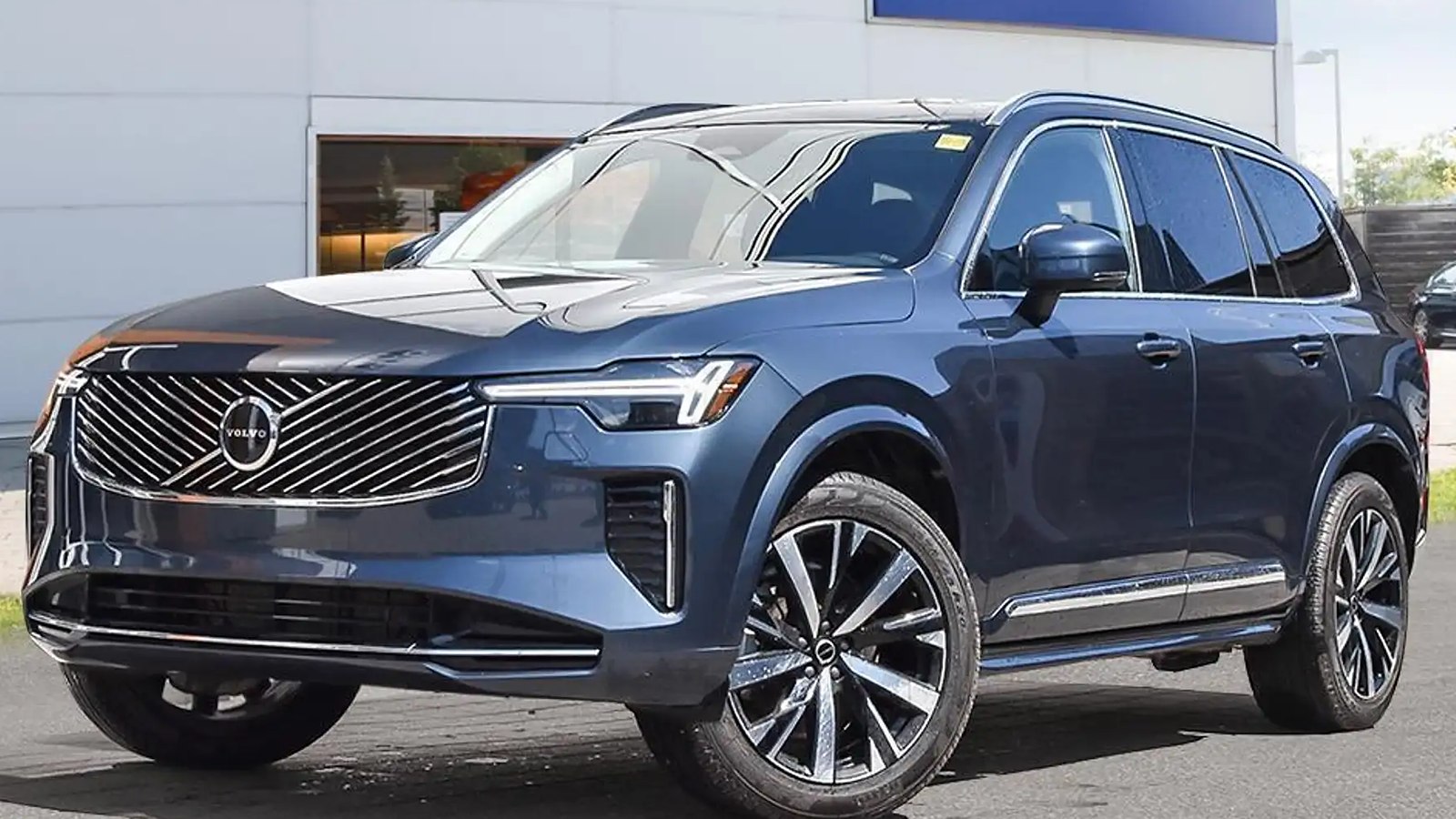
Three clarifications before anything else, because Volvo Canada's showroom is unusually confusing right now. The mild-hybrid XC90 is sold as a 2026. The plug-in hybrid version of the same vehicle is sold as a 2027. And parked beside both is the EX90 — a fully electric SUV on a different platform, sold as a 2025, which shares neither the XC90's underpinnings nor its specifications. Three model years, two vehicles, one showroom.
The mild-hybrid range opens with the Core at $76,950, followed by the Plus at about $79,900 and the Ultra at about $83,900. The plug-in hybrid Ultra costs roughly $95,900 and the Black Edition about $97,100. To any of those, add Volvo's fees: $2,770 in transport costs on the mild hybrid or $3,100 on the plug-in, plus a $100 air-conditioning tax, a tire levy and a retailer administration fee of up to $699 — $3,589 on the cheapest car in the range. None of the prices is net of incentives, and the federal luxury tax is extra, which matters because every plug-in trim crosses the $100,000 threshold once fees land.
Canada gets one petrol powertrain and one plug-in. The B6 mild hybrid pairs a 2.0-litre four with a 48-volt system for 295 horsepower and 310 pound-feet, reaching 100 km/h in 6.7 seconds. The lower-output B5 sold in other markets is not offered here — Volvo's configurator, its specification pages and Natural Resources Canada's database all list only the B6. The T8 plug-in hybrid adds a 107-kilowatt motor and a 19-kilowatt-hour battery for 401 horsepower and 494 pound-feet, and 5.4 seconds.
The efficiency figures are properly sourced, which is worth stating because Volvo's Canadian pages carry a blanket European-specification disclaimer. Natural Resources Canada rates the B6 at 10.4 litres per 100 kilometres combined on premium fuel. The T8 is rated at 53 kilometres of electric range and 8.9 litres per 100 kilometres once the battery is depleted, for a total of 803 kilometres — and those are NRCan figures, not WLTP estimates. One caveat: NRCan has not yet published ratings for the 2027 model year, so the plug-in numbers above are the 2026 data.
Practicality is the XC90's enduring argument. Seven seats are standard with a six-seat configuration available for $600, and cargo runs 247 litres behind the third row, 653 behind the second and 1,139 with both folded — or nearly 2,000 loaded to the roof. One figure we are leaving out: Volvo's Canadian pages give towing as 2,250 and 2,400 kilograms under that European-specification disclaimer, and we could not find a Canadian-specific rating.
Inside, an 11.2-inch portrait touchscreen faces the driver alongside a 12.3-inch instrument display, running Google built-in with Maps, Play and Assistant and four years of included data. Pilot Assist is standard from the base Core, as are collision avoidance with automatic braking for vehicles, pedestrians, cyclists and large animals, and blind-spot monitoring with steering support. Frequency-selective damping is standard; rear air suspension is optional. Volvo names Bowers and Wilkins and Harman Kardon audio systems but publishes no speaker count for either, so we are not printing one.
The context is a vehicle that reset its maker. Revealed in August 2014, the second-generation XC90 was the first Volvo on the company's Scalable Product Architecture and the first all-new model developed after Geely acquired the brand from Ford, and it was named North American Truck of the Year for 2016 — repeating the original XC90's win in 2003. For 2026 the Insurance Institute for Highway Safety rates it a Top Safety Pick, a step below the Top Safety Pick Plus it held for 2025.
A 6.9/10 from the Torbrook Rating Agency reflects a genuinely capable and safe family SUV sold through a lineup that takes real effort to decode, at a price that grows by thousands after the number on the page. The specifications above are Volvo's and Natural Resources Canada's; the score is ours.
The TNN Rating is a private, independent assessment issued by the Torbrook Rating Agency, TNN’s automotive review desk. Vehicles are scored out of 10 on engineering, usability, value and transparency. Ratings cannot be bought.